On this page
Both work. A log on paper or a digital record does the same job, as long as each reading shows date, time of day and the top and bottom number, and you bring it to the appointment. You can keep one digitally in the blood pressure diary in Sam, which also imports readings from Apple Health. Ask your practice which form they prefer. Below are the fields to copy, the usual measuring protocol and free templates.
What is a blood pressure log and why does the doctor need it?
A blood pressure log is a table for the readings you take yourself. You keep it at home, usually for a week or longer, and take it to your appointment.
Your doctor needs it because a single reading says little. The 2024 European guidelines put weight on measurements outside the clinic for diagnosis, and the NHS says your doctor may ask you to check at home for several days. With a log, the conversation is about weeks, not one number in the waiting room. How daily numbers add to the picture is in living with high blood pressure and daily readings.
Which fields belong in every row?
A row is one reading. These fields belong in every row:
- Date and time: morning and evening are separate readings, and without the time of day they cannot be sorted.
- Top and bottom number: systolic and diastolic in mmHg, as the monitor shows them. Do not round or leave anything out.
- First and second reading: most protocols ask for two readings per time of day, each with its own top and bottom number.
- Pulse: most monitors show it. The American Medical Association log has a field for it.
- Arm: left or right. The American Medical Association log has a box for the arm you use.
- Circumstances: coffee, a cigarette, alcohol, salty food, stress, poor sleep or exercise beforehand. One word will do. The British Heart Foundation diary has space for symptoms and factors such as illness or stress.
- Tablets: whether you had taken your blood pressure medicine. A tick is enough.
- Place: at home or at the clinic.
A row can look like this: 12 Oct, 07:45, right arm, reading 1: 138/86, reading 2: 134/84, pulse 68, note: two coffees, tablet not taken yet. The numbers show only the format. They are not targets.
You do not need a column for good or bad. Your doctor decides which values apply to you. The blood pressure category calculator shows the 2024 European categories for clinic readings. They do not apply to single home readings.
How often should I measure?
The usual pattern is one week: seven days, morning and evening, with two or three readings each time.
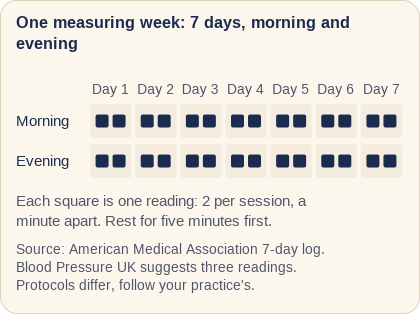
The grid follows the American Medical Association log. Other protocols differ slightly:
British and Irish Hypertension Society
One row per day, with morning and evening readings, for 7 days.
British Heart Foundation
One session between 6 am and noon and one between 6 pm and midnight, for 7 days, with two readings a few minutes apart in each. A third reading is advised if the first two differ a lot. From week two you record once a week.
Blood Pressure UK
Three readings each time. Ignore the first day when you work out an average.
Follow the protocol of your practice. How this fits your treatment, you discuss with your doctor.
How to measure, according to Blood Pressure UK:
- Rest for five minutes, back supported, feet flat on the floor.
- Rest your arm on a firm surface at heart level.
- Keep still and do not talk while it measures.
- Avoid measuring within 30 minutes of eating, smoking, caffeine or exercise.
Use a validated upper-arm monitor. The British Heart Foundation points to the list of the British and Irish Hypertension Society.
A log does not replace an emergency call. Call your local emergency number (112 in the EU, 999 in the UK, 911 in the US) if a high reading comes with chest pain, breathlessness, vision or speech problems or weakness. The British Heart Foundation lists a top number over 180 or a bottom number over 120 as severe hypertension and says to seek urgent medical help if a reading is dangerously high. NICE calls a clinic reading of 180/120 or higher severe hypertension and advises same-day specialist assessment if it comes with life-threatening symptoms such as new confusion or chest pain. Cleveland Clinic advises that without symptoms you rest for several minutes, measure again and get medical care if it does not come down.
Where can I get a blood pressure log for free?
- British Heart Foundation: a blood pressure chart and diary, to print or fill in on screen (published February 2025). It has space for readings, symptoms and factors affecting them.
- British and Irish Hypertension Society: a fillable home blood pressure diary for 7 days, with name, target if advised, morning and evening readings and notes (updated August 2025).
- American Medical Association: a 7-day blood pressure recording log in many languages, with systolic, diastolic and pulse for two morning and two evening readings.
Ask your practice or pharmacy whether they have a booklet. We offer no template of our own. If you prefer a computer, build a table from the fields above.
What does Apple Health offer?
An Apple Watch does not measure blood pressure. Your readings come from your monitor, not from the watch. The British and Irish Hypertension Society says it cannot endorse any wearable blood pressure devices. The reasons are in can a smartwatch measure blood pressure?.
The Health app on the iPhone has its own blood pressure log anyway. You need an iPhone 11 or later and a cuff. You enter date, time and the top and bottom value by hand. Some makers' apps write the readings to Apple Health. Check your maker's guide to see whether yours does.
Apple offers two variants: 7 mornings and 7 evenings, or one reading a day for 28 days. When the log is complete, you export a PDF for your doctor. Ask which variant your practice wants. The steps are in connect a blood pressure monitor to Apple Health.
Paper or app: what is missing from each?
Each has gaps, and both can be filled.
On paper you need no battery and any practice can read it. But you copy every value by hand, work out averages yourself and can lose the sheet. A photo of the pages saves the readings.
Digitally, readings come from a connected monitor, from Apple Health or from your own entry. A PDF can be sent. But your practice must accept a PDF or look at a screen. In Sam there are fields for arm, circumstances and place. In other apps check this beforehand. If fields are missing, write them in a note.
Full rows matter most: both readings, the time and a short note on circumstances. Ask whether your practice works out the average itself. You can combine both: paper at the place where you measure, an export or a photo for the appointment. A general list for the visit is in our checklist for a doctor visit with a chronic condition. If you are newly diagnosed, see high blood pressure diagnosis: what now.
In Sam
Enter blood pressure in Sam and take it to your appointment as a PDF
You bring a doctor report with your readings instead of a copied booklet. That works in the high blood pressure program once a doctor has diagnosed high blood pressure.
- Instead of working out averages yourself: the PDF shows your 7-day home average, and clinic readings are marked separately.
- Instead of copying every row: Sam takes blood pressure readings from Apple Health. You add arm, pulse and circumstances such as alcohol or stress with a tap.
- Instead of memory: Sam reminds you at your set times to take your tablets, you tick off each intake, and it appears in the report.
Sam does not measure blood pressure, so you still need your upper-arm monitor.
Sam is a wellness companion, not a medical device. No diagnosis, no replacement for medical advice.
More on high blood pressure
Sources
Updated: October 2026Updated: October 2026
- British Heart Foundation: Blood pressure chart and diary (published 12 February 2025) and Choosing and using a blood pressure monitor
- British and Irish Hypertension Society: Home blood pressure diary, fillable (updated 18 August 2025) and Validated BP monitors
- American Medical Association: 7-day blood pressure recording log and PDF
- Blood Pressure UK: How to measure your blood pressure at home
- NHS: Blood pressure test (reviewed 25 November 2025) and Diagnosis of high blood pressure
- ESC: 2024 ESC Guidelines for the management of elevated blood pressure and hypertension. Eur Heart J 2024;45(38):3912-4018
- British Heart Foundation: High blood pressure (updated 31 March 2026)
- NICE: Hypertension in adults: diagnosis and management (NG136)
- Cleveland Clinic: Hypertensive crisis (last updated 1 April 2026)
- Apple Support: Log your blood pressure in the Health app