Living with Asthma

Asthma: Symptoms, Reliever Use and Doctor Report

Take care of your asthma.

Sam keeps your symptoms, inhaler use and sleep in one place. You take the history to your next appointment.

  • Not a medical device
  • Works with Apple Watch, Oura, Whoop & Garmin
  • Built in Europe

What happens in the airways with asthma

Step by step: where asthma plays out, how the airways work without it, what changes with it and where it is felt. The model shows the windpipe and bronchi without the lung tissue around them.

  1. 1The airways

    The airways

    Where asthma happens

    Asthma is a long-term condition of the airways. The windpipe runs down from the voice box and divides into two bronchi, which branch into ever thinner tubes inside the lungs.

    Windpipe / Bronchi

    A human figure, seen from the front at an angle. The view moves towards the chest, where the windpipe and the branching bronchi turn light blue and expand slightly with each breath.

  2. 2Without asthma

    Breathing

    Air in, air out

    With each breath in, air flows down the windpipe and through the bronchi to tiny air sacs. Cartilage helps keep the larger bronchi open.

    Air in and out / Main bronchi

    Close-up of the windpipe and the bronchial tree in light blue. With each breath the tree widens slightly, and small white dots stream down the windpipe into both main bronchi and back up as the breath goes out.

  3. 3With asthma

    In asthma

    When the airways narrow

    In asthma, the airways are usually inflamed over the long term. Triggers such as allergens, cold air or exercise can narrow them: they swell, the muscle around them can tighten and more mucus can form.

    Open airway

    • Airway wall
    • Muscle

    With asthma, narrowed

    • Swollen wall
    • Tightened muscle
    • Mucus

    Airway narrowing

    The bronchi turn a deeper blue and become visibly thinner. The windpipe stays light blue. Breathing and the white dots continue unchanged. A sketch compares an open airway with a narrowed one.

  4. 4Where people feel it

    Day to day

    Symptoms that come and go

    Typical symptoms are wheezing, breathlessness, chest tightness and cough. They come and go, vary in strength and are often worse at night or on waking. Too breathless to speak, or bluish lips: call emergency services.

    Worth discussing with your doctor.

    Chest area

    The view pulls back to the whole figure. The airways return to a neutral grey, and a soft blue area marks the front of the chest. The breathing motion continues.

Sources concern the condition
  1. [1] Global Initiative for Asthma (GINA). Global Strategy for Asthma Management and Prevention, 2026 update. 2026. ginasthma.org. https://ginasthma.org/2026-gina-strategy-report/
  2. [2] Bundesärztekammer, Kassenärztliche Bundesvereinigung, AWMF. Nationale VersorgungsLeitlinie Asthma, Langfassung, Version 5.0. 2024. register.awmf.org (AWMF-Register-Nr. nvl-002). https://register.awmf.org/de/leitlinien/detail/nvl-002
  3. [3] National Heart, Lung, and Blood Institute (NHLBI), NIH. How the Lungs Work: The Respiratory System. 2022. nhlbi.nih.gov. https://www.nhlbi.nih.gov/health/lungs/respiratory-system
  4. [4] National Heart, Lung, and Blood Institute (NHLBI), NIH. Asthma: Causes and Triggers. 2024. nhlbi.nih.gov. https://www.nhlbi.nih.gov/health/asthma/causes

Own simplified illustration based on the sources above.

The model shows the windpipe, the bronchi and, for orientation, the larynx. Lung tissue, air sacs, blood vessels, ribs and the diaphragm are not shown. The dots stand for air moving in and out of the airways, and the soft area on the chest marks where symptoms are felt. The narrowing is shown by thinning the tubes and is exaggerated for visibility; in the body the passage narrows from within the airway wall, as the sketch shows. Adult male reference model; close-ups and the sketch are not to scale.

3D anatomy: BodyParts3D, (c) The Database Center for Life Science, CC BY 4.0. Prepared via human-atlas; simplified, cropped, coloured and animated by SanoLabs.

What Sam keeps for you

No watch sees inside the airways. What you notice, Sam keeps.

For people living with asthma who want a record for their appointments. Sam is not a medical device. It keeps what you and your wearable already produce and puts it in one place.

How the Asthma Medical Program works.

Your Air, Your Rhythm

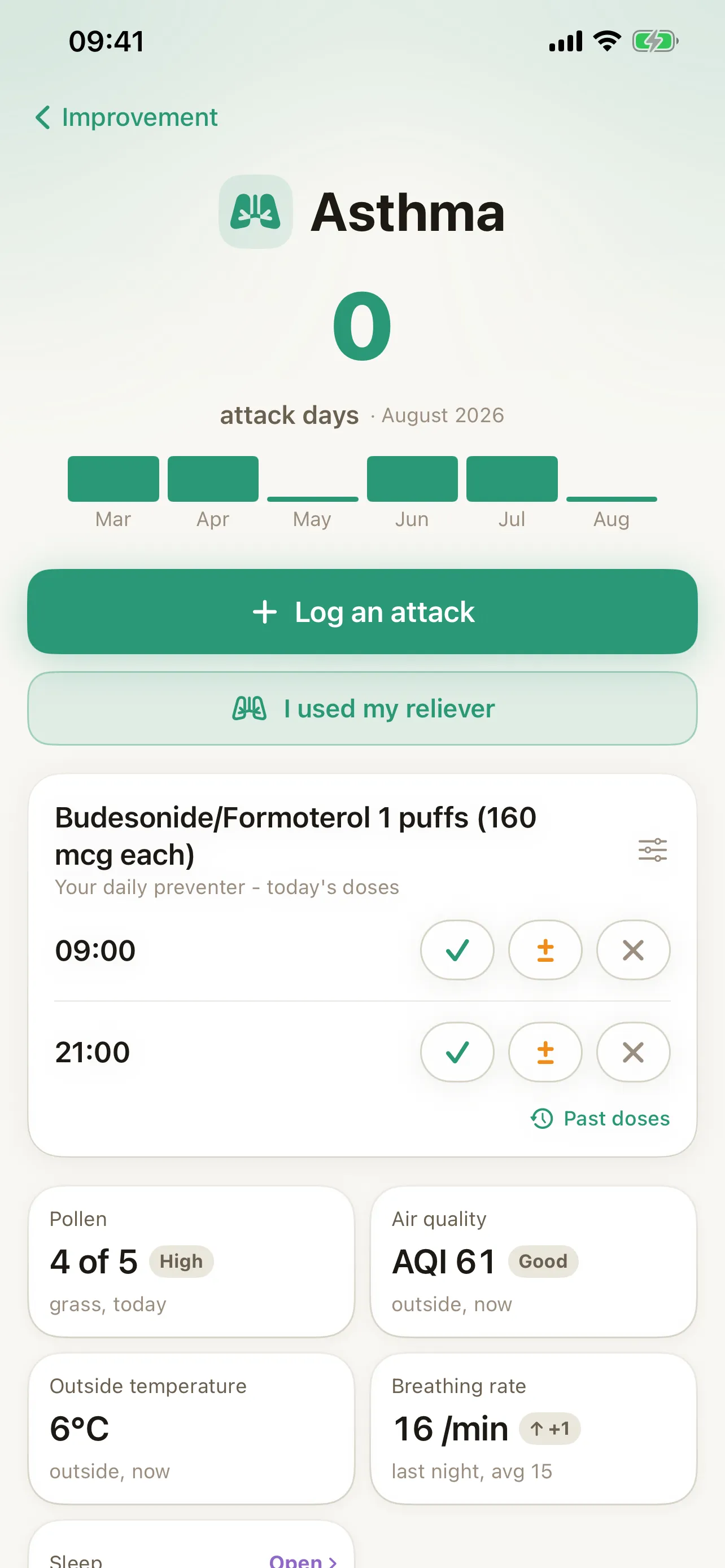
Sam shows pollen index, air quality (Universal Air Quality Index, higher means better air) and temperature for your approximate location if you share it, next to your overnight respiratory rate and sleep from Apple Health: measured numbers with no conclusion drawn. Sam also counts the days in the last 28 on which you used your reliever for symptoms. Uses before exercise are counted apart, and there is no streak and no goal.

Respiratory RateSleepResting Heart RatePollenAir QualityOutside Temperature

A Schedule for Your Preventer, Not Your Reliever

Sam reminds you to take your preventer (controller) inhaler on the schedule and dose you set, and you check off each dose. Your reliever inhaler never gets a reminder schedule, because you do not take it by schedule: you log it only when you use it, with puffs and the reason.

Preventer remindersReliever use when it happens

Every Attack, in Context

For each attack, log how bad it got, whether your reliever helped, whether you needed medical help, the emergency room or steroid tablets, whether it woke you at night, and what might have set it off. Not sure it really was an attack? Log it as 'not sure': it stays in your record but out of your attack count.

Attacks and severityNight wakingTriggers

A Monthly Check-In, GINA-Aligned

Once a month, Sam asks four yes/no questions on the areas GINA uses for symptom control: daytime symptoms, night waking, reliever use and activity limitation. The wording is Sam's own. You see your score from 0 to 4 as a trend from month to month.

GINA-aligned control check-inPDF report

If you choose 'severe' or 'my reliever did not help' on an entry, Sam shows an emergency notice right away that tells you to call 112 (the EU emergency number; use your local one elsewhere). A permanent note in the program makes clear that Sam neither detects, predicts nor prevents an asthma attack and never tells you when to use your inhaler. A quiet diary does not mean your asthma is controlled.

All of it can go into one doctor report as a PDF for your appointment.

Every Medical Program has its own doctor report as a PDF. You choose the period it covers and can share the report.

Sam is a wellness companion, not a medical device. The app does not diagnose, treat, cure, or prevent any illness and does not replace medical advice. Consult a qualified healthcare professional for medical decisions.

Sam app screen for people living with Asthma

Lung function and attacks are outside what a smartwatch can record. What your Watch produces and what you log, Sam keeps.

Doctor report (PDF)

Your asthma record as a doctor report

Sam puts your entries together as a PDF for your pulmonologist or GP. You choose the period the visit should cover: 1, 3, 6 or 12 months, or the whole record.

  • How often you used your reliever in the last 28 days and on how many nights symptoms woke you.
  • Your attacks in the period with the trend per month, whether the reliever helped and whether you took oral steroid tablets.
  • Your preventer medication: scheduled doses you took, plus the last 30 days at a glance.
  • Air quality, pollen, fine particles and felt temperature at the time of the entry, when you share your location.

Doctor report: asthma

Sample view

Report covers

1 month3 months6 months12 monthsWhole record

At a glance

5

Reliever-use days, last 28 days (9 puffs)

1

Nights woken by symptoms, last 28 days

3

Attacks in the period

24 of 28

Scheduled doses taken

Attacks per month

The current month is not included.

Preventer medication taken, last 30 days

Dose taken

Attacks, reliever use and preventer medication

Attacks where the reliever did not help
1
Self-tagged circumstances, across 3 entries
pollen (2), cold air (1), exercise (1)

Diary

  • 12 May, 18:30

    Attack - reliever helped - pollen - PM2.5 12 ug/m3, felt 14 C

  • 08 May, 07:10

    2 reliever puffs - exercise

Self-tracked data, not a diagnosis.

Example values, not real data. Your report is based on your own entries.

Ask about your numbers. Take the report along.

Sam shows your values next to your entries. What they mean is something to talk through with your doctor.

Ask Sam about your data

You ask a question, Sam answers with your own numbers. For example:

What was my average respiratory rate last week?
Your overnight respiratory rate averaged 17 breaths per minute, about 2 above your typical baseline of 15. It is a plain number without a conclusion; your symptom diary holds the details.
What did my symptom diary show over the same days?

Your monthly report as a PDF

The monthly report sums up your weeks - for appointments, applications, or simply your own record.

Monthly Report - June

Your Health Overview

Respiratory rate

16Breaths/min
-1vs. baseline
28Nights logged

Activity

142Training minutes
19Days on target
+8%vs. last month
Created by Sam HealthPDF

Example values. Your report is based on your own data.

Articles about Asthma

Further reading: what wearable data can show about everyday life with Asthma - and where its limits are.

6 min read

Asthma Not Well Controlled? What That Means

What does uncontrolled asthma mean? The four GINA questions, how they differ from the ACT, and what to record about reliever use and nights.

Frequently Asked Questions

Can my Apple Watch detect an asthma attack?+

No. Neither Sam nor a consumer wearable detects or predicts an asthma attack, and no wearable measures lung function. Sam records what you enter: for each attack how bad it was, whether your reliever helped, night waking, steroid tablets, medical help and triggers. It also shows measured values like respiratory rate and sleep from Apple Health, with no conclusion.

Should I keep an asthma diary?+

Yes. A diary can help you spot your own triggers and show your doctor how often symptoms occur. Note when symptoms start (cough, breathlessness, chest tightness, wheeze), what came before and when you used your reliever. In Sam you log each use, even without an attack. Your practice can show you what a good diary looks like.

How do I log my asthma symptoms in Sam?+

Sam has three entries. Log an attack: how bad it was, whether your reliever helped, steroid tablets, medical help, night waking and what might have set it off. Log a reliever use: the number of puffs, and whether it was for symptoms or before exercise. Or choose Not sure: it stays in your record but out of your attack count.

Is Sam a substitute for my asthma action plan?+

No. Your written action plan, made with your doctor, is your medical guide, and Sam is a diary. It reminds you of your daily preventer and never tells you which inhaler to use or when. For acute symptoms use your action plan and your local emergency number (112 in the EU, 999 in the UK, 911 in the US).

Can tracking stress help with asthma control?+

In Sam you can tag stress as something that might have set off an entry. These tags are your own notes, not a verdict on what caused anything, and the doctor report shows them as counts. That gives you a pattern to talk through with your doctor. Whether stress matters for your asthma is a question for your doctor.

How often should I check my respiratory rate trends?+

Sam sets no rhythm for this. In the asthma program it shows your overnight respiratory rate from Apple Health as a number next to your own average, with no conclusion. If you notice higher values over several days, note your symptoms and bring both to your next appointment. What the numbers mean for you is for your doctor to say.

Does Sam replace my peak flow chart?+

No. You keep measuring peak flow with your meter and record it on paper or in a peak flow app. Sam has no field for peak flow values. Sam adds a diary for reliever use and attacks, a reminder for your daily preventer and a monthly check with four yes/no questions.

What is in the asthma report for my doctor visit?+

You export a PDF report from your asthma program for the period you choose. It shows reliever days in the last 28 days with the puff count, night waking, your attacks with the severity you gave, steroid courses, preventer intake, your tagged triggers and a reference line based on GINA. Everything is self-entered. It holds no peak flow values.

Is Sam's monthly check the Asthma Control Test (ACT)?+

No. Sam does not include the ACT. The check has four yes/no questions on the areas GINA uses for symptom control: daytime symptoms, night waking, reliever use and activity limitation. The wording is Sam's own and the check is not a validated questionnaire. Your score from 0 to 4 shows your trend over time.

How does Sam count my reliever use?+

You log each use: puffs and the reason, symptoms or planned before exercise. Sam counts the days in the last 28 on which you used it for symptoms, not the puffs. Uses before exercise are counted apart. There is no streak and no goal. Sam never tells you which inhaler to use or when.

Can I follow asthma and hay fever in Sam together?+

Asthma and hay fever are separate programs, each with its own diary, monthly check and report. There is no combined report. Both show pollen and air quality values for your approximate location if you share it. More is on the page about asthma and hay fever together.

Is there an asthma diary app for iPhone and Apple Watch?+

Sam is an iPhone app and reads values from Apple Health that your Apple Watch stores there. There is no separate Watch app. The asthma program is for people whose asthma a doctor has diagnosed, and you confirm that at the start. You log reliever use and attacks, answer four questions each month and export a report.

Understand what your body is telling you.

Download Sam for free, connect Apple Health, and see what your data says about everyday life with Asthma - compared to your own baseline.

Free for iPhoneBuilt in Europe
Sam dashboard with wellbeing score, heart rate and sleep

Sam is a wellness companion, not a medical device. Sam does not diagnose, treat, cure, or prevent any illness and does not replace medical advice. For health questions or concerns, always consult a qualified medical professional.