
Living with Gout

Gout: Flares, Daily Life and Doctor Report

Take care of your gout.

Sam keeps your flares, doses and uric acid levels in one place. You take the history to your next appointment.

  • Not a medical device
  • Works with Apple Watch, Oura, Whoop & Garmin
  • Built in Europe

What happens in the joint with gout

Step by step: where gout often begins, what changes when urate crystals form in the joint, and where a flare is felt. The model shows the bones of the left foot and lower leg, without cartilage, joint capsule or soft tissue.

  1. 1Big toe joint

    Big toe joint

    Where gout often begins

    At the base of the big toe, the first metatarsal meets the toe's first bone. The first gout flare often affects this joint.

    Big toe joint

    A simplified human figure, seen from the front at an angle and framed from the feet up. In the left foot, the first metatarsal and the bones of the big toe turn light green. The other foot bones stay grey.
  2. 2With gout

    Urate crystals

    Crystals form, the joint reacts

    If blood urate stays high for a long time, needle-shaped crystals can form in the joint. A flare is the body's inflammatory reaction to these crystals.

    Without crystals

    • Cartilage
    • Joint lining
    • Joint fluid

    With urate crystals

    • Urate crystals
    • Inflamed joint lining

    Urate crystals / Big toe

    Close-up of the big toe joint from above and the inner side. Small white rods, drawn far larger than real urate crystals, appear one after another at the joint and then stay still. The other foot bones fade back. A sketch compares a joint without crystals with an inflamed joint containing crystals.

  3. 3Where people feel it

    Day to day

    When a flare comes

    In a flare, the joint typically becomes very painful, swollen and warm within a day. Flares settle again, but the crystals can remain in the joint. A hot, swollen joint can also be an infection, which is an emergency.

    Worth discussing with your doctor.

    Big toe joint area

    The view pulls back to the lower body, and the joint close-up with the crystals leaves the picture. The foot bones return to grey, and a soft green area marks the skin over the left big toe joint.

Sources concern the condition
  1. [1] Embaby OM, Elalfy MM. First metatarsophalangeal joint: Embryology, anatomy and biomechanics. 2025. World Journal of Orthopedics 16(4):102506. https://doi.org/10.5312/wjo.v16.i4.102506
  2. [2] Deutsche Gesellschaft für Rheumatologie und Klinische Immunologie (DGRh) et al.. S3-Leitlinie Diagnostik und Therapie der Gicht, Version 2.1. 2024. AWMF-Register Nr. 060-005. https://register.awmf.org/de/leitlinien/detail/060-005
  3. [3] Neogi T, Jansen TL, Dalbeth N, et al. (American College of Rheumatology / EULAR). 2015 Gout classification criteria: an American College of Rheumatology/European League Against Rheumatism collaborative initiative. 2015. Annals of the Rheumatic Diseases 74(10):1789-1798. https://doi.org/10.1136/annrheumdis-2015-208237
  4. [4] Richette P, Doherty M, Pascual E, et al. (EULAR). 2018 updated European League Against Rheumatism evidence-based recommendations for the diagnosis of gout. 2020. Annals of the Rheumatic Diseases 79(1):31-38. https://doi.org/10.1136/annrheumdis-2019-215315
  5. [5] Dalbeth N, Gosling AL, Gaffo A, Abhishek A. Gout. 2021. The Lancet 397(10287):1843-1855. https://doi.org/10.1016/S0140-6736(21)00569-9

Own simplified illustration based on the sources above.

The model shows only the bones of the left foot and lower leg. The left foot is shown as an example. Cartilage, the joint capsule and its lining, joint fluid, tendons and blood vessels are not in the model. Swelling and redness are not shown. The rods stand for urate crystals and are drawn many times larger than real crystals. Adult male reference model; close-ups and the sketch are not to scale.

3D anatomy: BodyParts3D, (c) The Database Center for Life Science, CC BY 4.0. Prepared via human-atlas; simplified, cropped, coloured and animated by SanoLabs.

What Sam keeps for you

No watch sees inside a joint. What you notice, Sam keeps.

For people living with gout who want a record for their appointments. Sam is not a medical device. It keeps what you and your wearable already produce and puts it in one place.

How the Gout Medical Program works.

Lab Values in Context

Upload your blood-test results and Sam shows your serum urate level, with automatic unit conversion, against the standard treat-to-target line used in gout care, plus eGFR and creatinine from the same labs. These figures come from the documents you upload, never from a sensor, and live alongside the rest of your records in the Health Vault.

Movement & ActivitySleep QualityAlcohol IntakeWalking DistanceStress & TensionRecovery & Energy

Medication Reminders

Set a reminder for your urate-lowering therapy, and Sam prompts you at the scheduled time. A custom dose stepper logs doses from 10 mg to 1000 mg in 10 mg increments, sized for medications like febuxostat.

Reminders for your long-term medicineDoses checked off

Flare Log

When a flare hits, log which joint is swollen and warm, your worst pain at rest on a 0-10 scale, and how many joints are involved. Tag possible triggers and note whether you took acute medication, all in one quick entry.

Flares: joint and pain at restPossible triggersAcute medication, if taken

Monthly Gout Impact Check-In

Once a month, Sam asks five short questions about how gout has affected you recently. The check-in is built on the PROMIS framework used in patient-reported outcome research, with scores ranging from 5 to 30.

PROMIS-framework check-inPDF report

All of it can go into one doctor report as a PDF for your appointment.

Every Medical Program has its own doctor report as a PDF. You choose the period it covers and can share the report.

Sam is a wellness companion, not a medical device. The app does not diagnose, treat, cure, or prevent any illness and does not replace medical advice. Consult a qualified healthcare professional for medical decisions.

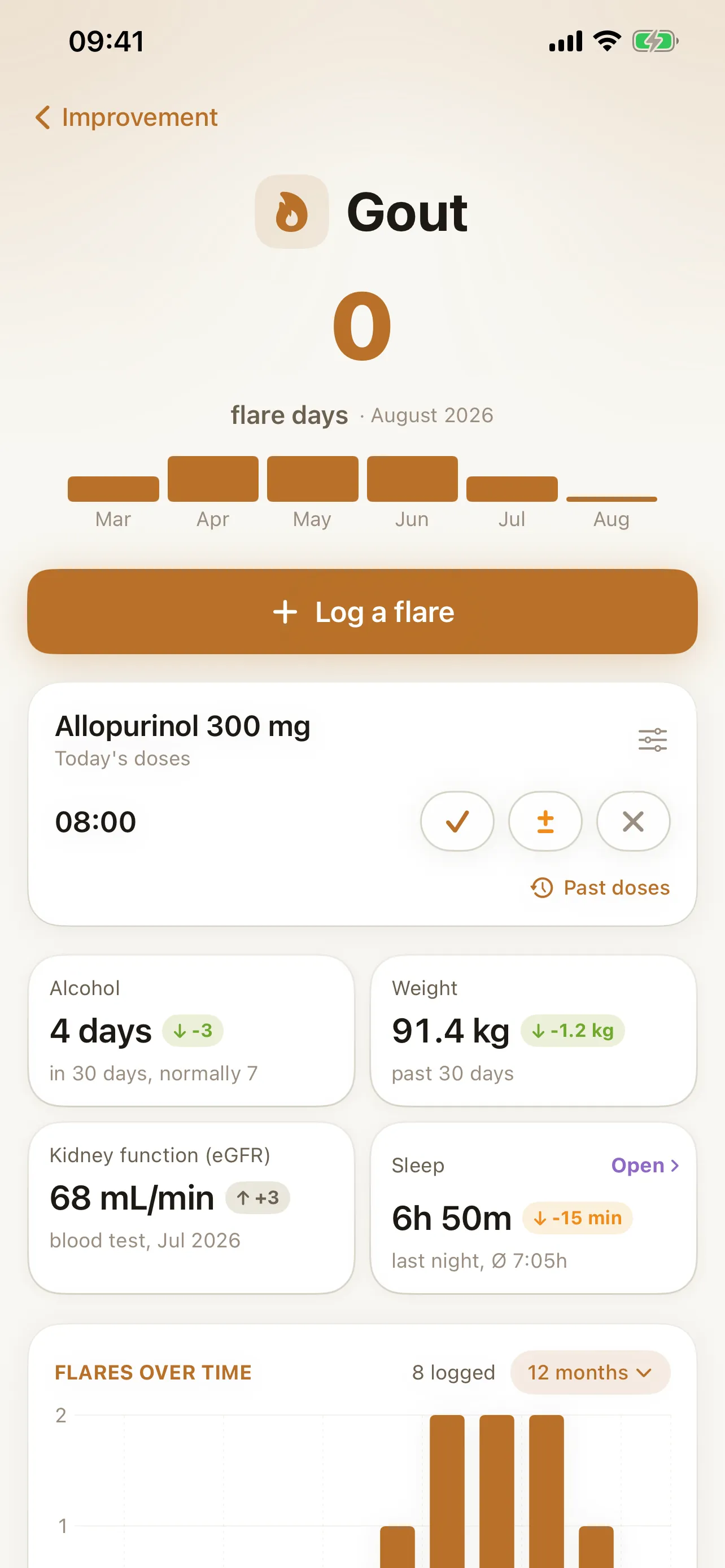
Sam app screen for people living with Gout

Urate levels and flares are outside what a smartwatch can record. Sam keeps your lab results and entries in one place.

Doctor report (PDF)

Your flare log as a doctor report

Sam puts your flare log together as a PDF for your rheumatologist or GP. You choose the period the visit should cover: 1, 3, 6 or 12 months, or the whole record.

  • Flares and flare days in the period, the joints involved and the trend per month.
  • Your most recent serum urate from an uploaded lab report, and up to the last six values over time.
  • Your intake: scheduled doses you took, plus the days you took an acute anti-inflammatory.
  • Your own tags for what came before a flare, counted and without attributing a cause, plus each flare with joint, swelling and warmth.

Doctor report: gout

Sample view

Report covers

1 month3 months6 months12 monthsWhole record

At a glance

3

Flares in the period

6.2 mg/dL

Most recent serum urate, 02 May

27 of 28

Scheduled doses taken

Flares per month

The current month is not included.

Medication taken, last 30 days

Dose taken

Flares, serum urate and medication

Joints involved
big toe (2), ankle (1)
Serum urate over time
7.1 (11 Feb), 6.6 (03 Apr), 6.2 (02 May)
Days with acute anti-inflammatory medication
4

Diary

  • 14 Apr, 03:20

    Big toe - swollen, warm - anti-inflammatory taken - tag: alcohol

  • 02 Mar, 22:05

    Ankle - swollen - tag: dehydration

Self-tracked data, not a diagnosis.

Example values, not real data. Your report is based on your own entries.

Ask about your numbers. Take the report along.

Sam shows your values next to your entries. What they mean is something to talk through with your doctor.

Ask Sam about your data

You ask a question, Sam answers with your own numbers. For example:

How's my movement been this week?
Your average daily steps this week were 6,400, about 1,800 below your three-month baseline.
How did that compare with last month?

Your monthly report as a PDF

The monthly report sums up your weeks - for appointments, applications, or simply your own record.

Monthly Report - June

Your Health Overview

Mobility

6.2kSteps/day
21Active days
+9%vs. last month

Health status

2Flare days
28Symptom-free
1Joint affected
Created by Sam HealthPDF

Example values. Your report is based on your own data.

Articles about Gout

Further reading: what wearable data can show about everyday life with Gout - and where its limits are.

4 min read

Gout flares: building your Apple Watch diary

Build a simple gout flare diary using Sam and Apple Watch. Log each attack and connect it to your health data for more productive rheumatologist conversations.

2 min read

Gout or Rheumatoid Arthritis? Key Differences

Gout and rheumatoid arthritis both affect the joints but follow different patterns. Learn the differences and which specialist can help you sort it out.

Frequently Asked Questions

Can Sam detect or warn me before a gout flare?+

No. No wearable can detect a gout flare or predict when one will happen. Flares start with acute joint inflammation that happens inside your body. What Sam can do is show your flare log with alcohol days, sleep and weight next to it, so you are better prepared for conversations with your doctor.

I have sudden severe joint pain, swelling, and redness. Is it gout?+

Sudden hot, swollen, red joints, especially if accompanied by fever, can indicate several conditions, including gout, but also infection (septic arthritis). Do not assume it's gout without a doctor's assessment. Seek urgent care to rule out infection, especially if this is your first flare or if you have a fever. A rheumatologist or your GP can confirm the diagnosis.

Can wearables measure uric acid levels?+

No wearable, including Sam's, can measure uric acid directly - that still requires a blood test. What Sam can do is read your serum urate value from an uploaded lab report and show it against the standard treat-to-target line, alongside eGFR and creatinine from the same labs, all stored in your Health Vault.

How do I log a gout flare in Sam?+

You log flares yourself; they aren't auto-detected. The log is structured: which joints are affected, whether the joint is warm and swollen, your worst pain at rest (0-10), plus trigger tags and whether you took acute medication. Sam does not calculate a diagnosis from these entries.

What's the difference between daily data and my monthly report?+

Sam shows you your daily Apple Health data (steps, sleep, stress, heart rate) so you can spot trends week to week. Once a month you can create a PDF report that compiles it into one summary you can share with your doctor. You don't need to manually export or screenshot anything.

I'm on allopurinol but keep having flares. What should I do?+

If your flares aren't improving despite urate-lowering therapy, that's a conversation for your rheumatologist. Don't adjust your medication on your own. Your doctor may order blood uric acid tests to check your dose, or explore other factors (diet, adherence, medication interactions) or additional therapies. Bring your Sam data and any flare notes you've kept.

How do I record a gout attack in Sam?+

In the Flare Log you record onset, the joints affected, pain (0-10), possible triggers and notes. Sam shows alcohol days, weight and sleep next to it - daily-life factors you often get asked about at the next appointment.

Understand what your body is telling you.

Download Sam for free, connect Apple Health, and see what your data says about everyday life with Gout - compared to your own baseline.

Free for iPhoneBuilt in Europe
Sam dashboard with wellbeing score, heart rate and sleep

Sam is a wellness companion, not a medical device. Sam does not diagnose, treat, cure, or prevent any illness and does not replace medical advice. For health questions or concerns, always consult a qualified medical professional.