Living with Hay Fever

Hay Fever: Symptoms, Pollen and Doctor Report

Take care of your hay fever.

Sam keeps your symptom days, medication and pollen levels in one place. You take the history to your next appointment.

  • Not a medical device
  • Works with Apple Watch, Oura, Whoop & Garmin
  • Built in Europe

What happens in the nose and eyes with hay fever

Step by step: where hay fever plays out, how the nose and eyes work without it, what changes with it and where it is felt.

  1. 1Nose and eyes

    Nose and eyes

    Where hay fever happens

    Hay fever is an allergic reaction of the upper airways to pollen in the air. It often affects the eyes as well.

    Turbinates / Eye

    A human figure, seen from the front at an angle. The view moves to the face: the turbinates inside the nose turn light blue, and a soft light blue area appears over the nose and the eyes.

  2. 2Without hay fever

    Nose and tears

    Warm, moist, filtered air

    The turbinates, ridges inside the nose, warm and moisten inhaled air. The nasal lining catches airborne particles. Tears from the tear gland drain through the tear duct into the nose.

    Inhaled air / Tear duct / Lower turbinate

    Close-up of the nose and eyes: the lower turbinate in light blue inside the nose, a soft light blue area over the eye. White dots stream steadily in through one nostril and back through the nasal passage past the lower turbinate. A few white dots move slowly from the tear gland across the eye and down the tear duct into the nose.

  3. 3With hay fever

    In hay fever

    When the nasal lining reacts

    In hay fever, the immune system overreacts to pollen, which is normally harmless. The nasal lining becomes inflamed and swells. Sneezing and a runny or blocked nose are typical; itching and watery eyes can come with them.

    Open passage

    • Septum
    • Turbinate
    • Lining

    With hay fever, swollen

    • Swollen lining
    • Pollen
    • Fluid

    Swollen lining / Itchy, watery eyes / Pollen

    The turbinates turn a deeper blue and thicken, so the nasal passage looks narrower. As the page scrolls, blue dots standing for pollen drift in through the nostril and settle at the front of the turbinate, and a few settle on the eye. The area over the eye turns a stronger blue. Air and tears keep moving. A sketch compares an open nasal passage with a swollen lining.

  4. 4Where people feel it

    Day to day

    In step with the pollen season

    Symptoms come with the pollen season. Hay fever often occurs together with asthma. Stronger symptoms can leave people weak and tired. Hay fever can affect work, school and social life.

    Worth discussing with your doctor.

    Nose and eyes

    The view pulls back to the head and shoulders. The turbinates return to a neutral grey and stay thickened, and a soft blue area marks the nose and the eyes.

Sources concern the condition
  1. [1] Institute for Quality and Efficiency in Health Care (IQWiG). Heuschnupfen (English edition: Hay fever). 2023. gesundheitsinformation.de; English edition: informedhealth.org/hay-fever.html. https://www.gesundheitsinformation.de/heuschnupfen.html
  2. [2] Bousquet J, Anto JM, Bachert C, et al. Allergic rhinitis. 2020. Nature Reviews Disease Primers 6:95. https://doi.org/10.1038/s41572-020-00227-0
  3. [3] Fakoya AO, Hohman MH, Georgakopoulos B, Le PH. Anatomy, Head and Neck, Nasal Concha. 2024. StatPearls, NCBI Bookshelf (NBK546636). https://www.ncbi.nlm.nih.gov/books/NBK546636/
  4. [4] Sobiesk JL, Munakomi S. Anatomy, Head and Neck, Nasal Cavity. 2023. StatPearls, NCBI Bookshelf (NBK544232). https://www.ncbi.nlm.nih.gov/books/NBK544232/
  5. [5] Machiele R, Lopez MJ, Czyz CN. Anatomy, Head and Neck: Eye Lacrimal Gland. 2023. StatPearls, NCBI Bookshelf (NBK532914). https://www.ncbi.nlm.nih.gov/books/NBK532914/
  6. [6] Cochran ML, Aslam S, Czyz CN. Anatomy, Head and Neck: Eye Nasolacrimal. 2023. StatPearls, NCBI Bookshelf (NBK482213). https://www.ncbi.nlm.nih.gov/books/NBK482213/
  7. [7] Sousa-Pinto B, Bousquet J, Vieira RJ, et al.; ARIA and EAACI. Allergic Rhinitis and Its Impact on Asthma (ARIA)-EAACI Guidelines-2024-2025 Revision: Part I-Guidelines on Intranasal Treatments. 2026. Allergy 81(4):954-976. https://doi.org/10.1111/all.70131

Own simplified illustration based on the sources above.

The model shows the lower turbinates inside the nose. The nasal lining, the conjunctiva, the eyes, the tear glands, the tear ducts, the sinuses and the middle and upper turbinates are not shown. The soft blue areas on the skin over the nose and the eyes mark where hay fever plays out and where it is felt. The white dots stand for inhaled air and for tears, the blue dots for pollen; breathing out is not drawn separately. The swelling of the lining, which the sketch shows, is drawn on the turbinate bone in the model and exaggerated for visibility. Air, tears and pollen are shown on one side only, and the pollen grains are enlarged. Adult male reference model; close-ups and the sketch are not to scale.

3D anatomy: BodyParts3D, (c) The Database Center for Life Science, CC BY 4.0. Prepared via human-atlas; simplified, cropped, coloured and animated by SanoLabs.

What Sam keeps for you

No watch sees inside the nose. What you notice, Sam keeps.

For people living with hay fever who want a record for their appointments. Sam is not a medical device. It keeps what you and your wearable already produce and puts it in one place.

How the Hay Fever Medical Program works.

Your exposure profile

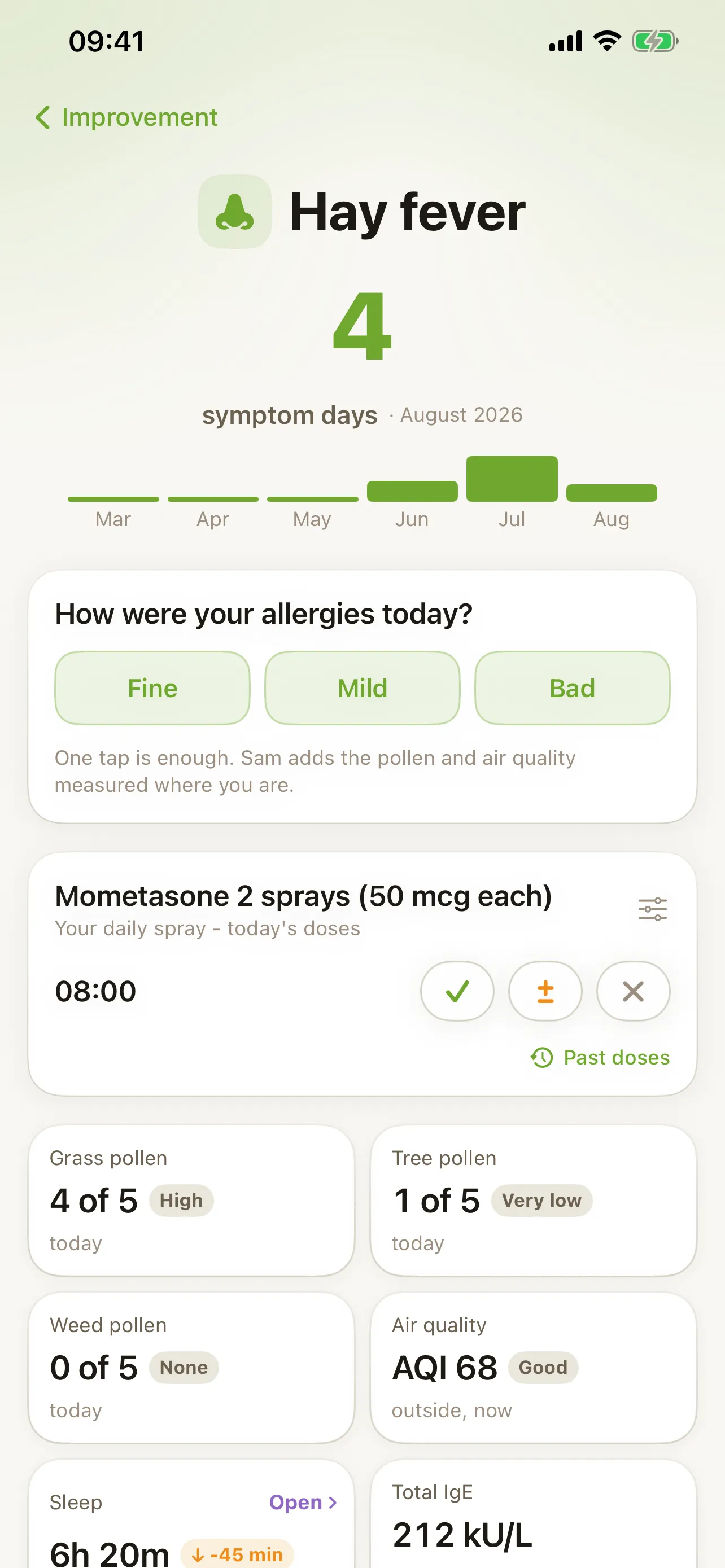
From 10 symptom days with pollen values, Sam counts on how many of them pollen was at moderate or higher (level 3 of 5) and on how many air quality was in the lower range of the index, each against the days that value was available. Days logged in another place are counted apart. It is a count of your own days, not a diagnosis and not a cause. If an uploaded blood test contains total IgE or eosinophils, Sam shows them as plain numbers. If you share your location, Sam pauses after three weeks without a symptom day and with pollen below level 3, and stops reminding you about the monthly check.

Grass PollenTree PollenWeed PollenAir QualitySleep

One daily reminder, logged treatments

Sam reminds you to use your daily corticosteroid nasal spray at the time and dose you set, and you check off each use. Other medicines, such as antihistamines, decongestants or eye drops, get no reminder schedule: you log them when you take them, by kind and never by dose. Sam records your doctor's plan and does not tell you what to take.

Daily nasal spray reminderAntihistamines when you take themEye drops when you use them

A daily log built for allergy days

Rate the day in one tap: Fine, Mild or Bad. Optionally add four nose symptoms (blocked, runny, sneezing, itchy), itchy eyes, sleep and daytime impact, medication and what you did about it. If you share your approximate location, Sam attaches that day's pollen index and air quality, so you do not have to look them up.

Allergy days: Fine, Mild, BadNasal symptom scoreEye symptomsToday's pollen and air quality

A monthly symptom check-in

Once a month, Sam asks six short questions about the last 7 days: five ratings from 0 to 10 (overall, nose, eyes, chest if you have asthma, sleep and daily life) and the number of days you used rescue medication. Only the overall rating is tracked; the other answers are kept for your doctor. The check follows the ARIA visual analogue scale in style. The wording is Sam's own, and it is not a validated questionnaire.

Symptom check-in, 0 to 10PDF report

If you tick wheeze, chest tightness, breathlessness or a whole-body reaction in the log, Sam shows an emergency notice right in the entry that tells you to call 112 (the EU emergency number; use your local one elsewhere). A permanent note in the program says that Sam does not diagnose your allergy, name the allergen you react to or predict your symptoms. Sam is no substitute for emergency help.

All of it can go into one doctor report as a PDF for your appointment.

Every Medical Program has its own doctor report as a PDF. You choose the period it covers and can share the report.

Sam is a wellness companion, not a medical device. The app does not diagnose, treat, cure, or prevent any illness and does not replace medical advice. Consult a qualified healthcare professional for medical decisions.

Sam app screen for people living with Hay Fever

A blocked nose and itchy eyes are outside what a smartwatch can record. Sam keeps what you log.

Doctor report (PDF)

Your allergy days as a doctor report

Sam puts your allergy diary together as a PDF for your allergist or GP. You choose the period the visit should cover: 1, 3, 6 or 12 months, or the whole record.

  • Days with and without symptoms in the period, per month, plus the weeks with symptoms on more than 4 days.
  • On how many nights sleep and on how many days your activities were affected, as you entered it.
  • Pollen and air quality measured at the time of your entry, counted next to your symptom days, when you share your location.
  • Which as-needed medication you took on how many days, by class, and which exposure measures you noted.

Doctor report: hay fever

Sample view

Report covers

1 month3 months6 months12 monthsWhole record

At a glance

34

Days with symptoms

12

Symptom-free days

9

Nights with disturbed sleep

11

Days with activities affected

Symptom days per month

The current month is not included.

Symptom days, last 30 days

Day with an entry

Symptom days, measured exposure and medication

Symptom days with measured pollen and air quality attached
28
As-needed medication by class and days
antihistamine tablet (14), eye drops (9)

Diary

  • 09 Apr, 08:30

    Symptoms - sleep disturbed - antihistamine tablet - birch 4/5, air quality 71/100

  • 08 Apr, 12:10

    Symptoms - activities affected - birch 3/5, air quality 78/100

Self-tracked data, not a diagnosis.

Example values, not real data. Your report is based on your own entries.

Ask about your numbers. Take the report along.

Sam shows your values next to your entries. What they mean is something to talk through with your doctor.

Ask Sam about your data

You ask a question, Sam answers with your own numbers. For example:

How has my sleep been over the last few weeks?
Over the last 6 weeks you slept 6 hours 12 minutes a night on average, 48 minutes below your three-month average.
Did my stress level change too?

Your monthly report as a PDF

The monthly report sums up your weeks - for appointments, applications, or simply your own record.

Monthly Report - June

Your Health Overview

Respiratory rate

16Breaths/min
-1vs. baseline
28Nights logged

Activity

142Training minutes
19Days on target
+8%vs. last month
Created by Sam HealthPDF

Example values. Your report is based on your own data.

Articles about Hay Fever

Further reading: what wearable data can show about everyday life with Hay Fever - and where its limits are.

4 min read

Hay Fever Symptoms: Signs, Season and Diary

Hay fever symptoms explained simply: typical signs, how they change over the pollen season and what to note in a diary for your doctor.

4 min read

Hay Fever and Sleep: Managing Pollen Season

Hay fever disrupts sleep and energy during pollen season. Learn how to track symptoms and support your wellbeing with Apple Health and Sam.

Frequently Asked Questions

Can Sam detect when I'm having an allergic reaction?+

No. Neither Sam nor a wearable detects or predicts an allergic reaction, and Sam does not name the pollen you react to. Your doctor clarifies that, for example with a skin-prick or blood test. Sam records what you enter and shows pollen and air quality for your location next to it, with no conclusion.

Does Sam show pollen levels and air quality?+

Yes, if you share your approximate location. When you log today, Sam attaches the pollen index for grass, trees and weeds (0 to 5) and the Universal Air Quality Index (higher means better air) to that entry. Entries for past days get no values, and Sam shows no pollen forecast.

What's actually causing my nasal congestion: allergies or something else?+

That is for your doctor or allergist to determine. A diagnosis usually starts with your history, for example in which months you have symptoms, followed by a skin-prick test and sometimes a blood test. Sam cannot diagnose. It can keep your symptom days so you can show them at the appointment.

What should I keep track of with hay fever day to day?+

What helps is for your doctor or pharmacist to advise. Sam is a record: you log how the day went, what you took (the kind, never a dose) and what you did about it, such as keeping windows closed. Sam does not tell you what to take or when. Bring the record to your allergist.

I take antihistamines. Will Sam show me if they're working?+

No. Sam does not judge whether a medicine works. You log the kinds of medicine you took on a day, never a dose, and the report counts those days next to your symptom days. Sam can also remind you of a daily corticosteroid nasal spray. Any change is your allergist's call.

Hay fever and asthma seem connected. Can Sam help with both?+

Sam has a separate Asthma program. Each program has its own diary, monthly check and report, and there is no combined report. How the two work side by side is described on the page about hay fever and asthma together. Whether the two are linked for you is a question for your doctor.

Can I use Sam as a pollen diary?+

Yes. You log your symptom days yourself, the way a pollen or allergy diary works. When you log today and share your approximate location, Sam attaches the pollen index for grass, trees and weeds and the air quality. Sam shows no pollen forecast.

Do I need a diagnosis to use the hay fever program?+

Yes. At the start you confirm that a doctor has diagnosed your hay fever. If you only suspect it, you can log sneezing, a runny or blocked nose and itchy eyes in the Symptoms area of Sam and show the entries at your first appointment. Testing, for example a skin-prick test, is for your doctor, not Sam.

I already use a pollen forecast app. Why would I need Sam?+

Many pollen apps show a forecast. Sam shows none. Sam records how a day went, what you took and did, and the pollen and air quality values at your location for that day, and turns that into a report for your allergist. You can use both.

What is in the hay fever report for my allergist?+

For a period you pick (1, 3, 6 or 12 months, or everything), the report counts symptom days, weeks with symptoms on more than four days, your mean nasal score, nights with disturbed sleep, as-needed medicine by kind and days, and your daily spray intake, plus how many symptom days had moderate or higher pollen. The entries are self-reported.

Can I log allergen immunotherapy in Sam?+

Sam has no feature for it. You can log symptom days, medication and what you did about it, and show the report to your allergist. Whether immunotherapy is an option for you is something to discuss with your doctor.

Understand what your body is telling you.

Download Sam for free, connect Apple Health, and see what your data says about everyday life with Hay Fever - compared to your own baseline.

Free for iPhoneBuilt in Europe
Sam dashboard with wellbeing score, heart rate and sleep

Sam is a wellness companion, not a medical device. Sam does not diagnose, treat, cure, or prevent any illness and does not replace medical advice. For health questions or concerns, always consult a qualified medical professional.