Living with Epilepsy

Epilepsy: Seizure Calendar, Sleep and Doctor Report

Take care of your epilepsy.

Sam keeps your seizure diary, sleep and medication intake in one place. You take the log to your next appointment.

  • Not a medical device
  • Works with Apple Watch, Oura, Whoop & Garmin
  • Built in Europe

What happens in the brain with epilepsy

Step by step: where seizures start, how nerve cells signal without a seizure, what changes during one and how seizures show.

  1. 1The brain

    Epilepsy

    Where seizures start

    Epilepsy is a disease of the brain with a lasting tendency to have seizures. It can affect people of any age.

    Brain

    A human figure, seen from the front at an angle. The view moves towards the head, where the cerebrum, the large upper part of the brain, turns a soft indigo. The cerebellum at the back of the head stays grey. Nothing moves or flashes.

  2. 2Without a seizure

    Nerve cells

    Signals between nerve cells

    Normally, nerve cells in the brain pass electrical and chemical signals to one another. These signals produce thoughts, feelings and actions.

    Temporal lobe / Cerebral cortex

    Side view of the head from the left. Both halves of the brain stay evenly indigo and still; the cerebellum recedes. Labels mark the cerebral cortex and the temporal lobe at the side of the brain.

  3. 3Example: focal seizure

    In a seizure

    When nerve cells fire in step

    During a seizure, groups of nerve cells become overactive or fire in step with one another. Focal seizures start in one half of the brain, as in this example; generalised seizures quickly involve both halves.

    Seizure activity

    Same side view, slightly lower. A darker indigo ring spreads slowly outward from the left temporal lobe over part of the left half of the brain, as one example of a focal seizure; the animation repeats every ten seconds. The rest of the brain stays unchanged. Nothing flashes.

  4. 4How seizures show

    Day to day

    Seizures can look very different

    A seizure's signs depend on where it starts and how far it spreads. Examples are brief blank spells, unusual feelings, twitching, or loss of consciousness with stiffening and jerking. If a seizure lasts over 5 minutes, call emergency services.

    Worth discussing with your doctor.

    The view pulls back to the whole figure. The brain returns to a neutral grey. Nothing moves.

Sources concern the condition
  1. [1] Fisher RS, Acevedo C, Arzimanoglou A, et al.; International League Against Epilepsy (ILAE). ILAE Official Report: A practical clinical definition of epilepsy. 2014. Epilepsia 55(4):475-482. https://doi.org/10.1111/epi.12550
  2. [2] Deutsche Gesellschaft für Neurologie (DGN) mit der Deutschen Gesellschaft für Epileptologie (DGfE). Erster epileptischer Anfall und Epilepsien im Erwachsenenalter, S2k-Leitlinie, Version 6.0. 2023. register.awmf.org (AWMF-Register-Nr. 030-041). https://register.awmf.org/de/leitlinien/detail/030-041
  3. [3] World Health Organization (WHO). Epilepsy (fact sheet). 2024. who.int. https://www.who.int/news-room/fact-sheets/detail/epilepsy
  4. [4] National Institute of Neurological Disorders and Stroke (NINDS), NIH. Epilepsy and Seizures. 2026. ninds.nih.gov. https://www.ninds.nih.gov/health-information/disorders/epilepsy-and-seizures
  5. [5] Beniczky S, Trinka E, Wirrell E, et al.; International League Against Epilepsy (ILAE). Updated classification of epileptic seizures: Position paper of the International League Against Epilepsy. 2025. Epilepsia 66(6):1804-1823. https://doi.org/10.1111/epi.18338
  6. [6] National Health Service (NHS). Epilepsy. 2025. nhs.uk. https://www.nhs.uk/conditions/epilepsy/

Own simplified illustration based on the sources above.

The model shows the cerebral cortex and, for orientation, the cerebellum. The hippocampus and other deeper structures, the brainstem, nerve cells and their connections are not shown. The indigo colour marks the cerebrum as a location; it does not show where epilepsy is. Seizure activity cannot be seen on the brain; it can be recorded with an EEG. The darker ring is a stylised marker for one example of a focal seizure starting in the left temporal lobe; seizures differ in where they start and how far they spread. The ring repeats slowly so it can be followed; it does not show the speed or rhythm of real seizure activity. Adult male reference model; close-ups are not to scale.

3D anatomy: BodyParts3D, (c) The Database Center for Life Science, CC BY 4.0. Prepared via human-atlas; simplified, cropped, coloured and animated by SanoLabs.

What Sam keeps for you

No watch sees inside the brain. What you notice or hear from others, Sam keeps.

For people living with epilepsy who want a record for their appointments. Sam is not a medical device. It keeps what you and your wearable already produce and puts it in one place.

How the Epilepsy Medical Program works.

Sleep, Resting Heart Rate and HRV as Context

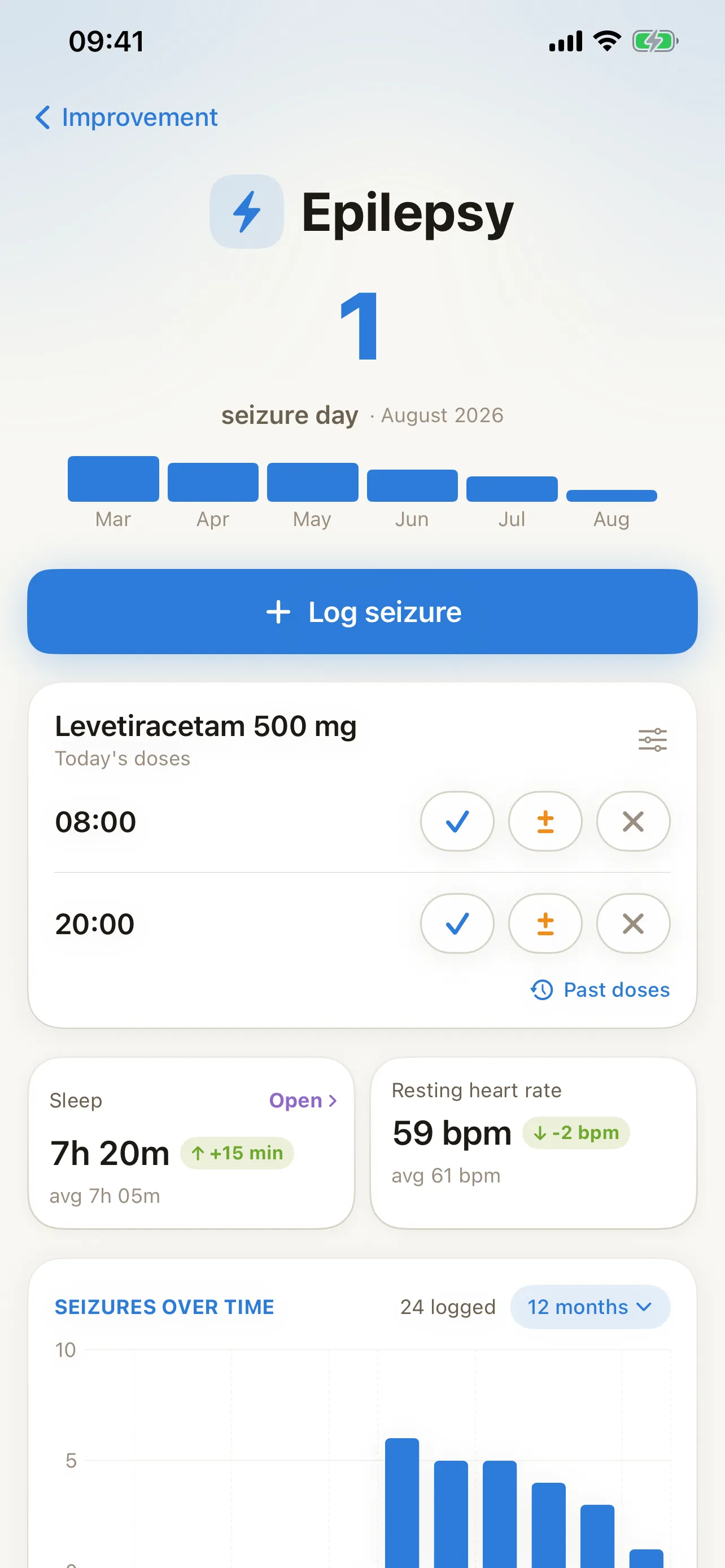
On the program home, Sam shows your latest measured sleep and resting heart rate next to your own average. A new entry logged today also gets sleep, HRV and resting heart rate from Apple Health, where Apple Health has values. Backdated entries get none. Sam makes no prediction from them.

Sleep DurationResting Heart RateHeart Rate Variability

Daily Dose Reminders

Sam reminds you at your scheduled times to take your medication, and you check off each dose as Taken, Adjusted, or Skipped. You enter one medication with its dose and times, exactly as prescribed. Reminders cover scheduled daily doses only, not as-needed medication. Sam gives no dosing advice.

Daily dose remindersEach dose: taken, adjusted or skipped

Seizure Diary, Right in Sam

Log each seizure with date and time and pick the type (names follow the ILAE classification): focal aware, focal impaired awareness, tonic-clonic, absence or not sure. Add whether you lost consciousness, any injury, whether someone saw it, a suspected trigger and a note. A new entry logged today gets sleep, HRV and resting heart rate as context.

Seizures with time and typeLoss of consciousnessInjuriesPossible triggers

Monthly Mood Check-In

Once a month, Sam asks the NDDI-E, a short six-item questionnaire about the last two weeks. It was developed as a screen for depressive symptoms in epilepsy and is not a diagnosis. It takes a couple of minutes and gives you a consistent check-in to bring to your neurologist.

NDDI-E mood check-inPDF report

One of the six questions in the monthly check-in is about thoughts of suicide. If you answer sometimes or more often, Sam shows crisis-line numbers in the same session. The program home always carries the line "Self-tracked data, not a diagnosis. In an emergency, call 112." (112 is the EU emergency number; use your local one elsewhere.) It also says that Sam does not detect seizures and that an empty diary never means there was no seizure.

All of it can go into one doctor report as a PDF for your appointment.

Every Medical Program has its own doctor report as a PDF. You choose the period it covers and can share the report.

Sam is a wellness companion, not a medical device. The app does not diagnose, treat, cure, or prevent any illness and does not replace medical advice. Consult a qualified healthcare professional for medical decisions.

Sam app screen for people living with Epilepsy

Brain activity is outside what a smartwatch can record. Sam keeps what you log and what your Watch produces.

Doctor report (PDF)

Your seizure log as a doctor report

Sam puts your seizure log together as a PDF for your neurologist. You choose the period the visit should cover: 1, 3, 6 or 12 months, or the whole record.

  • Your seizures in the period, split by type, how many happened at night, and the trend per month.
  • The days since your last logged seizure, with the date.
  • Your intake: scheduled doses you took, skipped or adjusted, plus the last 30 days at a glance.
  • For each seizure, whether someone witnessed it and whether you lost awareness. If you log it the same day, the previous night's sleep, HRV and resting heart rate from Apple Health are added when data is available.

Doctor report: epilepsy

Sample view

Report covers

1 month3 months6 months12 monthsWhole record

At a glance

4

Seizures in the period

23

Days since the last logged seizure

27 of 28

Scheduled doses taken

Seizures per month

The current month is not included.

Medication taken, last 30 days

Dose taken

Seizures and medication

By type
focal aware (2), focal impaired awareness (1), absence (1)
Of which at night
1
Skipped doses
1

Diary

  • 03 May, 02:10

    Focal impaired awareness - witnessed - sleep 5 h 10, HRV 41 ms, resting heart rate 62 bpm

  • 19 Apr, 16:45

    Absence - sleep 6 h 20, HRV 47 ms, resting heart rate 60 bpm

Self-tracked data, not a diagnosis.

Example values, not real data. Your report is based on your own entries.

Ask about your numbers. Take the report along.

Sam shows your values next to your entries. What they mean is something to talk through with your doctor.

Ask Sam about your data

You ask a question, Sam answers with your own numbers. For example:

How's my sleep been compared to last month?
Your sleep averaged 6 hours 14 minutes this month, 45 minutes below your baseline. You had three nights under 5 hours of sleep. That's a notable change from your usual pattern.
Should I mention this to my neurologist?

Your monthly report as a PDF

The monthly report sums up your weeks - for appointments, applications, or simply your own record.

Monthly Report - June

Your Health Overview

Sleep

07:10Average
23:50Bedtime
71Score

Stress level

38Avg (score)
-6vs. baseline
22Days logged
Created by Sam HealthPDF

Example values. Your report is based on your own data.

Articles about Epilepsy

Further reading: what wearable data can show about everyday life with Epilepsy - and where its limits are.

6 min read

Epilepsy Newly Diagnosed: Your First Weeks

Epilepsy diagnosed, what now? Which tests and appointments follow, how a witness describes your seizure and what to record from day one.

Frequently Asked Questions

Can the Apple Watch detect seizures?+

That is not something Sam does: Sam does not detect seizures. Apps from other companies advertise seizure detection with the Apple Watch. Whether anything like that suits you is a question for your neurologist. In Sam you log seizures yourself, and Sam shows sleep, resting heart rate and HRV from Apple Health as context.

Can Sam detect or predict my seizures?+

No. Sam does not detect seizures and does not predict them. A seizure is in your diary only if you log it, so an empty diary never means there was no seizure. Sam shows your sleep, resting heart rate and HRV as plain numbers. What they mean for you is for your neurologist to judge.

What triggers seizures most often?+

For some people with epilepsy, flickering light can trigger a seizure; occasionally too little sleep, alcohol or, mainly in children, high fever can. In a survey of 104 adults at one epilepsy clinic, stress, sleep deprivation and fatigue were reported most often (Ferlisi and Shorvon, 2014). In Sam you note a suspected trigger per seizure.

Should I keep a seizure diary?+

Ask your neurologist what they want to see. Patient information from health institutes notes that for diagnosis it matters when and under what circumstances a seizure happened, and that people often remember a seizure poorly. In Sam you log time, type, loss of consciousness, injury, whether someone saw it, a suspected trigger and a note.

Can I use Sam to prevent seizures?+

No. Sam is a diary, not a treatment, and it does not prevent seizures. Your neurologist plans any seizure-preventing medication with you. Sam reminds you at the dose times you set and keeps your diary, so you have your own record to bring to appointments.

What should I do if I have a seizure while wearing my Apple Watch?+

Sam cannot help in the moment: it is a diary you fill in afterwards and it does not detect seizures. For what to do during a seizure, see the first-aid pages of your national epilepsy organisation (for example the Epilepsy Foundation in the US or Epilepsy Action in the UK) and ask your neurologist about an emergency plan.

Is epilepsy the same in everyone?+

No. Epilepsy has many forms and causes, and the course differs. Some people have a single seizure, others live with epilepsy long term, and about 3 in 10 still have regular seizures despite treatment. Your neurologist knows your type and plan. In Sam you log your own seizures, so you have your own record to discuss.

Is Sam's Seizure Diary a seizure calendar?+

It serves the same purpose. You log each seizure with date, time and type, plus loss of consciousness, injury, whether someone saw it, a suspected trigger and a note. Sam shows seizures per month, the seizure days of the current month and a month calendar. For entries logged today, sleep, HRV and resting heart rate are added.

Can Sam remind me to take my medication?+

Yes, with medication reminders at the times you set. You enter one medication with its dose and times and mark each dose as taken, adjusted or skipped. Reminders cover scheduled daily doses, not as-needed medication. Sam gives no dosing advice: your doctor sets the plan.

What is in the report for my neurologist?+

You choose the period: 1, 3, 6 or 12 months, or everything. Among other things the doctor report shows seizures per month, by type and how many began at night (between 21:00 and 06:00), the doses taken as scheduled, the last 30 days and up to 30 entries. It notes that an empty log does not mean no seizures occurred.

Where can I find reliable information on driving and disability status?+

Sam assesses neither fitness to drive nor entitlements. Rules differ by country and state, but in general people with seizures are not considered fit to drive while a significant risk of further seizures remains; exceptions follow official guidelines. Discuss it with your treating doctor. Disability status and benefits are likewise decided by the authorities in your country.

Can I use Sam for epilepsy and another condition?+

Epilepsy, migraine, blood pressure, panic disorder, asthma, hay fever, acid reflux and gout are separate programs, each with its own log, monthly questionnaire and doctor report. There is no combined report. How two programs run side by side is described for epilepsy and migraine.

Understand what your body is telling you.

Download Sam for free, connect Apple Health, and see what your data says about everyday life with Epilepsy - compared to your own baseline.

Free for iPhoneBuilt in Europe
Sam dashboard with wellbeing score, heart rate and sleep

Sam is a wellness companion, not a medical device. Sam does not diagnose, treat, cure, or prevent any illness and does not replace medical advice. For health questions or concerns, always consult a qualified medical professional.