
Living with Reflux (GERD)

Reflux (GERD): Heartburn, Daily Life and Doctor Report

Take care of your reflux.

Sam keeps your reflux episodes, meals and sleep in one place. You take the history to your next appointment.

  • Not a medical device
  • Works with Apple Watch, Oura, Whoop & Garmin
  • Built in Europe

What happens at the stomach entrance with reflux

Step by step: where reflux plays out, how swallowing works without reflux disease, what changes with it and where it is felt. The model shows the esophagus and the stomach with a cut-out of the diaphragm.

  1. 1The esophagus

    The esophagus

    Where reflux happens

    The esophagus runs from the throat, behind the windpipe and the heart, down to the stomach. Just before the stomach, it passes through a narrow gap in the diaphragm.

    Esophagus / Stomach / Diaphragm (cut-out)

    A simplified human figure, seen from the front at an angle. The view moves towards the chest and upper abdomen, where the esophagus and the stomach turn orange. A cut-out of the diaphragm, the windpipe and the heart stay grey.
  2. 2Without reflux disease

    Swallowing

    Down, then closed again

    After a swallow, a muscle wave pushes food down. At the lower end, a ring muscle opens to let it into the stomach, then closes again, supported by the diaphragm.

    Lower esophageal sphincter, approximate / Swallowed food / Diaphragm (cut-out)

    Closer view of the esophagus and the stomach in orange, with the diaphragm cut-out in grey. A white band and a few white dots travel down the esophagus into the stomach. The ring muscle at the lower end sits at the level of the diaphragm.

  3. 3With reflux disease

    In reflux disease

    When stomach contents flow back

    Occasional backflow of stomach contents is common, for example after a large meal. It counts as reflux disease when it causes troublesome symptoms such as heartburn or regurgitation. A main reason: the stomach entrance closes less reliably.

    Closed

    Open, backflow

    • Esophagus
    • Lower sphincter
    • Diaphragm
    • Stomach

    Backflow

    Same view, slightly closer to the junction. A darker orange band and small dots rise from the stomach a short way into the lower esophagus, a schematic picture of backflow. The wall of the esophagus itself does not change. A sketch compares the junction closed and open.

  4. 4Where people feel it

    Day to day

    Behind the breastbone, up to the neck

    Heartburn is a burning feeling behind the breastbone that can rise toward the neck. Stomach contents can also come back up toward the mouth, often with a sour or bitter taste. Symptoms can increase when bending over or lying down.

    Worth discussing with your doctor.

    New or severe symptoms need a doctor. Chest pain, fainting or sudden breathlessness: call emergency services. Chest pain can also be a heart problem.

    Behind the breastbone / Throat

    The view pulls back to the whole figure and the organs return to grey. Two soft orange areas on the body surface mark the area behind the breastbone and the front of the neck.

Sources concern the condition
  1. [1] Omole AE, Bordoni B. (StatPearls). Anatomy, Thorax, Esophagus. 2026. StatPearls Publishing, NCBI Bookshelf (last update 31 January 2026). https://www.ncbi.nlm.nih.gov/books/NBK482513/
  2. [2] Institut für Qualität und Wirtschaftlichkeit im Gesundheitswesen (IQWiG). Sodbrennen und Refluxkrankheit. 2024. gesundheitsinformation.de (updated 31 July 2024). https://www.gesundheitsinformation.de/sodbrennen-und-refluxkrankheit.html
  3. [3] National Institute of Diabetes and Digestive and Kidney Diseases (NIDDK), NIH. Your Digestive System & How It Works. 2017. niddk.nih.gov (last reviewed December 2017). https://www.niddk.nih.gov/health-information/digestive-diseases/digestive-system-how-it-works
  4. [4] Rosen RD, Winters R. (StatPearls). Physiology, Lower Esophageal Sphincter. 2023. StatPearls Publishing, NCBI Bookshelf (last update 17 March 2023). https://www.ncbi.nlm.nih.gov/books/NBK557452/
  5. [5] National Institute of Diabetes and Digestive and Kidney Diseases (NIDDK), NIH. Definition & Facts for GER & GERD. 2020. niddk.nih.gov (last reviewed July 2020). https://www.niddk.nih.gov/health-information/digestive-diseases/acid-reflux-ger-gerd-adults/definition-facts
  6. [6] Vakil N, van Zanten SV, Kahrilas P, Dent J, Jones R; Global Consensus Group. The Montreal definition and classification of gastroesophageal reflux disease: a global evidence-based consensus. 2006. Am J Gastroenterol 101(8):1900-1920. https://doi.org/10.1111/j.1572-0241.2006.00630.x
  7. [7] Madisch A, Koop H, Miehlke S et al.; Deutsche Gesellschaft für Gastroenterologie, Verdauungs- und Stoffwechselkrankheiten (DGVS). S2k-Leitlinie Gastroösophageale Refluxkrankheit und eosinophile Ösophagitis, AWMF-Register-Nr. 021-013. 2023. Z Gastroenterol 61:862-933; AWMF version March 2023, valid until 30 June 2027. https://register.awmf.org/de/leitlinien/detail/021-013
  8. [8] Katz PO, Dunbar KB, Schnoll-Sussman FH, Greer KB, Yadlapati R, Spechler SJ; American College of Gastroenterology. ACG Clinical Guideline for the Diagnosis and Management of Gastroesophageal Reflux Disease. 2022. Am J Gastroenterol 117(1):27-56. https://doi.org/10.14309/ajg.0000000000001538

Own simplified illustration based on the sources above.

The model shows the esophagus, the stomach and a cut-out of the diaphragm around the point where the esophagus passes through; the opening itself is not modelled. The windpipe, the heart wall and the duodenum are there for orientation. The lower esophageal sphincter is not a separate structure in the model, so its position is approximate. The white dots in the swallow step stand for food moving down; backflow is drawn as a band with dots, and its height and amount are schematic. The soft areas over the breastbone and the throat mark where symptoms are felt. Hiatal hernia and changes to the lining are not shown. Adult male reference model; close-ups and the sketch are not to scale.

3D anatomy: BodyParts3D, (c) The Database Center for Life Science, CC BY 4.0. Prepared via human-atlas; simplified, cropped, coloured and animated by SanoLabs.

What Sam keeps for you

No watch sees inside the esophagus. What you notice, Sam keeps.

For people living with reflux (GERD) who want a record for their appointments. Sam is not a medical device. It keeps what you and your wearable already produce and puts it in one place.

How the Reflux (GERD) Medical Program works.

Your personal trigger map

Once you've logged 5 or more episodes, Sam shows a trigger map of your food and circumstance tags side by side, making patterns easier to spot. It's not a verdict on any food, just a mirror of what you've logged.

Sleep QualityResting Heart RateHRVAlcohol IntakeStress LevelDaily Steps

A daily reminder for your medication

Sam reminds you to take your prescribed acid-suppressant medication, defaulting to 7:30 am, before your first meal of the day. You can adjust the time to match your own routine.

Acid-suppressant remindersEach dose checked off

A quick way to log each episode

When heartburn, regurgitation, chest discomfort, cough, or throat irritation comes on, you log the symptom type and how severe it was. You can also note what you ate, the circumstances, whether it happened at night, and how well your medication worked.

Reflux episodes and severityWhat you ateCircumstancesNight-time episodes

A monthly check-in with the GERD-HRQL

Once a month, Sam walks you through the GERD-HRQL (Velanovich) questionnaire, a validated 10-item quality-of-life questionnaire, to see how reflux has been affecting you.

GERD-HRQL questionnairePDF report

If you log chest discomfort that could signal a cardiac issue, Sam points you straight to emergency services.

All of it can go into one doctor report as a PDF for your appointment.

Every Medical Program has its own doctor report as a PDF. You choose the period it covers and can share the report.

Sam is a wellness companion, not a medical device. The app does not diagnose, treat, cure, or prevent any illness and does not replace medical advice. Consult a qualified healthcare professional for medical decisions.

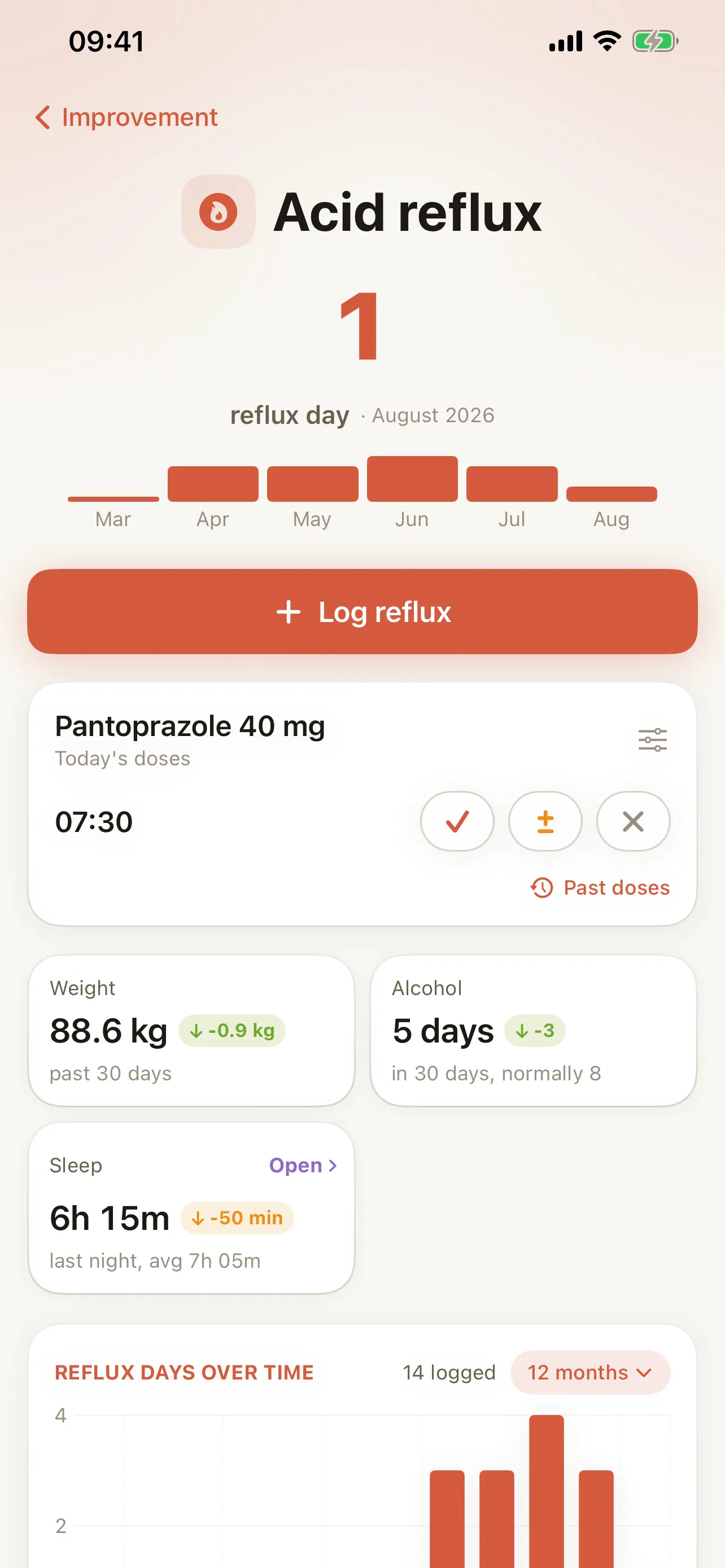
Sam app screen for people living with Reflux (GERD)

Stomach acid and reflux episodes are outside what a smartwatch can record. Sam keeps the rest.

Doctor report (PDF)

Your reflux diary as a doctor report

Sam puts your reflux diary together as a PDF for your GP or gastroenterologist. You choose the period the visit should cover: 1, 3, 6 or 12 months, or the whole record.

  • Reflux days and episodes in the period, plus the nights reflux woke you.
  • Which symptoms you reported, on how many days you took acid medication and whether it helped.
  • Your own tags for food, drink, timing and position, counted and without attributing a cause.
  • Your medication plan and the history of your monthly GERD-HRQL questionnaire.

Doctor report: reflux

Sample view

Report covers

1 month3 months6 months12 monthsWhole record

At a glance

12

Reflux days in the period

3

Nights reflux woke you

8

Days with acid medication

Reflux days per month

The current month is not included.

Reflux days, last 30 days

Day with an entry

Reflux, patterns and medication

Symptoms you reported
heartburn (14), regurgitation (4)
Self-tagged food and drink
coffee (6), alcohol (3)
Self-tagged timing and position
after a meal (7), lying down (5)

Diary

  • 10 May, 23:40

    Heartburn - woke me at night - lying down - acid medication, helped

  • 06 May, 13:15

    Regurgitation - after a meal - coffee

Self-tracked data, not a diagnosis.

Example values, not real data. Your report is based on your own entries.

Ask about your numbers. Take the report along.

Sam shows your values next to your entries. What they mean is something to talk through with your doctor.

Ask Sam about your data

You ask a question, Sam answers with your own numbers. For example:

Have my heartburn episodes gotten worse when my sleep quality drops?
Your sleep this week averaged 6 hours 20 minutes, 40 minutes below your three-month average. On the nights you logged worse heartburn, your resting heart rate was slightly higher.
Could my alcohol intake be part of this?

Your monthly report as a PDF

The monthly report sums up your weeks - for appointments, applications, or simply your own record.

Monthly Report - June

Your Health Overview

Sleep

07:05Average
23:15Bedtime
64Score

Activity

6.8kSteps/day
16Days on target
+5%vs. last month
Created by Sam HealthPDF

Example values. Your report is based on your own data.

Articles about Reflux (GERD)

Further reading: what wearable data can show about everyday life with Reflux (GERD) - and where its limits are.

2 min read

Heartburn or Gastritis? Key Differences

Heartburn and gastritis often feel similar but come from different causes. Learn the symptom differences and which specialist can tell them apart.

Frequently Asked Questions

What exactly is GERD, and how is it different from normal heartburn?+

GERD (gastroesophageal reflux disease) is a condition in which stomach acid regularly flows back into the esophagus, causing troublesome symptoms like heartburn or regurgitation. Most people experience occasional reflux, but GERD involves frequent or disruptive episodes. Only a gastroenterologist can diagnose GERD through clinical assessment or testing (such as pH monitoring or endoscopy); Sam cannot perform that diagnosis.

What are the most common reflux triggers?+

Common triggers include eating large or fatty meals, eating close to bedtime, lying down shortly after eating, obesity, alcohol, caffeine, smoking, and certain medications. Triggers differ from person to person. In Sam you can tag foods and circumstances on each logged episode and see your own counts, next to your sleep and alcohol days.

Can I manage reflux without medication?+

Guidelines list lifestyle changes as a first step: elevating the head of the bed, avoiding meals 2-3 hours before lying down, avoiding personal trigger foods, weight management if relevant, and reducing alcohol and caffeine. Whether medication is needed depends on your individual case and should be discussed with a gastroenterologist or your primary care doctor.

Can GERD cause serious complications?+

GERD rarely causes serious complications in most people. Untreated cases can occasionally progress to erosion of the esophageal lining, strictures, or Barrett's esophagus, especially in severe cases or when other factors are present. Talk to a gastroenterologist if symptoms persist, worsen, or significantly disrupt your life. Your doctor can rule out complications and plan appropriate long-term management.

Does Sam measure stomach acid or predict when I'll have heartburn?+

No. No consumer wearable, including those paired with Sam, can measure stomach acid levels or pH. Sam cannot automatically detect or predict heartburn episodes; these depend on your own awareness and logging. What Sam does do is show your sleep, alcohol days and weight alongside your logged episodes, so you and your doctor can look at them together.

Should I keep a food diary for reflux?+

A diary linking foods and meal times to heartburn episodes is a standard tool clinicians use to identify your personal triggers. In Sam's reflux episode log you record each episode with food tags, circumstance tags and whether it happened at night. After 5 or more logged episodes Sam shows how often each tag occurs, not a verdict on any food.

Can I keep a reflux diary in Sam?+

Yes. You log each episode yourself - symptom, severity, what you ate, the circumstances and whether it happened at night. Sam shows sleep quality, alcohol days and weight beside it, which is the context your clinician would otherwise have to ask you to recall.

Understand what your body is telling you.

Download Sam for free, connect Apple Health, and see what your data says about everyday life with Reflux (GERD) - compared to your own baseline.

Free for iPhoneBuilt in Europe
Sam dashboard with wellbeing score, heart rate and sleep

Sam is a wellness companion, not a medical device. Sam does not diagnose, treat, cure, or prevent any illness and does not replace medical advice. For health questions or concerns, always consult a qualified medical professional.