Can Sam predict when I'll have a migraine?+
No. No wearable can reliably predict a migraine attack before it starts. Sam shows trends in sleep, stress, and activity that you might correlate with your own experience, but these are observations over weeks and months, not predictions of individual attacks.
What's the connection between sleep and migraine?+
In people with migraine, irregular sleep and meal times can raise the likelihood of an attack, according to IQWiG. What sets off attacks differs from person to person. Sam shows your sleep duration and sleep quality over time, and you can compare them with your own attack entries. What to change, if anything, is a question for your neurologist.
Should I stop keeping a migraine diary if I'm using Sam?+
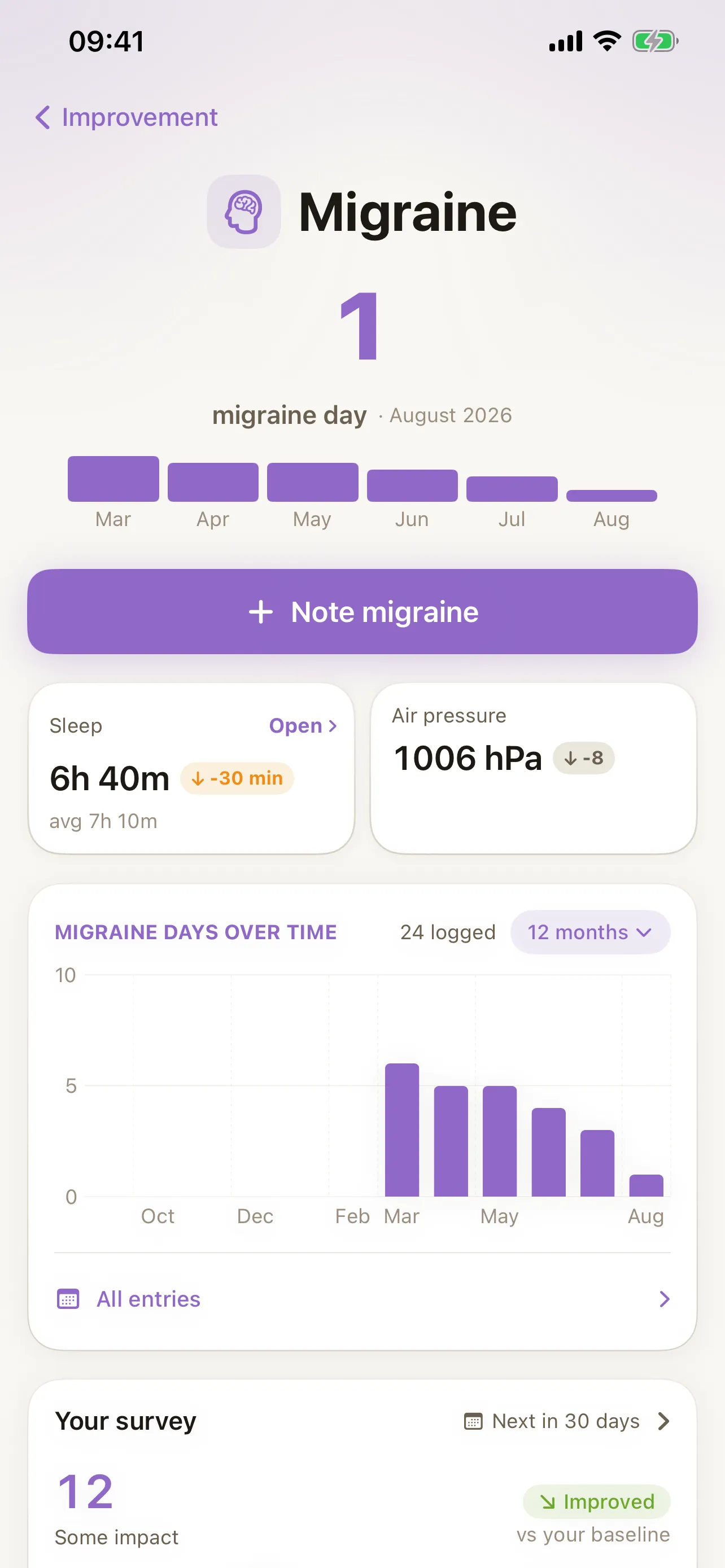
No, you do not need a second diary. Sam's attack diary covers onset time, intensity, duration, symptoms and aura, and you can add a note. For new entries logged today, your sleep from last night and your HRV are added, and barometric pressure too if you share your location. If your practice asks for its own form, use that one.
Can my Apple Watch detect a migraine attack?+
No. While an Apple Watch can detect some physiological changes (like irregular heart rate), it cannot reliably identify a migraine attack. Only you, the person experiencing it, can report that you're having a migraine.
What should I do if I notice my migraines follow a pattern in the data?+
Write down what you observe and share it with your neurologist at your next appointment. For example, 'I notice more migraines after high-stress weeks' is a useful thing to tell your doctor. Your doctor can help you explore whether that pattern is meaningful for your care.
Can better sleep actually reduce my migraines?+
That differs from person to person, and Sam cannot tell you. According to IQWiG, irregular sleep and meal times can raise the likelihood of an attack in people with migraine. Whether changing your sleep makes sense for you is a question for your neurologist. In Sam you can log your attacks and see your sleep next to them.
Does Sam replace a headache diary?+
Sam's attack diary records the basics a headache diary asks for: onset time, intensity, duration, symptoms, aura and a note. The difference is that for new entries logged today, your sleep from last night and your HRV are filled in automatically, plus barometric pressure if you share your location. On paper you would add all of that by hand.
Do I need a diagnosis to use the migraine program?+
Yes. At the start you confirm that a doctor has diagnosed your migraine. If you only have headaches so far, you can log them in the Symptoms area of Sam, rated by severity, and show the entries at your first appointment. Working out what is behind them is for your doctor, not Sam.
What is in the migraine report for my doctor visit?+
You choose the period: 1, 3, 6 or 12 months, or everything. The doctor report counts your logged migraine days, in total and per month, and shows how long attacks lasted. It adds MIDAS over time and your latest entries with sleep, HRV and, if captured, pressure. Days without an entry count as unconfirmed.
What is the MIDAS score, and how often does Sam ask for it?+
MIDAS asks how many days in the last three months migraine limited you at work, at home and in your social life. The days are added up and fall into a grade from I to IV. Sam asks for it once a month and shows the trend in the doctor report. The score is not a diagnosis.
How many migraine days a month count as chronic migraine?+
ICHD-3, the international headache classification, describes chronic migraine as headache on 15 or more days a month for over three months, with migraine features on at least 8 of them. Your care team decides whether that applies to you. ICHD-3 notes that frequent headache generally needs a diary of at least one month. Sam counts the migraine days you log.
Can I follow migraine and a second condition in Sam together?+
Migraine, blood pressure, epilepsy, panic disorder, asthma, hay fever, acid reflux and gout are separate programs, each with its own log, monthly questionnaire and doctor report. There is no combined report. How two programs run side by side is described for migraine and epilepsy and for migraine and panic disorder.
Are clock changes and migraine linked?+
A small observational study of 23 adults with episodic migraine found more migraine after the spring switch to daylight saving time. It cannot show a cause. Clocks change on 25 October 2026 and 28 March 2027 in the EU and UK, and on 1 November 2026 and 14 March 2027 in the US. Your attack diary shows your own weeks around the date.