Free Tool
Blood Pressure Category Calculator
This calculator classifies a blood pressure reading taken in a doctor's office against the ESC 2024 categories: non-elevated (under 120/70 mmHg), elevated (120-139/70-89 mmHg) or hypertension (140/90 mmHg or higher). It also shows the Grade 1 to 3 bands of the ESH 2023 guideline.
See it in Sam
Your readings, all in one place
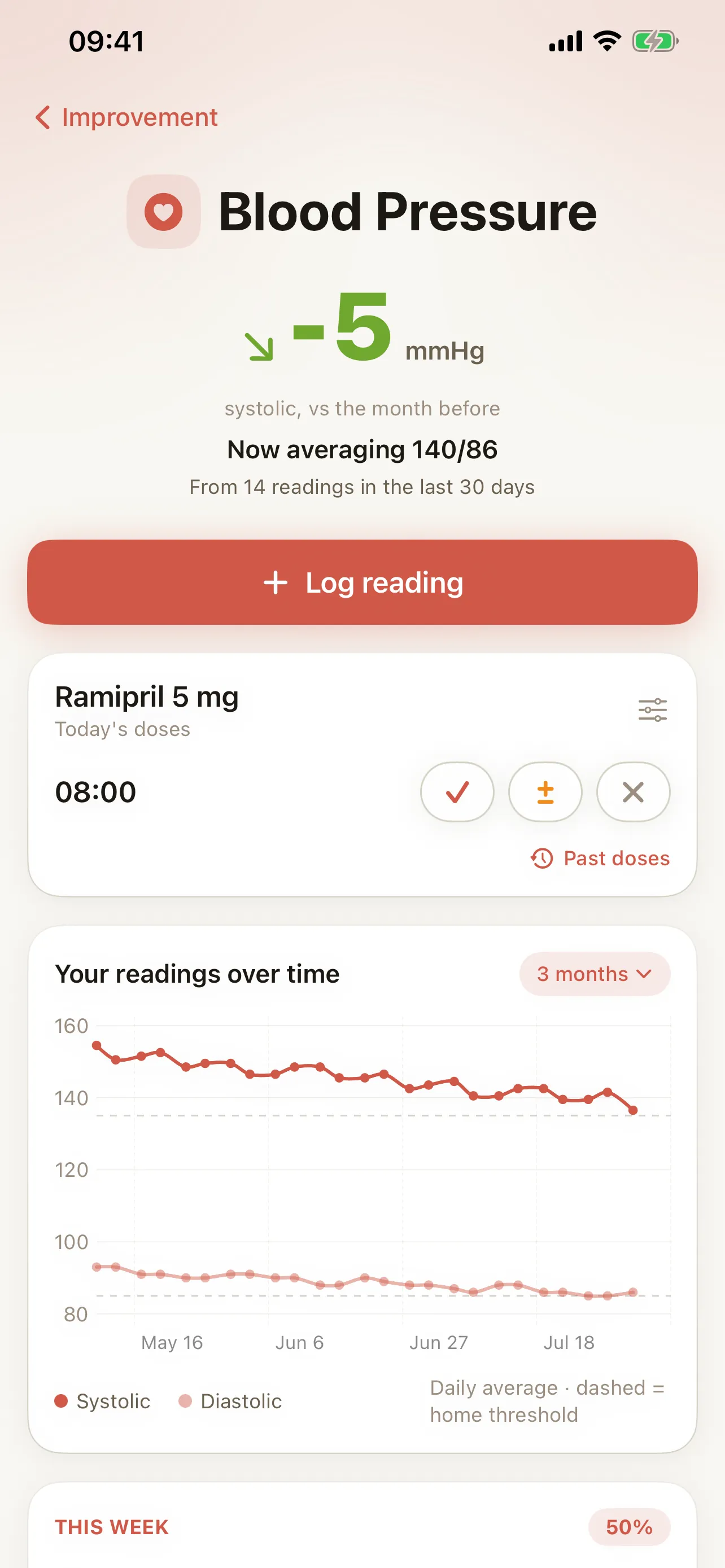
Sam does not measure blood pressure - that is still your cuff. In the High Blood Pressure program you enter your readings or import them from Apple Health. Sam keeps them as a trend and prepares them for your doctor's visit.
Home and practice readings side by side
- A PDF for your appointment: The monthly report turns your readings into a PDF you bring and talk about over weeks, not one value.
- Apple Health trends next to your readings: Sleep, resting heart rate, steps and weight sit in the trend beside your values compared with your own average.
- Share via Care Circle: You decide what you share with whom - read-only, per person, revocable at any time.
Plus an optional monthly MEDAS-14 diet check-in when you want to fill it in.
The ESC 2024 categories
Applies to office readings. Both numbers are checked; the higher one decides the category.
| Category | Systolic (mmHg) | Diastolic (mmHg) |
|---|---|---|
| Non-elevated | < 120 | < 70 |
| Elevated blood pressure | 120-139 | 70-89 |
| Hypertension | ≥ 140 | ≥ 90 |
The ESH 2023 grades
The 2023 ESH guideline divides readings further into grades. The ranges are the same as in the 2018 ESC/ESH guideline.
| Category | Systolic (mmHg) | Diastolic (mmHg) |
|---|---|---|
| Optimal | < 120 | < 80 |
| Normal | 120-129 | 80-84 |
| High-normal | 130-139 | 85-89 |
| Grade 1 Hypertension | 140-159 | 90-99 |
| Grade 2 Hypertension | 160-179 | 100-109 |
| Grade 3 Hypertension | ≥ 180 | ≥ 110 |
| Isolated Systolic Hypertension | ≥ 140 | < 90 |
The American Heart Association / American College of Cardiology use different category names and thresholds (categories from 2017, kept in the 2025 guideline). Shown here for reference only - this page's primary classification is the 2024 ESC guideline.
| Category | Systolic (mmHg) | Diastolic (mmHg) |
|---|---|---|
| Normal | < 120 | < 80 |
| Elevated | 120-129 | < 80 |
| Stage 1 Hypertension | 130-139 | 80-89 |
| Stage 2 Hypertension | ≥ 140 | ≥ 90 |
AHA/ACC also define a Hypertensive Crisis category: higher than 180 and/or higher than 120 mmHg.
Sources
- McEvoy JW, et al. 2024 ESC Guidelines for the management of elevated blood pressure and hypertension. European Heart Journal, 45(38), 3912-4018.
- Mancia G, et al. 2023 ESH Guidelines for the management of arterial hypertension. Journal of Hypertension, 41(12), 1874-2071.
- Germany's national guideline for high blood pressure (Nationale VersorgungsLeitlinie Hypertonie), published by the German Medical Association, the National Association of Statutory Health Insurance Physicians and the AWMF, Version 1.0, 2023 (in German).
- American Heart Association. When To Call 911 About High Blood Pressure.
Frequently asked questions
Is this a diagnosis?+
No. This tool only looks up which category your entered numbers fall into - the same tables doctors use. A hypertension diagnosis requires repeated readings over time, home or ambulatory monitoring, or a doctor's assessment, not a single number.
Which blood pressure classification does this calculator use?+
The main categories are those of the 2024 ESC guideline (European Society of Cardiology): non-elevated, elevated and hypertension. The calculator also shows the Grade 1 to 3 bands of the 2023 ESH guideline, which Germany's national guideline for high blood pressure uses as well. In all three, hypertension starts at 140/90 mmHg in the office. The US-based AHA/ACC categories differ in names and thresholds and are shown separately below, for reference only.
Do readings at home use different numbers?+
Yes. For readings at home the European guidelines name 135/85 mmHg as the threshold, and 130/80 mmHg as the average for 24-hour ambulatory monitoring. In the office the threshold is 140/90 mmHg. This calculator is meant for office readings; which numbers apply to you is for your doctor to say.
What does 'isolated systolic hypertension' mean?+
Only the systolic (top) number is elevated - 140 mmHg or higher - while the diastolic (bottom) number stays below 90 mmHg. It becomes more common with age as arteries stiffen.
What should I do if my reading is above 180/110 mmHg?+
A top number above 180 or a bottom number above 110 mmHg is very high. Talk to your doctor about this reading soon. If in doubt: your doctor or the local emergency number (112 in the EU).
Does Sam measure blood pressure?+
No. Sam doesn't measure blood pressure - a cuff does, at home or in a doctor's office. This calculator only classifies a reading you enter yourself; Sam's own app shows resting heart rate, activity, and sleep trends as additional context.
Living with high blood pressure
Sam doesn't measure blood pressure - a cuff does, at home or in a doctor's office. Sam's High Blood Pressure program shows resting heart rate, activity, and sleep trends alongside your own readings, as a starting point for your next doctor conversation.
See the High Blood Pressure program