Sleep science

Sleep Cycle Calculator

Every sleep cycle averages 90 minutes - enter when you want to wake up or go to bed to see four bedtime or wake-time options timed to the end of a full cycle, not a flat 8-hour countdown.

Enter a time

Pick whichever you know: when you want to wake up, or when you're going to bed.

Your options

Enter a time above and submit to see your options.

This calculator adds a 15-minute estimate for the time it takes to fall asleep, then counts backward or forward in full 90-minute sleep cycles - the average length researchers report for one complete pass through the sleep stages. For a 07:00 wake-up, going to bed at 23:15 covers five full cycles (7h 30min of sleep) before the 15-minute latency; going to bed at 21:45 covers six. All four cycle counts are shown side by side rather than singling one out as best - see Sources below for the two cited numbers behind the math.

In the Sam app

Make it a nightly habit

This calculator gives you tonight's numbers. Sam's Sleep Program turns them into an ongoing habit: a nightly self-check, your own sleep-quality goal, and a 90-day progress view.

Uses MOS Sleep Scale self-assessment

Sleep Program

Set a personal sleep quality goal and track your nightly progress.

  • Short sleep self-check to understand where you are starting
  • Set your own sleep quality goal that works for you
  • Nightly streak tracking and 90-day progress calendar
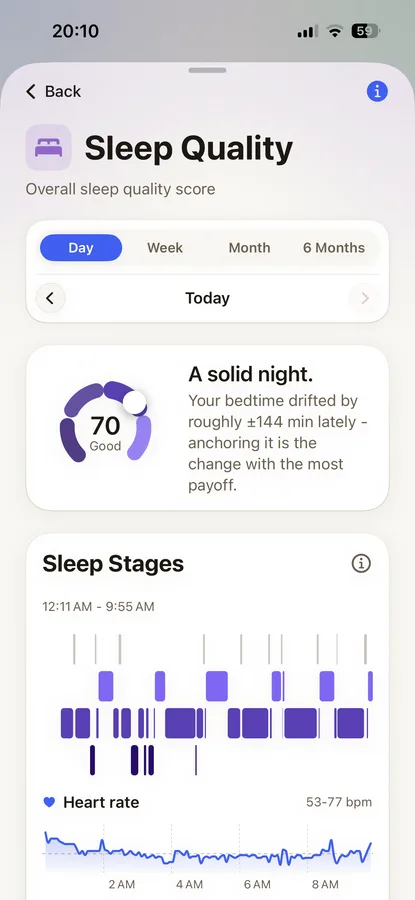
Sam app sleep quality deep-dive screen showing trends and recovery insights

Where these numbers come from

Average sleep cycle length (90 minutes)

The body cycles through all sleep stages roughly 4 to 6 times each night, averaging about 90 minutes per cycle. This calculator uses that 90-minute average to count backward or forward from your target time in whole-cycle steps.

Source: Patel et al., StatPearls / NCBI Bookshelf (NBK526132), "Physiology, Sleep Stages"

https://www.ncbi.nlm.nih.gov/books/NBK526132/

Time to fall asleep (15 minutes)

An 18-member National Sleep Foundation consensus panel rated a sleep-onset latency (time to fall asleep) of 0-15 minutes as a good sleep-quality indicator across all age groups, including young adults and adults. This calculator uses 15 minutes - the upper, more conservative edge of that 'good' range - as its fixed onset-latency estimate.

Source: Ohayon et al. (2017), Sleep Health, National Sleep Foundation Sleep Quality Recommendations

https://doi.org/10.1016/j.sleh.2016.11.006

Curious how melatonin timing shifts your sleep window? Try the Melatonin Half-Life Calculator

Frequently asked questions

Why is a sleep cycle 90 minutes?+

Over a night, sleep moves through a repeating pattern of light sleep, deep sleep, and REM sleep, and one full pass through that pattern - a sleep cycle - averages about 90 minutes, repeating roughly 4 to 6 times a night. This calculator uses that average to count backward or forward from your target time in whole-cycle steps.

How long does it typically take to fall asleep?+

Most people don't fall asleep the instant they get into bed. An 18-member National Sleep Foundation consensus panel rated a sleep-onset latency of 0-15 minutes as good sleep quality across age groups, so this calculator adds a fixed 15-minute estimate for that gap before counting cycles - meaning the count starts from roughly when you're actually asleep, not from when you lie down.

Is it bad to wake up in the middle of a sleep cycle?+

That's the popular theory behind cycle-based alarm timing: waking during light sleep is supposed to feel easier than waking during deep sleep. It's a reasonable idea, but the evidence that timing an alarm this way meaningfully reduces grogginess is mixed and far from settled - sleep-cycle length and timing also vary night to night and person to person, so a 90-minute average won't line up perfectly for everyone. Treat these results as options to try, not a guarantee.

Does a sleep cycle calculator save or share my data?+

No. The time you enter stays in your browser for this session only - there's no account, no server storage, and nothing is sent anywhere when you close the tab.

What's the difference between this calculator and tracking my real sleep?+

This calculator is a one-off calculation based on published averages, not a measurement of how you actually slept. If you want to track your real sleep quality over time, Sam's Sleep Program does that with a nightly self-assessment and a 90-day progress view.

Want to track your actual sleep quality?

This calculator gives you one-off bedtime and wake-time options. Sam's Sleep Program tracks your real sleep quality night after night, with a personal goal and a 90-day progress view.

This tool estimates bedtime and wake-time options using published averages for sleep-cycle length and typical time to fall asleep. It does not measure your actual sleep and cannot predict how you personally will feel at any of these times. If you have ongoing sleep problems, talk to a qualified healthcare professional.