Chronotype test
Answer 5 short questions to get your rMEQ score - the reduced Morningness-Eveningness Questionnaire researchers use to classify people as morning types, evening types, or neither. Takes about 2 minutes.
Answer based on how you've generally felt in recent weeks, not just today - that's the rMEQ's own framing for an accurate result.
Your next step
Sam's Sleep program
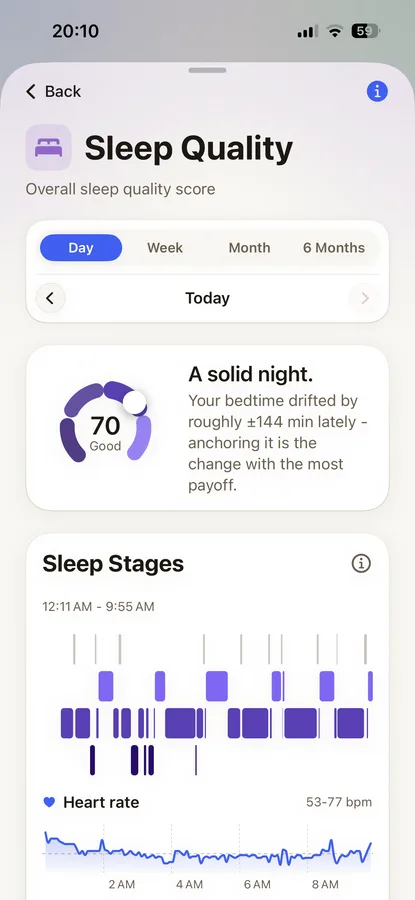
Your rMEQ score is a one-time snapshot. Sam's Sleep program builds on it with an ongoing self-check, a personal quality goal, and nightly tracking.
Sleep Program
Set a personal sleep quality goal and track your nightly progress.
- Short sleep self-check to understand where you are starting
- Set your own sleep quality goal that works for you
- Nightly streak tracking and 90-day progress calendar
How to find your chronotype with the rMEQ
- 1
Answer the 5 questions
Pick the option that best matches your general habits in recent weeks for each of the 5 questions - not just today.
- 2
Add up the points
Each answer carries its own point value. Add all 5 together for a total score between 4 and 25.
- 3
Read your type
The total sorts into one of three types: evening (4-11), neither (12-17), or morning (18-25).
About the rMEQ score
The rMEQ (reduced Morningness-Eveningness Questionnaire) is a validated 5-question short form of the original 19-item Horne-Ostberg MEQ, developed by Adan and Almirall in 1991. It asks about your preferred wake time, how you feel right after waking, your preferred bedtime, when you feel your best, and how you'd describe your own type. Each answer carries a point value, and the 5 answers sum to a score between 4 and 25. Scores of 4-11 fall in the evening-type range, 12-17 in the neither-type range, and 18-25 in the morning-type range. It takes about 2 minutes and reflects your own reported preferences, not a clinical diagnosis.
Frequently Asked Questions
Is the rMEQ chronotype test a medical diagnosis?+
No. The rMEQ is a self-report questionnaire that classifies your own timing preferences against a published scale - it's not a diagnosis and not medical advice from Sam. Only a doctor can diagnose a sleep or circadian rhythm disorder.
Can your chronotype change over time?+
Yes, to some degree - a large survey study found chronotype shifts later through adolescence, peaks around age 20, then shifts earlier again with age, independent of any app (Roenneberg et al., 2004, Current Biology, 14(24), R1038-R1039). Everyday habits like light exposure and sleep schedule can nudge it too, but Sam doesn't change your chronotype for you.
Is a chronotype test the same as a sleep disorder screening?+
No - the rMEQ measures your timing preference, not whether you have a sleep disorder. It doesn't screen for insomnia, sleep apnea, or other conditions. If sleep is a persistent problem, Sam's Sleep program or a doctor's visit will get you further than a timing questionnaire.
Sam is a wellness companion, not a medical device. Sam does not diagnose, treat, cure, or prevent any illness and does not replace medical advice. For health questions or concerns, always consult a qualified medical professional.