Circadian Science

Jet Lag Planner

Enter your home and destination time zones, arrival date, and usual sleep schedule to get a day-by-day plan for when to seek and avoid bright light, and when to sleep, based on the published circadian-science protocol for shifting your body clock.

Plan your trip

Whole-hour time zones only in this version - see the scope note below for zones on the half-hour.

Your day-by-day plan

Each day's suggested sleep schedule and light-exposure windows, shifting a little further every day until you're fully adjusted.

Fill in the form above to see your day-by-day plan.

In the Sam App

Keep your new rhythm steady

Once you've landed and adjusted, Sam's Sleep Program uses your Apple Watch data to help you keep that new rhythm steady.

Uses MOS Sleep Scale self-assessment

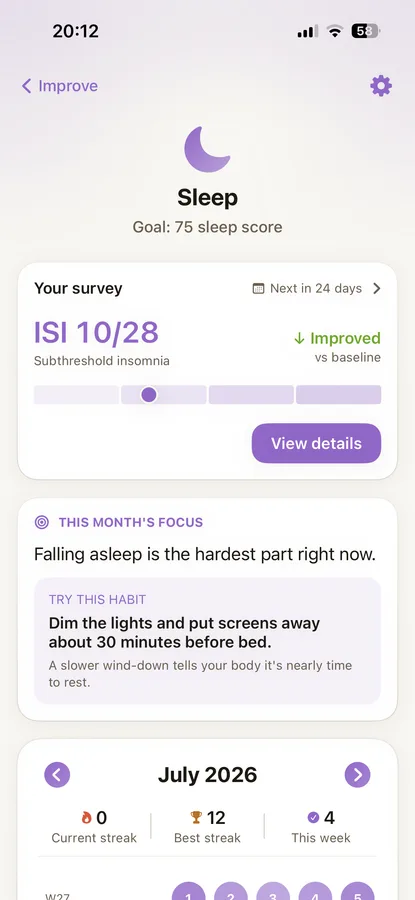
Sleep Program

Set a personal sleep quality goal and track your nightly progress.

  • Short sleep self-check to understand where you are starting
  • Set your own sleep quality goal that works for you
  • Nightly streak tracking and 90-day progress calendar
Sam sleep program screen with MOS Sleep Scale self-assessment and nightly streak

What this planner doesn't cover

Two simplifications worth knowing about. First, time zones here are rounded to the nearest whole hour, so 30- or 45-minute offsets (India, Nepal, parts of Australia) aren't modeled precisely in this version. Second, your CBTmin is estimated from your wake time only, not a full chronotype assessment - the slider above lets you nudge it within the cited range if you know your own tendency.

This planner covers light exposure and sleep-schedule timing only, not medication. For how long a melatonin dose stays in your system, see the melatonin half-life calculator.

For general strategies to reset a disrupted sleep schedule, not just around travel, see the guide to resetting your sleep schedule with wearable data.

Talk to your doctor first if this applies to you

Bright light is a strong circadian signal, and timing it around CBTmin can interact with conditions that are sensitive to light or to disrupted sleep. Talk to your doctor before following a light-timing plan like this one if you have bipolar disorder, a retinal or other eye condition, or take a photosensitizing medication.

The Eastman & Burgess (2009) circadian-shift protocol adjusts your body clock by about 1 hour a day when advancing eastward and 1.5 hours a day when delaying westward. This planner applies that rate, plus CBTmin-based light timing, to turn your home and destination time zones, arrival date, and usual sleep schedule into a day-by-day light-exposure and bedtime plan. It does not take a return date, so the plan does not change based on trip length. The up-to-2-day pre-departure start is a practical cap this tool applies, not a figure from the cited protocol itself.

Where this plan comes from

The day-by-day shift protocol

This plan's daily shift rate (about 1 hour/day advancing eastward, about 1.5 hours/day delaying westward), the CBTmin-before-wake estimate, and the 3-hour light-seeking and light-avoiding windows all come from this protocol paper.

Source: Eastman CI, Burgess HJ (2009), Sleep Medicine Clinics, "How To Travel the World Without Jet Lag"

https://doi.org/10.1016/j.jsmc.2009.02.006

Clinical review corroborating the protocol

A widely cited clinical review of jet lag that corroborates the same adjustment approach, including the asymmetry between eastward and westward adaptation speed and the guidance to skip adjustment entirely on very short trips.

Source: Sack RL (2010), New England Journal of Medicine, "Clinical practice. Jet lag."

https://doi.org/10.1056/NEJMcp0909838

The human phase-response curve to light

The underlying mechanism this planner applies: bright light seen after your CBTmin shifts (advances) your clock earlier, while light seen before CBTmin shifts (delays) it later.

Source: Khalsa SBS, Jewett ME, Cajochen C, Czeisler CA (2003), Journal of Physiology, "A Phase Response Curve to Single Bright Light Pulses in Human Subjects"

https://doi.org/10.1113/jphysiol.2003.040477

Safety considerations for bright light exposure

Backs the caution above: bright light exposure is generally well tolerated but has documented interactions with bipolar disorder, certain eye conditions, and photosensitizing medications.

Source: Terman M, Terman JS (2005), CNS Spectrums, "Light therapy for seasonal and nonseasonal depression: efficacy, protocol, safety, and side effects"

https://doi.org/10.1017/s1092852900019611

Frequently asked questions

Why does light timing matter for jet lag?+

Bright light is the strongest cue your circadian clock uses to set its schedule. Seen at the right time relative to your body's temperature minimum (CBTmin), it can shift your clock earlier or later by roughly an hour a day; seen at the wrong time, it can push the shift in the opposite direction. This planner times your light exposure so it works with the shift you need instead of against it.

How many days before a flight should I start adjusting for jet lag?+

For shifts that need more than a single day to adjust, start 1 to 2 days before you depart - this planner caps the pre-departure start at 2 days even for the largest shifts. That 2-day cap is a practical rule this planner applies, not a figure drawn from the cited protocol. For a 1-day shift, the plan starts on your day of arrival instead.

Do I need a jet lag adjustment plan for a short trip?+

Not necessarily. This planner doesn't ask for a return date, so it always builds a full adjustment plan regardless of trip length. For genuinely brief trips, most circadian researchers - including Eastman and Burgess, cited below - advise skipping adjustment altogether and staying on your home schedule instead, since you'd barely finish adapting before flying home. That call is yours to make; this planner's day-by-day plan doesn't factor trip length in.

How much melatonin should I take for jet lag?+

This planner doesn't cover that - it's for light exposure and sleep-schedule timing only. If you're using melatonin, see the melatonin half-life calculator to understand how long a dose stays active in your system, and talk to a doctor or pharmacist about dosing and timing.

What if my jet lag time difference is more than 9-10 hours?+

Past roughly 9-10 hours of time difference, delaying your clock the long way around actually adapts faster than advancing directly, because the body delays faster (about 1.5h/day) than it advances (about 1h/day). This planner detects that automatically and switches direction for you - you'll see a note on your plan when it applies.

Keep your sleep schedule on track after you land

Sam's sleep program helps you build and stick to a consistent sleep-wake routine using your Apple Watch data - useful well beyond the days you're actively adjusting to a new time zone.

This tool is for general information only and does not provide medical advice. The plan is a population-average estimate based on published circadian research, not a measurement of your own body clock, and it does not diagnose, treat, or prevent jet lag. If you have questions about bright light exposure and your health, talk to a qualified healthcare professional.