Pharmacokinetics

Nicotine Half-Life Calculator

Log your cigarettes, vaping sessions, pouches or gum and see an estimated decay curve for the next 8 hours, based on the exponential half-life model researchers use to describe how the body clears nicotine.

Log your nicotine use

Add each cigarette, vape session, pouch or piece of gum with when you had it. Milligram values auto-fill from typical absorbed-dose estimates and are editable.

Logged nicotine use

Nothing logged yet.

Estimated level over the next 8 hours

Estimated nicotine in your system right now

0 mg

Log a cigarette, vape session, pouch or gum above to see your decay curve.

Adjust the half-life

Nicotine's half-life is commonly cited as about 2 hours on average, with directly-measured plasma studies putting the range at about 2 to 3 hours. Move the slider to see how a faster or slower clearance rate changes the curve.

Half-life: 2.0 hours

About the model: this uses first-order exponential decay (amount = dose x 0.5^(time / half-life)), applied to each dose you log. It assumes each dose is absorbed instantly, so it doesn't model the short delay before nicotine reaches peak blood level, and it uses the plasma-based half-life rather than the much longer figure derived from urinary excretion (see Sources below).

Nicotine and sleep

Nicotine withdrawal disrupts sleep - track how it's affecting yours

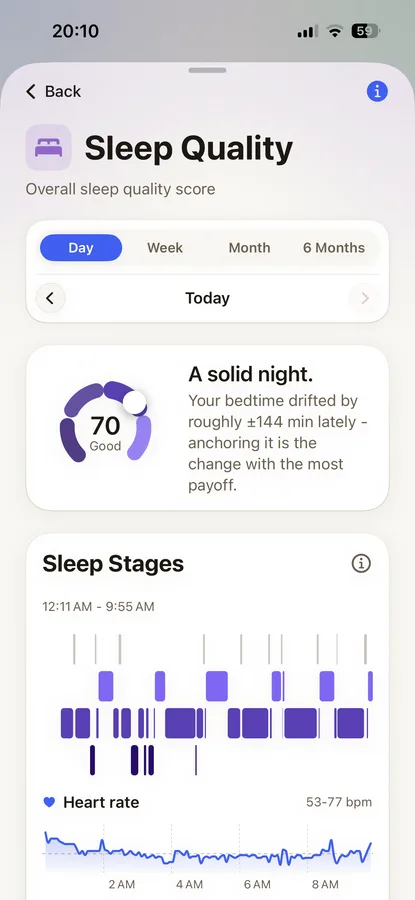
Nicotine's half-life means levels keep falling for hours after your last dose, and insomnia is one of the most commonly reported withdrawal symptoms - more trouble falling asleep, more waking overnight. Sam's Sleep program pairs a validated sleep self-check with nightly tracking, so you can see how your own nights are actually going.

Uses MOS Sleep Scale self-assessment

Sleep Program

Set a personal sleep quality goal and track your nightly progress.

  • Short sleep self-check to understand where you are starting
  • Set your own sleep quality goal that works for you
  • Nightly streak tracking and 90-day progress calendar
Sam sleep program screen with MOS Sleep Scale self-assessment and nightly streak

This tool estimates how much nicotine is still in your body over the next 8 hours, using the exponential half-life model: remaining amount equals dose times 0.5 to the power of (hours elapsed divided by half-life). The default half-life is 2 hours, the most commonly cited average for a healthy adult, and you can adjust it from 2 to 3 hours to reflect the range reported when half-life is measured directly from blood plasma.

Where these numbers come from

Average half-life (~2 hours)

The elimination half-life of nicotine in a healthy adult averages about 2 hours, whether measured after intravenous infusion or after smoking a cigarette.

Source: StatPearls / NCBI Bookshelf (NBK499915), "Nicotine Addiction"

https://www.ncbi.nlm.nih.gov/books/NBK499915/

Range (2-3 hours)

Nicotine's half-life is commonly cited as about 2 to 3 hours when measured from blood plasma levels - the slider above uses this directly-measured range. Measured a different way, from how long nicotine's byproducts take to leave the urine, the figure comes out much higher, around 11 hours - a reminder that "half-life" depends on what's actually being measured.

Source: NCBI Bookshelf (NBK222359), "Nicotine Pharmacology: Clearing the Smoke"

https://www.ncbi.nlm.nih.gov/books/NBK222359/

Cigarette (~1 mg absorbed)

Smokers absorb roughly 1 mg of nicotine per cigarette on average, though the real figure ranges from about 0.3 to 2 mg depending on how the cigarette is smoked.

Source: NCBI Bookshelf (NBK507191), "Public Health Consequences of E-Cigarettes"

https://www.ncbi.nlm.nih.gov/books/NBK507191/

Vape / e-cigarette session (~0.55 mg absorbed)

A short, standardized 10-puff vaping session was measured to deliver about 0.55 mg of absorbed nicotine on average (range 0.16-0.82 mg) in a study using a pod-style device - actual delivery varies a lot by device, liquid strength, and puffing style, and a longer real-world session delivers considerably more.

Source: "Nicotine Dosimetry in Evaluating Electronic Cigarettes" (PMC12015950)

https://pmc.ncbi.nlm.nih.gov/articles/PMC12015950/

Nicotine pouch (~1.5 mg absorbed)

A 3 mg-labeled nicotine pouch (ZYN) was measured to release about 1.5 mg of absorbed nicotine (around 56% of the labeled dose); a 6 mg pouch released about 3.5 mg. Extraction varies by brand and strength.

Source: Lunell et al. 2020, Nicotine & Tobacco Research (PMID 32319528)

https://pubmed.ncbi.nlm.nih.gov/32319528/

Pregnancy speeds clearance

Pregnancy increases nicotine clearance by about 60% (and cotinine clearance by about 140%), through increased activity of the CYP2A6 liver enzyme - so the same dose clears faster during pregnancy than postpartum.

Source: NCBI Bookshelf (NBK507191); Benowitz, "Nicotine Chemistry, Metabolism, Kinetics and Biomarkers" (PMC2953858)

https://pmc.ncbi.nlm.nih.gov/articles/PMC2953858/

CYP2A6 genetic variation

Nicotine is broken down mainly by the CYP2A6 liver enzyme, and genetic variation in that enzyme changes clearance a lot between people. In one pharmacokinetic study, people with the slowest-metabolizing CYP2A6 genotypes cleared nicotine at about 62% of the rate of normal metabolizers (11.7 vs. 18.8 mL/min/kg), extending its effective half-life.

Source: Benowitz et al. 2006, Clinical Pharmacology & Therapeutics (PMID 17112802)

https://pubmed.ncbi.nlm.nih.gov/17112802/

Frequently asked questions

What does "half-life" mean for nicotine?+

Half-life is the time it takes for the amount of a substance in your bloodstream to fall by half. For nicotine, a commonly cited average is about 2 hours in a healthy adult - so roughly half of what your body absorbed is gone 2 hours later, a quarter after 4 hours, and so on.

Why is the adjustable range only 2 to 3 hours?+

That's the range reported when nicotine's half-life is measured directly from blood plasma levels, which is what this tool's decay model is based on. Measured a different way - from how long nicotine's breakdown products stay in urine - the figure comes out much higher, around 11 hours, because that method captures slower downstream elimination rather than how fast nicotine itself leaves the blood. Real individual half-life can also fall outside this window: pregnancy speeds clearance considerably, while a slow-metabolizing CYP2A6 genotype slows it down - see the half-life section above for both.

How is the curve on this page calculated?+

Each dose you log decays on its own exponential curve, amount(t) = dose x 0.5^(t / half-life), and the chart adds up every dose that's still active at each point in time. It's the same math researchers use to describe nicotine clearance, applied to whatever you typed in - not a measurement of your actual blood nicotine level.

Why isn't the nicotine patch included as a source?+

Patches are built to deliver nicotine steadily over 16 to 24 hours - roughly 15 to 22 mg in total - rather than in one dose the way a cigarette, vape session, pouch, or piece of gum does. This page's model treats every entry as a single instant dose that then decays, which doesn't represent a patch's continuous release accurately, so we left it out rather than show a misleading curve.

Does this tool tell me when to use, or how to quit, nicotine products?+

No. This page is a general information tool about how the body clears nicotine over time - it does not give advice on when to smoke, vape, or use other nicotine products, and it isn't a smoking or vaping cessation program. If you're looking to cut down or quit, a healthcare professional or a dedicated cessation service is the right place to start.

Does this tool store or send my data anywhere?+

No. Everything you log stays in your browser for this session only - there's no account, no server storage, and nothing is sent anywhere when you close the tab.

This tool is for general information only and does not provide medical advice, dosing guidance, or advice about starting, changing, or stopping nicotine use. The curve is a population-average estimate, not a measurement of your own nicotine level. If you have questions about nicotine and your health, talk to a qualified healthcare professional.