Pharmacokinetics

Melatonin Half-Life Calculator

Enter your dose and when you took it to see an estimated decay curve for the next 10 hours, based on the exponential half-life model researchers use to describe how the body clears immediate-release oral melatonin.

Enter your dose

Melatonin is normally taken as a single tablet before bed, not logged across the day like caffeine. Pick a typical strength or enter your own amount, and when you took it.

This models immediate-release melatonin only

Extended-release and sustained-release tablets (sometimes labelled ER, PR, or "prolonged-release") clear far more slowly than immediate-release melatonin, but published studies don't agree by how much: one crossover trial found extended-release running about 1.7 times longer than immediate-release, another found sustained-release running about 5 times longer. With no single reliable multiplier, this calculator only models immediate-release tablets - the most commonly sold form. If you took an extended-release or prolonged-release product, this chart will not reflect how long it stays in your system.

Estimated level over the next 10 hours

Estimated melatonin in your system right now

0 mg

Enter a dose above to see your decay curve.

Adjust the half-life

1 hour sits in the middle of the 1-2 hour range StatPearls cites for immediate-release melatonin, though individual trials report figures from under an hour to just over two. Move the slider to see how a faster or slower clearance changes the curve.

Half-life: 1.00 hours

About the model: this uses first-order exponential decay (amount = dose x 0.5^(time / half-life)), applied to a single immediate-release dose. It assumes the full dose is absorbed instantly, so it doesn't model the short delay to peak blood level. It also doesn't account for melatonin's highly variable oral bioavailability - published estimates range from about 1% to 74% of a dose reaching the bloodstream - so the same mg amount can produce very different blood levels in different people.

See it in Sam

One dose is a curve. Your sleep is a pattern.

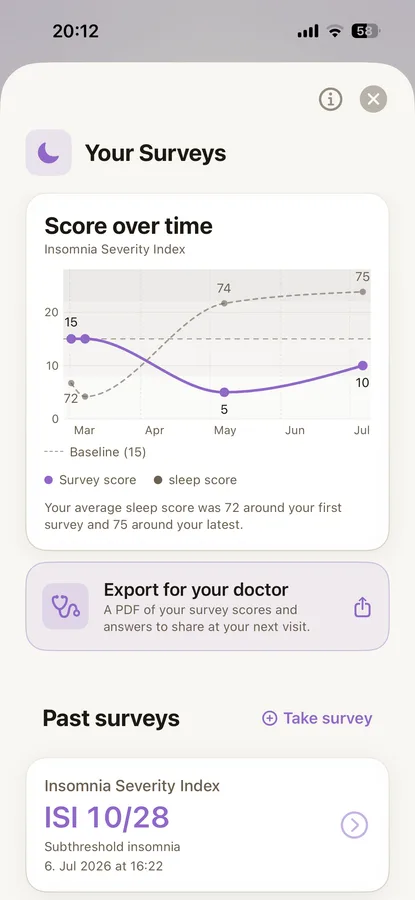
This tool models how a single dose clears from your system. Sam's Sleep program tracks how you actually sleep night after night with a short self-assessment and a 90-day progress calendar, so you can see whether your melatonin timing is actually helping.

Uses MOS Sleep Scale self-assessment

Sleep Program

Set a personal sleep quality goal and track your nightly progress.

  • Short sleep self-check to understand where you are starting
  • Set your own sleep quality goal that works for you
  • Nightly streak tracking and 90-day progress calendar
Sam sleep program screen with MOS Sleep Scale self-assessment and nightly streak

Melatonin's elimination half-life for immediate-release oral tablets is about 1 hour, with a commonly cited range of 1 to 2 hours (StatPearls). This tool applies that half-life to a single dose you enter, using the exponential decay model researchers use to describe melatonin clearance: remaining amount = dose x 0.5^(hours elapsed / half-life). It models immediate-release melatonin only - extended-release tablets clear on a different, less consistent timeline (see the note below).

Where these numbers come from

Elimination half-life (1-2 hours)

Melatonin's elimination half-life is relatively short, typically ranging from 1 to 2 hours, varying with the formulation used. Individual pharmacokinetic trials of immediate-release melatonin report figures of about 0.95 to 1.01 hours specifically.

Source: StatPearls / NCBI Bookshelf (NBK534823), "Melatonin"

https://www.ncbi.nlm.nih.gov/books/NBK534823/

Oral bioavailability (1%-74%)

Melatonin's oral bioavailability varies significantly, from about 1% to 74% of a dose, depending on formulation and dosage. This is a major reason the same mg amount doesn't translate into a predictable blood level across people.

Source: StatPearls / NCBI Bookshelf (NBK534823), "Melatonin"

https://www.ncbi.nlm.nih.gov/books/NBK534823/

Immediate- vs extended/sustained-release

Direct comparisons find extended- and sustained-release melatonin clear noticeably slower than immediate-release, but by inconsistent margins: one crossover trial found an extended-release half-life of 1.63 hours versus 0.95 hours for immediate-release (about 1.7x), while a separate trial found a sustained-release half-life of 5.10 hours versus 1.01 hours for immediate-release (about 5x). This inconsistency is why the calculator only models immediate-release melatonin.

Source: Pharmaceutics (2024), PMC11510348, "Comparative Pharmacokinetics of Sustained-Release versus Immediate-Release Melatonin Capsules"

https://www.ncbi.nlm.nih.gov/pmc/articles/PMC11510348/

Age and clearance

A pharmacokinetic study of a sustained-release melatonin dose in older adults with insomnia found a mean elimination half-life of about 2.1 hours - longer than the immediate-release figures typically reported in younger adults, consistent with slower melatonin clearance in older age.

Source: Gooneratne et al. (2012), Journal of Pineal Research, PubMed 22348451

https://pubmed.ncbi.nlm.nih.gov/22348451/

Frequently asked questions

What does "half-life" mean for melatonin?+

Half-life is the time it takes for the amount of a substance in your bloodstream to fall by half. For oral immediate-release melatonin, the commonly cited range is 1 to 2 hours - individual trials report figures as low as about 0.95 hours - so most of a dose has cleared within a few hours, much faster than substances like caffeine.

Why does melatonin's half-life vary between people?+

Melatonin is broken down mainly by the CYP1A2 liver enzyme, and how active that enzyme is differs significantly from person to person. Older adults tend to clear melatonin more slowly - one study of a sustained-release dose in older adults found a half-life of about 2.1 hours - which is why the slider lets you move toward the upper end of the range.

Does this calculator work for extended-release melatonin?+

No. This tool models immediate-release melatonin only, the most commonly sold tablet form. Extended-release and sustained-release products clear on a genuinely different timeline, and published studies disagree on the exact multiplier (roughly 1.7x to 5x slower than immediate-release), so there's no single honest way to model them here.

How is the curve on this page calculated?+

The chart applies first-order exponential decay to the single dose you enter: amount(t) = dose x 0.5^(t / half-life). It's the same math researchers use to describe melatonin clearance, applied to whatever you typed in - not a measurement of your actual blood melatonin level, and it doesn't account for the fact that oral bioavailability varies enormously (published estimates span roughly 1% to 74% of a dose).

Does this tool store or send my data anywhere?+

No. Your dose and time stay in your browser for this session only - there's no account, no server storage, and nothing is sent anywhere when you close the tab.

This tool is for general information only and does not provide medical advice. The curve is a population-average estimate for a single immediate-release dose, not a measurement of your own melatonin level, and it does not account for melatonin's highly variable oral bioavailability. If you have questions about melatonin and your health, talk to a qualified healthcare professional.