Average half-life (~5 hours)
The mean elimination half-life of caffeine in a healthy adult is about 5 hours.
Source: StatPearls / NCBI Bookshelf (NBK519490), "Caffeine"
https://www.ncbi.nlm.nih.gov/books/NBK519490/Pharmacokinetics
Caffeine has an average half-life of about 5 hours in a healthy adult - log what you drank and see an estimated 24-hour decay curve based on the exponential model researchers use to describe how your body clears it.
Add each drink with when you had it. Milligram values auto-fill from typical serving sizes and are editable.
Logged drinks
No drinks logged yet.
Estimated caffeine in your system right now
0 mg
Log a drink above to see your decay curve.
5 hours is the commonly cited average for a healthy adult, but individual half-life is reported anywhere from 1.5 to 9.5 hours. Move the slider to see how a faster or slower metabolism changes the curve.
Half-life: 5.0 hours
About the model: this uses first-order exponential decay (amount = dose x 0.5^(time / half-life)), the standard simplification for caffeine at typical dietary doses. It assumes each dose is absorbed instantly, so it doesn't model the short delay between drinking and peak blood level, or the way clearance can turn non-linear at very high doses.
See it in Sam
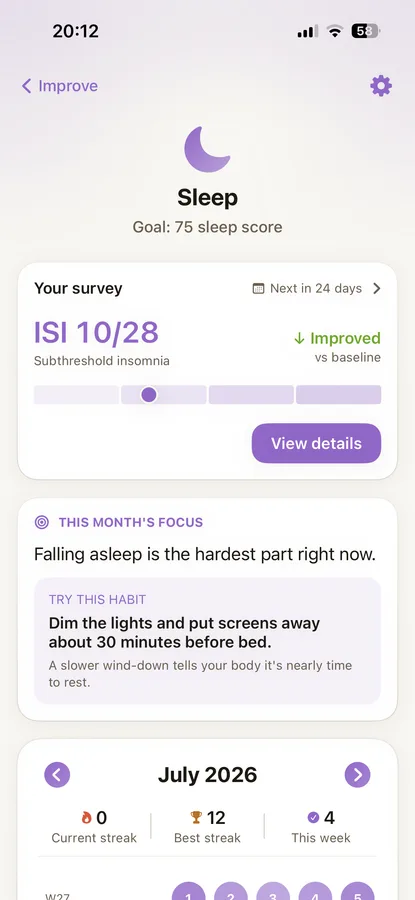
This calculator estimates how much caffeine is still in your system right now. Sam's Sleep program tracks your sleep quality alongside your daily habits over time, so you can see whether a late coffee or energy drink is behind a restless night.
Set a personal sleep quality goal and track your nightly progress.
This tool estimates how much caffeine is still in your body over the next 24 hours, using the exponential half-life model: remaining amount equals dose times 0.5 to the power of (hours elapsed divided by half-life). The default half-life is 5 hours, the commonly cited average for a healthy adult, and you can adjust it from 1.5 to 9.5 hours to reflect individual variation.
The mean elimination half-life of caffeine in a healthy adult is about 5 hours.
Source: StatPearls / NCBI Bookshelf (NBK519490), "Caffeine"
https://www.ncbi.nlm.nih.gov/books/NBK519490/Individual half-life is commonly cited as ranging from 1.5 to 9.5 hours depending on the person.
Source: NCBI Bookshelf (NBK223808), "Pharmacology of Caffeine" - Institute of Medicine
https://www.ncbi.nlm.nih.gov/books/NBK223808/The mg values used for the quick picker (8 oz / 237 ml serving): brewed coffee ~96 mg, black tea ~48 mg, energy drink ~79 mg, cola ~33 mg.
Source: Mayo Clinic - Caffeine content for coffee, tea, soda and more
https://www.mayoclinic.org/healthy-lifestyle/nutrition-and-healthy-eating/in-depth/caffeine/art-20049372Half-life is the time it takes for the amount of a substance in your bloodstream to fall by half. For caffeine, a commonly cited average is about 5 hours in a healthy adult - so roughly half of what you drank is still in your system 5 hours later, a quarter after 10 hours, and so on.
Caffeine is broken down mainly by the liver enzyme CYP1A2, and how active it is varies a lot between people. Smoking roughly doubles the clearance rate, while pregnancy, especially the third trimester, can slow it to around 15 hours. Liver disease and some CYP1A2-inhibiting medications extend the half-life too.
Each dose you log decays on its own exponential curve, amount(t) = dose x 0.5^(t / half-life), and the chart adds up every dose that's still active at each point in time. It's the same math researchers use to describe caffeine clearance, applied to whatever you typed in - not a measurement of your actual blood caffeine level.
No. The model assumes each dose is fully in your system the moment you log it. In reality there's a short absorption delay after drinking, and at unusually high doses clearance can stop following this simple exponential pattern. Treat the chart as an illustration of the decay math, not a precise personal reading.
No. Everything you log stays in your browser for this session only - there's no account, no server storage, and nothing is sent anywhere when you close the tab.
This tool is for general information only and does not provide medical advice. The curve is a population-average estimate, not a measurement of your own caffeine level. If you have questions about caffeine and your health, talk to a qualified healthcare professional.