On this page
TL;DR
Heart rate recovery - how many beats per minute your heart rate drops in the first one to two minutes after you stop exercising - measures how quickly your parasympathetic nervous system reasserts control once the exercise demand is removed. It is one of the few wearable metrics that responds directly and measurably to aerobic training over weeks. It is also one of the most easily misread, because exercise intensity is a massive confounder: a high HRR from a light workout and a modest HRR from a hard effort can both reflect exactly the same level of cardiovascular fitness.
What heart rate recovery measures
During exercise, sympathetic nervous system activation accelerates the heart to deliver more oxygenated blood to working muscles. The harder you work, the more sympathetic drive and the higher the heart rate ceiling. When exercise stops, two things happen in sequence: the parasympathetic (vagal) system rapidly reasserts control, pulling heart rate down; and, over a longer period, the sympathetic system gradually withdraws as metabolites clear and circulating catecholamines decline.
Heart rate recovery captures the combined speed of these two processes. It is most commonly expressed as:
- HRR1 - the drop in heart rate from the peak exercise rate to the rate exactly one minute after stopping. This is the standard clinical and wearable metric.
- HRR2 - the drop from peak to the rate at two minutes. This extends the window into the slower sympathetic withdrawal phase and adds further information.
Apple Watch reports HRR1 - stored in HealthKit as heartRateRecoveryOneMinute - automatically after every recorded workout. The sensor continues running for up to three minutes post-workout to capture the recovery curve.
The mechanism: two phases, one direction
The physiology of HRR is well characterised. A comprehensive analysis by Pierpont, Adabag, and Yannopoulos describes two physiologically distinct phases of post-exercise cardiac deceleration. The first - spanning roughly the first 30 to 90 seconds - is driven primarily by parasympathetic reactivation: the vagus nerve reasserts its inhibitory modulation of the sinoatrial node almost as soon as the exercise stimulus is removed. This rapid deceleration is heavily dependent on resting vagal tone and, consequently, on cardiovascular fitness.
The second, slower phase covers the subsequent minutes to hours and reflects both continued vagal recovery and progressive sympathetic withdrawal as muscle metabolites clear and plasma catecholamine levels fall. A 2013 Sports Medicine review by Stanley, Peake, and Buchheit examined parasympathetic reactivation across exercise intensities and fitness levels.
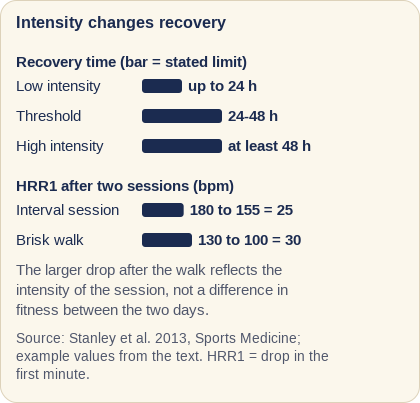
Complete cardiac autonomic recovery after a single aerobic session takes up to 24 hours after low-intensity exercise, 24-48 hours after threshold intensity, and at least 48 hours after high-intensity exercise. Critically, individuals with greater aerobic fitness recover more rapidly at every intensity level.
How Apple Watch captures it
Apple Watch begins measuring post-workout heart rate as soon as you end a recorded workout session. The optical PPG sensor, which was tracking your heart rate continuously during exercise, stays active for up to three minutes after you tap "End Workout." The resulting HRR1 value - peak workout heart rate minus heart rate at one minute post-cessation - is displayed on the workout summary screen and stored in the Health app under Heart Rate Recovery.
The measurement is automatic and requires no action beyond ending the workout within the app. One practical note: if you move around significantly in the minute after ending a workout - stretching, walking to a water fountain, cooling down actively - the recovery heart rate will be elevated compared to stopping and standing still, because light movement sustains some sympathetic drive. Apple Watch cannot distinguish whether your 1-minute rate reflects true resting recovery or continued low-level activity.
What the numbers actually mean
The most widely cited reference point in HRR research comes from a landmark 1999 study in the New England Journal of Medicine by Cole and colleagues. In 2,428 consecutive adults referred for exercise stress testing, those whose heart rate fell 12 beats per minute or fewer in the first minute of recovery had a four-fold higher relative risk of death over six years than those whose heart rate fell by more than 12 bpm - and roughly twice as high after adjustment for age, sex, medications, perfusion defects, and standard cardiovascular risk factors. The association was independent of exercise workload, the presence of perfusion defects on imaging, and changes in heart rate during the test itself.
That threshold - 12 bpm - has remained the most cited reference point in the field. What it does not represent is a direct benchmark for interpreting a wrist wearable reading after your morning run. Several important context points apply:
The Cole study used a standardised graded exercise protocol (treadmill or bicycle ergometry) taken to maximum or near-maximum effort, with recovery assessed in a controlled supine or standing position. The population was adults referred for cardiac evaluation - not a general wellness population. And the 12 bpm threshold was derived from that specific protocol's distribution, not from everyday workout data.
What the research does consistently support is the directional relationship: faster HRR is associated with better cardiovascular health and fitness. Broadly, an HRR1 above 18-20 bpm is considered healthy in clinical testing contexts. Endurance athletes routinely show HRR1 values above 25 bpm. What matters for personal wearable use is not a single number against a population reference, but whether your HRR1 is trending upward over comparable workouts over weeks and months - a personal-baseline trend that an app like Sam can surface from your Apple Health data.
What genuinely affects your HRR reading
Several factors routinely shift the HRR number in ways that have nothing to do with cardiovascular fitness:
Exercise intensity is the dominant confounder. After a high-intensity interval session, your heart rate may peak at 180 bpm and drop to 155 bpm at 1 minute (HRR1 25), while after a brisk walk it may peak at 130 bpm and drop to 100 bpm (HRR1 30). The larger absolute drop reflects the specific recovery dynamics of that session's intensity, not a meaningful difference in cardiovascular fitness between the two days. Pierpont et al. identify exercise intensity as the primary determinant of recovery kinetics, alongside age and ambient temperature. This is why HRR readings should only be compared across workouts of similar type and subjective intensity.
Heat and humidity slow recovery through a distinct mechanism. When you exercise in hot or humid conditions, the body must maintain significant skin vasodilation and sweating effort even after you stop - thermoregulation demands continue while the cardiovascular system is already trying to decelerate. Research has demonstrated that heart rate recovery is slower after exercise in high humidity than in dry conditions at the same temperature. A summer outdoor run in humid weather will typically show a slower HRR than a winter treadmill session, independent of fitness changes.
Dehydration reduces circulating blood volume and keeps heart rate elevated during both exercise and recovery, compressing the absolute drop in the first minute.
Beta-blockers and rate-modifying medications suppress the sympathetic ceiling during exercise, reducing peak heart rate. A lower peak means a smaller absolute drop is possible in the first minute regardless of cardiovascular fitness. If you take these medications, your HRR numbers exist on a different scale from population norms and from your own readings before medication - comparisons across those contexts are not valid.
Cool-down behaviour matters more than most people realise. Standing still after stopping produces a faster apparent HRR than light activity. Conversely, immediately sitting or lying down can modestly accelerate the HRR through reduced postural demand. Consistency in your post-workout behaviour is essential for comparing readings across days.
How HRR improves with training
Heart rate recovery is one of the more directly trainable metrics captured by consumer wearables. The mechanism is the same as that underlying resting HRV and resting heart rate improvement: sustained aerobic training progressively enhances vagal tone - the chronic parasympathetic drive to the heart - which accelerates the parasympathetic reactivation that drives the fast phase of HRR.
The Stanley et al. review quantitatively analyses this across fitness levels and confirms that more aerobically fit individuals show faster cardiac autonomic recovery across all exercise intensities. A randomised controlled trial in sedentary adults found that 12 weeks of moderate-intensity aerobic exercise at 75 minutes per week produced a statistically significant improvement of around 4 bpm in HRR1. In endurance athletes, HRR1 values that would be considered exceptional in the general population are routine - a reflection of the cumulative vagal adaptation that years of aerobic training produces.
The practical signal for wearable users: if your HRR1 - measured consistently, after comparable workouts, in similar conditions - is trending upward over months, that is a direct marker of improving cardiovascular fitness. It is not the most sensitive marker (resting HRV and resting heart rate trends tend to be more informative between workouts), but it adds a within-workout datapoint that the other metrics cannot provide.
What your wearable can't tell you from this number alone
HRR is meaningful in context and limited without it. The key constraints:
It cannot tell you why the number changed. A drop in HRR1 compared to last week could reflect worse fitness, a harder session, a hotter day, dehydration, poor sleep the night before, or early illness. Without knowing what intensity the workout was and what the environmental conditions were, the number alone is ambiguous.
It is not a diagnostic measurement. The Cole 1999 threshold of ≤12 bpm was established in a clinical population undergoing standardised stress testing - not consumer wearable users after self-selected workouts. Using that threshold to make judgements about your own wearable data misapplies the research. HRR from a wrist PPG device after a workout you designed yourself is a wellness trend tool.
It requires consistency to be interpretable. The value of tracking HRR comes from comparing like with like: the same type of workout, at similar effort, in similar conditions, over time. A single reading has limited meaning; a stable trend over 8-12 weeks of consistent training tells you something real.
The wearable measurement itself has limits. The Apple Watch PPG sensor performs well during the relatively stable conditions of the post-workout recovery minute, but the reading can be affected by poor skin contact, movement, and ambient light. The resulting HRR1 value should be treated as an estimate with a margin of error of several beats per minute.
In Sam
Look at your resting heart rate, HRV and workouts in Sam side by side
Sam shows your resting heart rate, HRV, exercise minutes and sleep side by side over 7 days, 30 days or six months, so the days around a hard session are in view when you look back.
- Instead of the Health app alone: these values sit in one app, so a week of hard training can be read next to what your sleep did.
- Instead of a notes app: the symptom diary keeps how you felt on a given day, such as tired or unwell, in a few taps.
- Instead of screenshots: the monthly report you create has an activity page with steps, active energy and exercise minutes, plus a sleep page, as a PDF.
Sam does not show heart rate recovery itself; it stays in the Health app.
Sam is a wellness companion, not a medical device. No diagnosis, no replacement for medical advice.
Related reading
More on recording and taking it along
Sources
- Cole CR, Blackstone EH, Pashkow FJ, Snader CE, Lauer MS. Heart-rate recovery immediately after exercise as a predictor of mortality. N Engl J Med. 1999;341(18):1351-7. (accessed 16 May 2026).
- Stanley J, Peake JM, Buchheit M. Cardiac parasympathetic reactivation following exercise: implications for training prescription. Sports Med. 2013;43(12):1259-77. (accessed 16 May 2026).
- Pierpont GL, Adabag S, Yannopoulos D. Pathophysiology of exercise heart rate recovery: a comprehensive analysis. Ann Noninvasive Electrocardiol. 2013;18(2):107-17. (accessed 16 May 2026).
- Jaafar Z, Lim YZ. A comparison of low and high dose of moderate intensity aerobic exercise on heart rate recovery of the sedentary adults: a pragmatic randomized controlled trial. J Sports Med Phys Fitness. 2023. DOI: 10.23736/S0022-4707.22.13958-7. (accessed 16 May 2026).
- Shieh C-C, et al. Recovery of heart rate variability after exercise under hot conditions: the effect of relative humidity. (accessed 16 May 2026).
- Apple Inc. heartRateRecoveryOneMinute - HealthKit. Apple Developer Documentation. (accessed 16 May 2026).