10 min read
Period Pain or Endometriosis? When to See a Doctor
Nobody can tell normal period pain from endometriosis at home. What guidelines tell doctors to look for, and when to see a doctor or get urgent help.
Living with Endometriosis
Pain days and period days, finally on one calendar.
Log pelvic pain as mild, moderate or severe and mark your bleeding days, with sleep and stress in the same app. Two PDF reports bring those months to your gynecologist.
Your data
Your wearable already captures them. Sam reads them from Apple Health and shows you how they change over time, for many values against your personal baseline.
Your plan
Sam supports you in building habits with different programs you can use inside the app.
You told us
Sam suggests
Endometriosis
Condition
What Sam keeps
For you if you are working toward answers or living with endometriosis and want to record your days.
Your entries and your Apple Health data, over time, in one place.
You log pain, for example pelvic pain, as mild, moderate or severe. Both show as dots on the same month calendar.
You can look at the same month as trends from Apple Health. Sam measures nothing itself.
The monthly report has symptom days, the Cycle report cycles and bleeding days. What they mean is for you and your doctor.
Sam shows your values next to your entries. What they mean is something to talk through with your doctor.
You ask a question, Sam answers with your own numbers. For example:

The monthly report sums up your weeks - for appointments, applications, or simply your own record.
Monthly Report - June
Your Health Overview
Sleep
Symptoms
Example values. Your report is based on your own data.
Further reading: what wearable data can show about everyday life with Endometriosis - and where its limits are.
Nobody can tell normal period pain from endometriosis at home. What guidelines tell doctors to look for, and when to see a doctor or get urgent help.
Which doctor to see if you think you have endometriosis, when a GP refers you to a gynecologist or centre, and what to do if you feel dismissed.
How to describe endometriosis pain to a doctor: when in your cycle, where, how bad, bowel and bladder symptoms, what guidelines say, and when not to wait.
According to the German endometriosis guideline, the history covers period pain, pain in the lower abdomen (with your cycle or in between), problems with bowel movements, urination and sex, and tiredness. Saying "9 of the last 30 days" can give the conversation more to work with than "often". In Sam, the monthly report shows on how many days you logged symptoms and which came up most, and the Cycle report lists your bleeding days. Pain that limits your daily life is worth getting checked, with or without a record.
The German guideline lists, among other things, period pain, pain in the lower abdomen, problems with bowel movements, urination and sex, tiredness and your menstrual history as part of the history. Sam has ready-made entries for Pelvic pain, Abdominal pain, Abdominal cramps, Lower back pain, Painful urination, Bloating, Diarrhea, Constipation, Nausea and Fatigue, each rated mild, moderate or severe per day, plus bleeding in cycle tracking. For anything without a ready-made entry, such as period pain, you can add your own symptoms in your own words. Anything you take as needed can go into your medication list. For what a good symptom record contains, see Symptom Diary: Paper Template or App?.
That is not proven. The European ESHRE guideline says there is no evidence that a symptom diary, questionnaire or app shortens the time to diagnosis. It does see a possible benefit next to the usual history, because it makes pain easier to describe. In Sam, each symptom gets one entry per day, with no time of day and no 0 to 10 pain scale, so it adds detail to a conversation and does not replace the exam or your doctor's pain history.
The WHO puts the average time to diagnosis at 4 to 12 years, and Germany's Federal Ministry of Health describes delays of more than seven years as common there. The WHO describes symptoms that are varied and broad, so they are not easily recognized. It also names social beliefs that often downplay period pain. It stresses that chronic pelvic pain in endometriosis is not normal, and it notes that starting treatment does not always have to wait for surgery. If you feel dismissed, When your doctor does not take your symptoms seriously covers how to prepare the conversation.
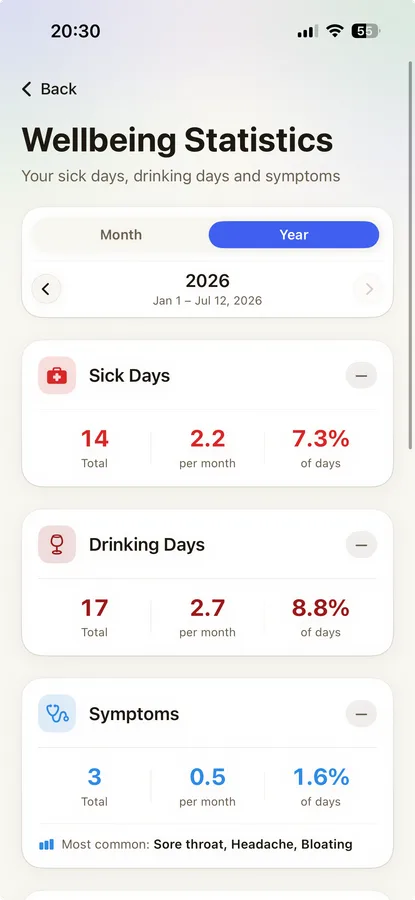
In Health History, the month calendar marks days with logged symptoms and period days as two dots. Open a day to see its symptoms and their strength. In Wellbeing Statistics, the Top Symptoms card counts the days for your five most logged symptoms. Limits: the symptom dot appears for any symptom, not only pain, and Sam does not place a symptom on a cycle day. You see both in the same month. From Apple Health, Sam brings in only bleeding days that have a flow level logged (light, medium or heavy); days logged without a flow level and spotting are not brought in.
A symptom record cannot settle that, in Sam or anywhere else. The German guideline notes that endometriosis can occur together with other chronic pain syndromes such as irritable bowel syndrome, and the WHO lists bloating and nausea among the symptoms of endometriosis. In Sam you log Abdominal pain, Bloating, Diarrhea and Constipation per day and see in the month calendar how symptom days and period days lie. Whether it is a bowel condition, endometriosis or both is for your doctor to work out. Blood in the stool or urine needs a doctor's check, even if it only appears around your period.
No to both. In endometriosis, tissue similar to the lining of the uterus grows outside the uterus; whether that applies to you can only be assessed by a doctor, usually starting with a history and an ultrasound (transvaginal sonography). A normal ultrasound does not rule endometriosis out. Ongoing lower abdominal pain is a non-specific symptom and does not always have this cause. Sam also does not calculate a next period: it shows cycle day, cycle length and period length, counted from your entries. And Sam does not measure pain; the strength is your own rating.
Call your local emergency number (112 in the EU, 999 in the UK, 911 in the US) if pelvic pain is severe or comes on suddenly and intensely, is getting worse or hurts when you move or touch the area, or if it comes with feeling faint, dizzy or passing out, pain in the tip of your shoulder, difficulty breathing, heavy bleeding from the vagina, sudden confusion, or a high temperature or feeling hot, cold or shivery. Severe difficulty breathing, sudden chest pain that does not go away, or chest pain with shortness of breath, sweating, feeling sick or light-headed also needs an emergency call, including around your period. Coughing up more than a few spots or streaks of blood, or coughing up blood with difficulty breathing, a very fast heartbeat or pain in your chest or upper back, needs an emergency call too; a few small spots or streaks of blood, or blood in your phlegm, need urgent help. Get urgent help (in the UK, an urgent GP appointment or NHS 111; elsewhere, an urgent appointment or your out-of-hours service) for period or pelvic pain that is severe or worse than usual, especially when painkillers have not helped, and for pelvic pain with blood in your pee or poo, trouble peeing or pooing, pain when peeing or needing to pee more than usual, unusual discharge or bleeding from the vagina, vomiting and diarrhea or feeling sick, or if you are or may be pregnant. If in doubt, go with the more urgent option. Out of hours, use your local out-of-hours medical service (116 117 in Germany). The NHS advises seeing a doctor if symptoms affect everyday life, work or relationships, and describes needing to change a pad or tampon every one to two hours as a sign of heavy periods. Sam does not replace an emergency call.
Download Sam for free, connect Apple Health, and see your data for everyday life with Endometriosis over time.
Sam is a wellness companion, not a medical device. Sam does not diagnose, treat, cure, or prevent any illness and does not replace medical advice. For health questions or concerns, always consult a qualified medical professional.