Long COVID: Symptoms, Resting Heart Rate and HRV on Record
Take care of your body.
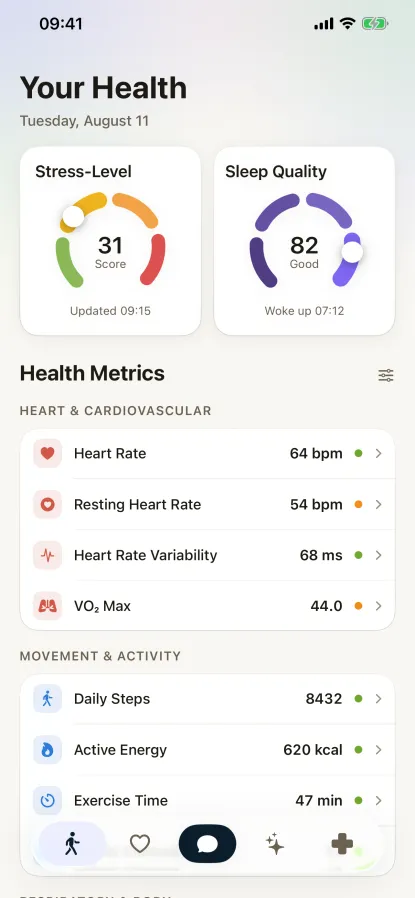
Sam keeps your symptoms, sick days, resting heart rate and sleep in one place. You take the history to your next appointment.
Not a medical device
Works with Apple Watch, Oura, Whoop & Garmin
Built in Europe
Long COVID: where it shows in the body
Step by step: what Long COVID is, where people report symptoms and how it shows up day to day.
1The body
Long COVID
When symptoms stay
Long COVID is the common name for symptoms that continue or begin after a COVID-19 illness and have no other explanation. It can also follow a mild illness.
A human figure, seen from the front at an angle. The view moves slowly towards the upper body. Nothing is highlighted.
2Where people report symptoms
What is known
Fatigue, shortness of breath and brain fog
Fatigue, shortness of breath and problems with memory or concentration, often called brain fog, are common symptoms. They can limit everyday life and can change or return over time. Research is still working out how Long COVID develops.
Acute illness
Symptoms continue or begin
Symptoms still there
About three months
Timing as in the WHO definition of post COVID-19 condition: usually three months after the illness began, with symptoms that last at least two months and that no other diagnosis explains. How long symptoms last differs.
Memory and concentration / Short of breath / Fatigue, whole body
Most of the figure, seen from the front. A faint violet tint covers the whole body for fatigue, and stronger violet areas on the head and chest mark where people often report problems with memory and concentration and shortness of breath. Nothing moves or flashes.
3Where people feel it
Day to day
Different from person to person
In some people, symptoms get clearly worse after even light physical or mental effort. Which symptoms appear, how strong they are and how long they last differ widely between people.
Worth discussing with your doctor.
The view pulls back to the whole figure. The faint violet tint over the body and the stronger areas on the head and chest stay unchanged.
Sources concern the condition
[1] World Health Organization (WHO). A clinical case definition of post COVID-19 condition by a Delphi consensus, 6 October 2021. 2021. who.int. https://iris.who.int/handle/10665/345824
[4] National Academies of Sciences, Engineering, and Medicine (NASEM). A Long COVID Definition: A Chronic, Systemic Disease State with Profound Consequences. 2024. The National Academies Press. https://www.nationalacademies.org/publications/27768
Own simplified illustration based on the sources above.
The picture shows a reference body without organs. The coloured areas mark where people often report symptoms: the head for problems with memory and concentration, the chest for shortness of breath and, more faintly, the whole body for fatigue. They show neither a cause nor a measurement. How strong a colour looks does not show how common or how severe a symptom is. Many other symptoms, such as aches, headaches, sleep problems or a changed sense of taste, are not painted. The timeline follows the WHO definition of 2021. Adult male reference model; figure and timeline are not to scale.
No watch sees what fatigue or brain fog feels like. What you notice, Sam keeps.
For people living with Long COVID who want a record for their appointments. Sam is not a medical device. It keeps what you and your wearable already produce and puts it in one place.
From Apple Health
Your Apple Watch, Oura, Whoop or Garmin already records them, and you add what you log. Sam reads them from Apple Health and shows you how they shift against your personal baseline.
Resting heart rateHRVSleep qualityBreathing rate
You log it
Fatigue, brain fog, shortness of breathHow strong, and where aches sitGood, off and sick daysSick notes and doctor's letters
Fatigue, brain fog and shortness of breath are outside what a smartwatch can record. Sam keeps your own account next to what your Watch records.
How Sam accompanies you day to day with Long COVID
Sam reads the data your wearable already writes to Apple Health and compares it to your personal baseline - understandable, not a wall of numbers.
1
Your day-to-day, on your own scale
Resting heart rate, HRV and sleep from Apple Health sit next to your own history of recent weeks. "Normal" is different for everyone.
2
Your numbers in one clear place
You don't have to compare figures daily. Using them for pacing isn't scientifically validated, so talk it through with your doctor.
3
Little effort on bad days
Resting heart rate, HRV and sleep come from Apple Health without typing. You don't have to enter anything.
Sam is a wellness companion, not a medical device. The app does not diagnose, treat, cure, or prevent any illness and does not replace medical advice. Consult a qualified healthcare professional for medical decisions.
Ask about your numbers. Take the report along.
Sam shows your values next to your entries. What they mean is something to talk through with your doctor.
Ask Sam about your data
You ask a question, Sam answers with your own numbers. For example:
What changed for me this week?
Your HRV was 8 ms below your baseline and your resting heart rate was slightly elevated - more of a shift than your usual pattern.
How did that compare to two weeks ago?
Your monthly report as a PDF
The monthly report sums up your weeks - for appointments, applications, or simply your own record.
Monthly Report - June
Your Health Overview
Sleep
07:20Average
23:40Bedtime
68Score
Health status
3Sick days
27Healthy
4Symptoms
Created by Sam HealthPDF
Example values. Your report is based on your own data.
Articles about Long COVID
Further reading: what wearable data can show about everyday life with Long COVID - and where its limits are.
Long COVID and Post-COVID are often used interchangeably, but they refer to different timeframes. Learn the official definitions from Germany's public health institute, current prevalence estimates, and where wearable data fits in.
Which metrics matter for Long COVID - from resting heart rate and HRV to blood oxygen - and how to track them with minimal effort, plus how to prepare a report for your post-COVID clinic, GP, or insurance provider.
Pacing is currently the recommended approach for managing post-exertional malaise (PEM) in Long COVID. What PEM is, why 'just exercise more' backfires, and how some people use resting heart rate and HRV as one of several signals for their daily energy planning.
Why resting heart rate and HRV often shift in long COVID, what recent research shows about autonomic nervous system regulation, and where wearable data reaches its limits.
What is pacing, and what do wearables have to do with it?+
Pacing means budgeting your energy to help minimize overexertion and the setback that can follow it, known as post-exertional malaise (PEM). Some people with Long COVID also watch resting heart rate and HRV as one of several reference points - this kind of self-guided pacing has not been scientifically validated so far.
Can Sam predict a crash (PEM)?+
No. No wearable and no app can reliably predict PEM, and Sam does not try to. Sam shows your values against your personal baseline as a plain trend view, without medical assessment or recommendation.
Do I need a specific wearable for this?+
No. Sam reads from Apple Health and works with the Apple Watch and with other wearables that save their data there, such as Oura, Whoop or Garmin. Which values arrive depends on the device. All you need is an iPhone.
Do brain fog and concentration problems show up in my wearable data?+
Not directly - an Apple Watch does not measure cognition or concentration and cannot detect brain fog. What it can show are signals like sleep quality, resting heart rate, and HRV, which some people track alongside their brain fog as context, not as an explanation or proof.
How many sick days are normal with Long COVID, and how do I keep track?+
There is no universal number - the course of the condition varies widely from person to person. Sam can log your sick days over time, so you have a clear record instead of vague memories for conversations with your doctor, insurer, or employer.
What should I do if my Apple Watch shows unusual readings related to Long COVID?+
A single unusual reading is usually not a cause for concern - resting heart rate and HRV naturally fluctuate. If a change persists over several days or comes with distressing symptoms like heart racing, dizziness, or shortness of breath, talk to your doctor rather than interpreting the values yourself.
Can I keep a crash diary in Sam?+
Yes. You log your symptom and sick days yourself. Next to them Sam shows resting heart rate, HRV, sleep and breathing rate from Apple Health, and the monthly report counts your symptom and sick days for your next appointment.
Understand what your body is telling you.
Download Sam for free, connect Apple Health, and see what your data says about everyday life with Long COVID - compared to your own baseline.
Free for iPhoneBuilt in Europe
Sam is a wellness companion, not a medical device. Sam does not diagnose, treat, cure, or prevent any illness and does not replace medical advice. For health questions or concerns, always consult a qualified medical professional.