On this page
TL;DR
Apple Watch, the Oura Ring, and a Polar H10 chest strap all report a number labelled "HRV," but the three are not the same measurement.
Apple Watch reports SDNN from opportunistic short windows, sampled by an optical PPG sensor at the wrist. The Oura Ring reports the mean of 5-minute rMSSD samples across the whole night, also from PPG but at the finger. The Polar H10 derives HRV from an ECG signal at the chest and is the device most validation studies use as their reference.
In a 2024 peer-reviewed study (O'Grady et al., Sensors), Apple Watch Series 9 and Ultra 2 underestimated HRV by an average of 8.31 ms (p = 0.025) versus a Polar H10 reference, with a mean absolute error of 20.46 ms and a mean absolute percentage error of 28.88%. Studies of the Oura Ring against ECG find that nocturnal rMSSD agrees closely with the chest reference.
None of this means one device is "wrong" - they measure different things on different schedules and the metrics are not interchangeable. (For why your Apple Watch number will sit lower than published reference ranges, see normal HRV by age and gender.)
Why a single number called "HRV" across three devices is misleading
Heart rate variability is the variation in the time interval between consecutive heartbeats. From that single underlying signal, researchers compute several distinct metrics - SDNN, rMSSD, low-frequency power, high-frequency power, the LF:HF ratio, and others - each of which captures a slightly different aspect of how the autonomic nervous system is modulating the heart.
Apple, Oura and Polar each choose differently:
- Apple Watch exposes HRV as SDNN - the standard deviation of normal-to-normal beat intervals - through HealthKit (
HKQuantityTypeIdentifierHeartRateVariabilitySDNN). Apple does not expose rMSSD or frequency-domain values directly. - Oura computes rMSSD from 5-minute windows across the night and reports the nightly average. Per Oura's own writing on the topic (accessed 15 May 2026), the choice of metric and the choice to use the entire night come from the lab of Marco Altini, who advises Oura.
- Polar H10 records the underlying R-R interval stream from an ECG-based chest strap (accessed 15 May 2026). It does not pick a single HRV metric for you; the strap delivers the R-R data and you (or your training app) compute whichever metric you want.
This matters before you compare numbers. SDNN and rMSSD answer different questions; opportunistic short windows and overnight averages capture different physiology. Even with a perfectly accurate sensor, the same person would show different absolute values across the three devices.
Apple Watch HRV versus a Polar H10 chest strap
The most directly relevant recent study is O'Grady et al., 2024, "The Validity of Apple Watch Series 9 and Ultra 2 for Serial Measurements of Heart Rate Variability and Resting Heart Rate," published in Sensors.
The study design: 39 healthy adults wore both an Apple Watch (Series 9 or Ultra 2) and a Polar H10 chest strap during a controlled 5-minute measurement each morning over 14 days, lying supine and still. The chest strap, paired with Kubios HRV analysis software, served as the reference standard. Over the cohort, 316 paired HRV measurements were collected.
The headline numbers:
- Apple Watch underestimated HRV by an average of 8.31 ms relative to the Polar H10 reference.
- The mean absolute error (MAE) was 20.46 ms.
- The mean absolute percentage error (MAPE) was 28.88%.
- For resting heart rate measured at the same time, the agreement was very close (mean difference: −0.1 bpm), and the study notes that errors in resting heart rate did not appear to drive the HRV error - meaning Apple Watch can read the heart rate well while still disagreeing with the chest strap on the HRV derived from it.
Plain-English summary: for an absolute SDNN value at a given moment, Apple Watch and a Polar H10 are not interchangeable. A ~29% mean absolute percentage error against the chest-strap reference is meaningful.
The study authors note that this kind of disagreement is consistent with what is known about wrist-PPG HRV: motion artifacts, peripheral pulse-wave timing and the algorithmic step of inferring beat intervals from a continuous optical signal all add error that an ECG electrode at the chest does not see.
What Apple Watch does do well, per the same study: track resting heart rate, and show directional changes over time in HRV that are useful at the individual level - your trend over weeks (which an app like Sam can surface from your Apple Health data) is more informative than any single morning value.
Oura Ring HRV versus an ECG reference
The most-cited validation of Oura is Cao et al., 2022, "Accuracy Assessment of Oura Ring Nocturnal Heart Rate and Heart Rate Variability in Comparison With Electrocardiography in Time and Frequency Domains," published in the Journal of Medical Internet Research.
The study design: 35 healthy participants wore an Oura Ring and a Shimmer3 medical-grade chest ECG monitor simultaneously through overnight sleep. The ring derives inter-beat intervals (IBI) from infrared PPG at the finger at a 250 Hz sample rate.
The headline findings:
- For nocturnal heart rate and rMSSD, the Oura Ring showed close agreement with the ECG reference, both in 5-minute windows and in averages computed across the entire night.
- For AVNN, pNN50, HF and SDNN, agreement was acceptable in the average-per-night test, though less reliable in 5-minute windows.
- For frequency-domain HRV - specifically LF power and the LF:HF ratio - error rates against the ECG reference were high in both tests.
A follow-up 2024 study (Liang, Yilmaz and Soon, Sensors, 2024) examined how data-quality filtering affects Oura's accuracy across 92 younger and 22 older participants. With a strict validity-proportion filter (≥80% of 5-minute windows clean) and aggregation over windows of at least 30 minutes, heart rate, rMSSD and the normalised high-frequency component (HFnu) showed very high correlations with ECG, including for older participants.
A 2025 multi-device study (Dial et al., Physiological Reports) compared five wearables - Garmin Fenix 6, Oura Generation 3, Oura Generation 4, Polar Grit X Pro and WHOOP 4.0 - against an ECG reference across 536 nights of sleep. Oura Gen 3 and Gen 4 showed the strongest agreement of the five devices tested, with Lin's concordance correlation coefficients of 0.97 and 0.98 for resting heart rate, respectively. Apple Watch was not included in that study.
Plain-English summary: for overnight rMSSD and nocturnal heart rate, the Oura Ring is the closest to an ECG reference of the consumer wearables that have been head-to-head tested. For frequency-domain HRV components, Oura is materially less accurate than ECG. Like Apple Watch, Oura is best used to track your own trend over time.
Where the three devices agree and where they diverge
| Question | Apple Watch | Oura Ring | Polar H10 |
|---|---|---|---|
| Sensor type | Wrist PPG (optical) | Finger PPG (optical, infrared, 250 Hz) | Chest ECG (electrical) |
| HRV metric reported | SDNN | Average of 5-minute rMSSD across the night | Raw R-R intervals (you choose the metric) |
| Sampling window | Opportunistic short windows during the day + Mindfulness session | Entire night, in 5-minute blocks | Continuous while worn |
| Accuracy vs an ECG / chest-strap reference (recent peer-reviewed) | Underestimates SDNN by ~8 ms; MAE 20.46 ms; MAPE 28.88% (Series 9 / Ultra 2 vs Polar H10, 2024) | Nocturnal rMSSD and HR agree closely with ECG; frequency-domain HRV less accurate (2022, 2024) | Reference standard in most validation studies |
| Best use | Directional trend in everyday wellness context | Directional trend in nightly recovery context | Research, training load, situations requiring an absolute value |
A few clarifications on what this table is not saying. It is not saying Apple Watch is "less accurate than Oura" - those two studies used different references, different cohorts, different metrics and different time windows. No published study has compared all three head-to-head in the same protocol on Apple Watch Series 9/Ultra 2 / Series 11 hardware.
What it is saying: each device is most useful as a longitudinal tracker against itself, and an absolute HRV number from any consumer wearable is not interchangeable with a chest-strap value at a moment in time.
What this means for you in practice
If you are deciding which device to trust as a wellness signal, the practical guidance is this:
- Pick one device and stick to it. Your trend is what matters. Switching devices mid-trend resets your baseline and obscures meaningful change.
- Treat absolute HRV values across devices as not comparable. Two devices showing 45 ms and 70 ms on the same night is normal - the metric and the window are different.
- Look at your trend over weeks, not nights. Single-night noise - sampling timing, sleep quality, alcohol the night before - can swamp the underlying signal. If you want to act on that trend, see how to improve HRV in 30 days without overtraining.
- For training-load decisions where the absolute value matters, use a chest strap. This is what serious endurance athletes do, and it is what most published validation studies use as reference.
For the deeper "what causes HRV to change overnight" question, see our companion piece on Apple Watch resting heart rate and what overnight changes mean and the pillar on what Apple Watch actually measures for the full sensor stack.
In Sam
Follow your HRV trend over weeks in Sam
You can read your Apple Watch HRV as a trend instead of a single reading, because Sam takes it from Apple Health and shows it over time.
- Instead of one night's value: HRV has a 7-day, 30-day and 6-month view with your own baseline beside it, so you compare yourself with yourself.
- Instead of each metric on its own screen: HRV, resting heart rate, sleep and steps use the same ranges in Sam, so you can read them against each other.
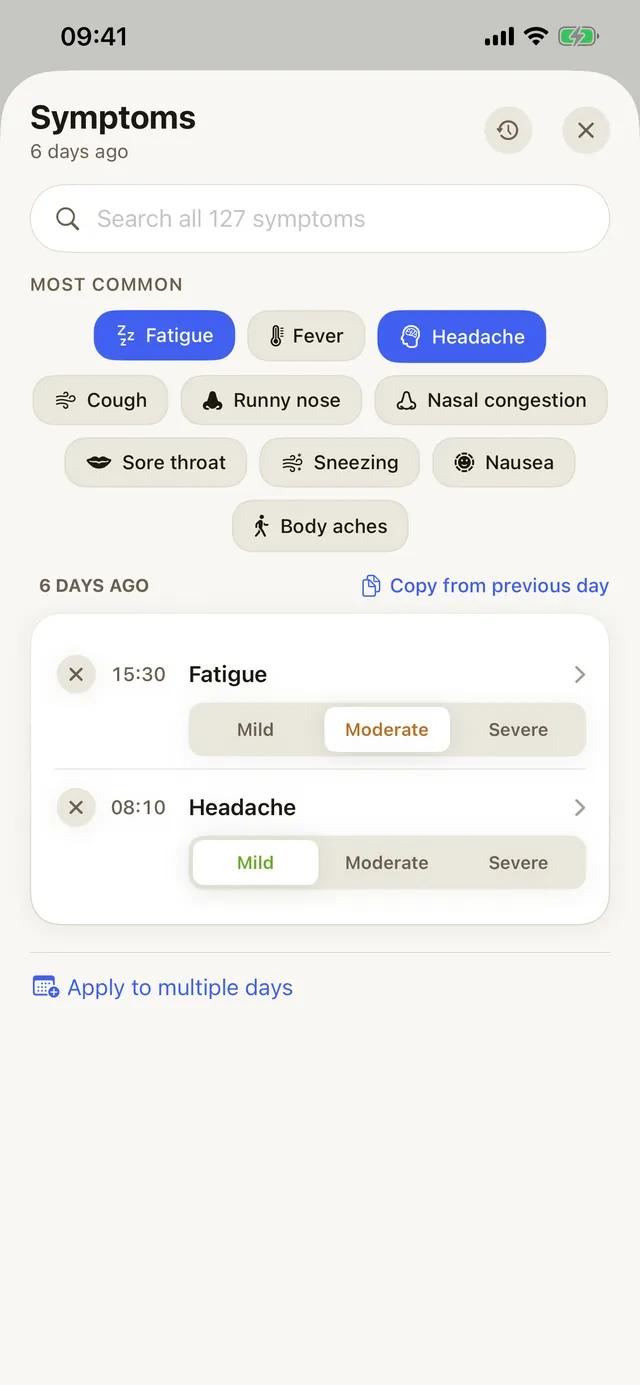
- Instead of relying on memory: days you log as sick appear in the chart, so a dip has its context when you talk it through.
Sam shows what Apple Health records and measures nothing itself; what a change means you discuss with your doctor.
Sam is a wellness companion, not a medical device. No diagnosis, no replacement for medical advice.
Related reading
More on recording and taking it along
Sources
- O'Grady, B., Lambe, R., Baldwin, M., Acheson, T. & Doherty, C. The Validity of Apple Watch Series 9 and Ultra 2 for Serial Measurements of Heart Rate Variability and Resting Heart Rate. Sensors 24(19): 6220, 2024. Accessed 15 May 2026.
- Cao, R., Azimi, I., Sarhaddi, F., Niela-Vilen, H., Axelin, A., Liljeberg, P. & Rahmani, A.M. Accuracy Assessment of Oura Ring Nocturnal Heart Rate and Heart Rate Variability in Comparison With Electrocardiography in Time and Frequency Domains: Comprehensive Analysis. Journal of Medical Internet Research 24(1): e27487, 2022. Accessed 15 May 2026.
- Liang, T., Yilmaz, G. & Soon, C.-S. Deriving Accurate Nocturnal Heart Rate, rMSSD and Frequency HRV from the Oura Ring. Sensors 24(23): 7475, 2024. Accessed 15 May 2026.
- Dial, M. et al. Validation of nocturnal resting heart rate and heart rate variability in consumer wearables. Physiological Reports 13(15), 2025. Accessed 15 May 2026.
- Apple Developer. heartRateVariabilitySDNN - HKQuantityTypeIdentifier. Accessed 15 May 2026.
- Oura. Why Oura Uses The Entire Night Of HRV Data. The Pulse Blog, March 2021 (updated July 2024). Accessed 15 May 2026.
- Polar. Polar H10 Heart Rate Sensor. Accessed 15 May 2026.