11 min read
IBS Before Your Period: What to Log Across Your Cycle
IBS before your period: what studies show about pain and diarrhea around bleeding, what to log over several cycles, and which signs cannot wait.
Living with IBS
Was this month worse than last? Your symptom days, already counted.
Log abdominal pain, bloating, diarrhea or constipation as mild, moderate or severe. A monthly report shows your doctor a month of symptom days, not memory gaps.
Your data
Your wearable already captures them. Sam reads them from Apple Health and shows you how they change over time, for many values against your personal baseline.
What Sam keeps
For people with IBS, or who suspect it, and want to bring numbers instead of estimates.
Your entries and your Apple Health data, over time, in one place.
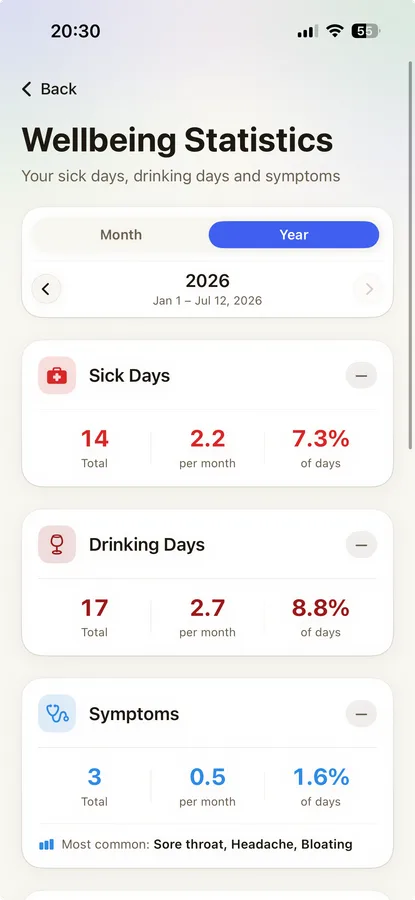
You log symptoms per day: mild, moderate or severe. Statistics compare your symptom days with the period before.
A few taps from your symptom days, but statistics and report calculate no link. Whether there is one is for your doctor.
Your doctor sees a month of symptom days instead of memory gaps. Stool type and meals are not in it.
Sam shows your values next to your entries. What they mean is something to talk through with your doctor.
You ask a question, Sam answers with your own numbers. For example:

The monthly report sums up your weeks - for appointments, applications, or simply your own record.
Monthly Report - June
Your Health Overview
Sleep
Symptoms
Example values. Your report is based on your own data.
Further reading: what wearable data can show about everyday life with Irritable Bowel Syndrome (IBS) - and where its limits are.
IBS before your period: what studies show about pain and diarrhea around bleeding, what to log over several cycles, and which signs cannot wait.
What kind of doctor treats IBS, which blood and stool tests rule out other causes, and why US and German guidelines differ on colonoscopy.
What your GP or gastroenterologist asks about IBS, how guidelines describe the diagnosis, a sample two-week diary and the signs that cannot wait.
According to the German S3 guideline, IBS means symptoms such as abdominal pain or bloating, usually with changes in bowel movements, that last longer than three months or keep returning, clearly affect quality of life, and are not likely explained by another condition. Sam makes no diagnosis and does not recognize IBS. It keeps what you logged between appointments. Which doctor to see, and how a colonoscopy and blood tests fit in, is covered in What kind of doctor for IBS? Colonoscopy and blood tests.
A diary notes, for each day, which symptoms you had and how strong they were. In Sam you tap symptoms such as abdominal pain, abdominal cramps, bloating, diarrhea, constipation or nausea and set mild, moderate or severe, for several days at once if you like. The symptom diary has one entry per symptom per day, with no time of day, no body spot, no count of bowel movements and no note. Heartburn is in the list too; once a doctor has confirmed reflux, there is a separate diary for it: Reflux. What belongs in a symptom diary is covered in Symptom diary: what to include, and the diary itself is at Symptom diary.
The NHS says your doctor asks how often symptoms happen and whether they come on after eating certain foods. The German S3 guideline adds how long they have lasted and how they developed, how severe they are and whether a gut infection came first. The guideline describes IBS as usually involving changes in bowel movements. From Sam you bring how many days each symptom was logged and at what strength. How often you went and how firm your stool was is not something Sam records. You note that yourself.
Your doctor decides, so ask before the appointment. For orientation, the S3 guideline (as of 2021) describes IBS as symptoms lasting longer than three months, and for sorting it into a diarrhea, constipation or mixed type it describes a two-week stool diary using the Bristol scale. Sam has no such scale. Its statistics show your symptom days by month or year and compare them with the period before.
The NHS lists stress and anxiety as possible triggers of flare-ups. The S3 guideline states that psychological stress and anxiety or depressive disorders can contribute to the onset and persistence of IBS, that stress alone does not cause it, and that anxiety or depression symptoms can also follow from the ongoing gut symptoms. Sam shows a stress level calculated from heart rate and HRV in the same app, and its Stress lifestyle program adds the K10 questionnaire once a month. In the statistics and the monthly report, Sam calculates no link between your stress level and your gut symptoms. Whether there is one for you is a question for your doctor.
Not in the symptom diary. Its symptom list has no fields for stool type (Bristol scale), individual bowel movements, meals, foods, FODMAPs or triggers, and Sam does not link symptoms to medication. When there are signs of a food intolerance, the S3 guideline names a food and symptom diary. You would keep that outside Sam, and your doctor decides what follows. Sam is also not a medical device and not a prescription app.
Get an urgent appointment today for blood in your stool, bleeding from your bottom or bloody diarrhea, losing a lot of weight for no reason, a hard lump or swelling in your tummy, symptoms that suddenly get much worse, or shortness of breath with palpitations and paler skin than usual, even if you already have an IBS diagnosis. Outside practice hours, use your local out-of-hours service (NHS 111 in the UK). Also get these checked before anyone calls it IBS, and if you already have an IBS diagnosis: fever, anemia on a blood test, unusual paleness, symptoms that keep getting worse, diarrhea that wakes you at night, symptoms that first started after age 50, smaller unintended weight loss, and bowel cancer, inflammatory bowel disease or celiac disease in your family. These lists are not complete and are not a self-test. New or lasting bowel symptoms are worth a doctor's visit even without any of these signs. Call your local emergency number (112 in the EU, 999 in the UK, 911 in the US) for stomach pain that starts suddenly and is severe, a lot of blood from your bottom, black sticky stool, vomiting blood or vomit that looks green or like ground coffee, not being able to pass stool or wind at all, struggling to breathe, or sudden chest pain or pressure. The first list follows the NHS, which advises an urgent appointment for these signs; the German S3 guideline names blood in the stool, weight loss, fever and steadily worsening symptoms, among others. A summary of the American Gastroenterological Association guideline in American Family Physician (2023) adds nocturnal diarrhea, onset after 50 and a family history. 'Blood in stool' is one of the symptoms you can log in Sam. An entry replaces neither a call to your doctor's office nor an emergency call, and Sam does not analyze it separately.
Show the statistics in the app or create the monthly report as a PDF. It sums up symptom days, days without a logged symptom and your five most frequent symptoms, plus pages on sleep, activity and stress from your Apple Health data. For symptoms, sleep and stress the report also prints short, generally worded notes from the app, for example on whether symptom days came in a row; they are not a medical assessment and do not refer to your gut. Stool type, meals and medication are not in it; you can show your medication list in the app. In Sam Chat you can ask for your entries to be described. If you want someone you trust to read along, share the symptoms area in Family & Friends, read-only.
Download Sam for free, connect Apple Health, and see your data for everyday life with Irritable Bowel Syndrome (IBS) over time.
Sam is a wellness companion, not a medical device. Sam does not diagnose, treat, cure, or prevent any illness and does not replace medical advice. For health questions or concerns, always consult a qualified medical professional.