Free Tool
Peak Flow Calculator
The Nunn & Gregg (1989) reference equation predicts your normal peak flow (PEF) from age, height, and sex - a separate EN13826 conversion then maps that prediction onto the scale modern peak flow meters use. Enter your numbers to see how your reading compares.
How to calculate your predicted peak flow
- 1
Enter your sex, age, and height
These three fields feed the Nunn & Gregg (1989) equation, which predicts your normal peak flow (PEF).
- 2
Enter your peak flow reading
Enter the L/min reading from your peak flow meter, EU/EN13826 scale.
- 3
Read your result
See whether your reading falls within Clement Clarke's published normal range for your age, height, and sex.
In the Sam App
Beyond a Single Reading
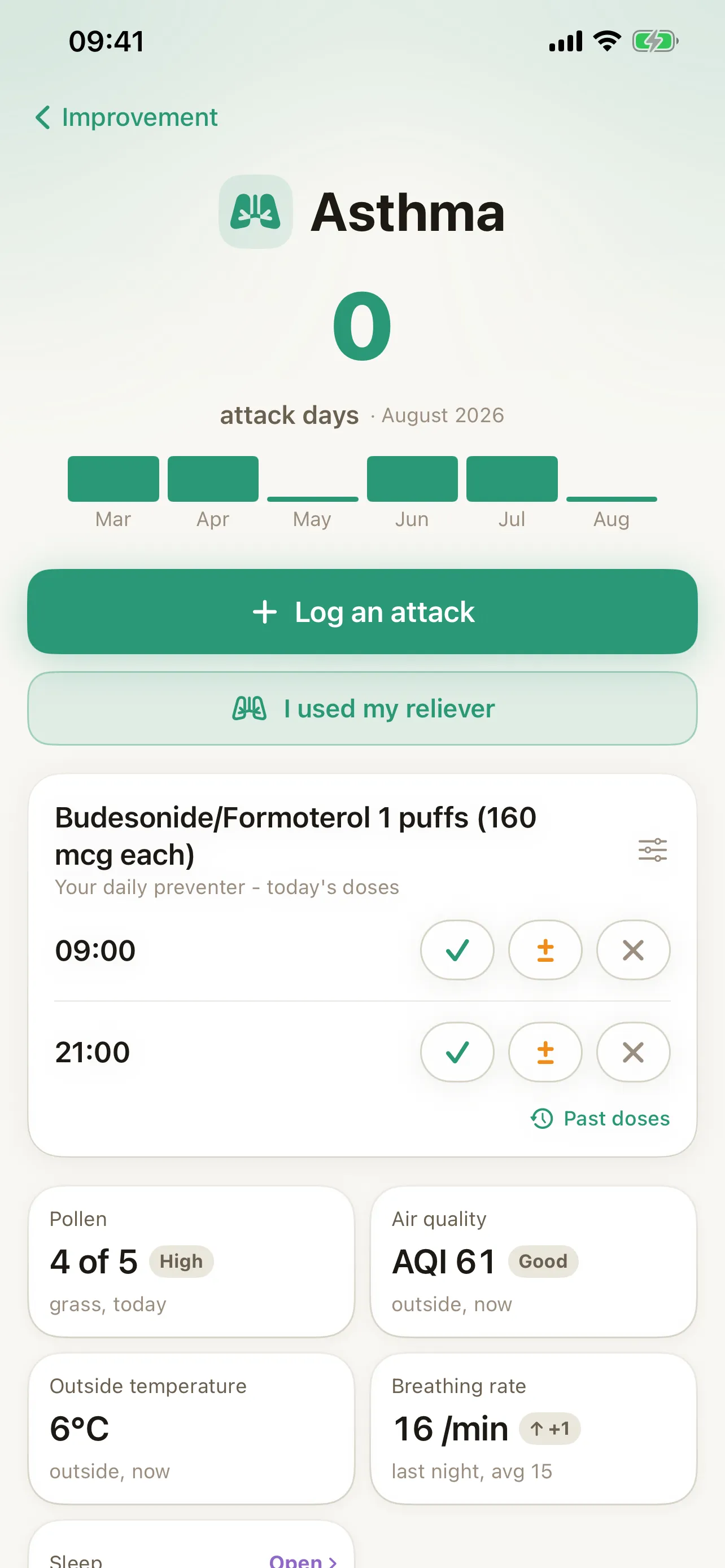
A peak flow number is one moment. Sam's Asthma program tracks your sleep, breathing, and triggers over time so you and your doctor see the pattern behind it.
Asthma Program
Paired with your own symptom diary, that gives your doctor real context for treatment decisions.
- Sam shows your nightly sleep duration, interruptions, and respiratory rate patterns.
- Sam tracks your stress levels, exertion zones, and daily activity from Apple Health.
- Sam compiles your entire month of Apple Health data into a ready-to-share PDF report, automatically.
What counts as a normal peak flow?
Peak flow varies naturally by age, height, and sex - taller people and younger adults generally blow higher numbers. The EU-scale reference equation (Nunn & Gregg, 1989) estimates the average reading for someone of your age, height, and sex; Clement Clarke, the manufacturer whose scale most European peak flow meters use, defines 'normal' as within 100 L/min of that average for men and 85 L/min for women. These reference values are derived from Caucasian populations, so the predicted-normal figure may be less accurate for people of other ethnic backgrounds. In real asthma care, a peak flow diary compares each reading against your own personal best - not this population average - because your own best result is a more precise reference point than an age-and-height estimate.
Read how to keep an asthma diary with Apple Watch and SamSources
- Nunn AJ, Gregg I. New regression equations for predicting peak expiratory flow in adults. BMJ, 298(6680), 1068-1070 (1989).
- Clement Clarke International Ltd. Peak Expiratory Flow Rate - Normal Values, EU/EN13826 Scale (Issue 1, 2004), adapted from Nunn & Gregg (1989).
Frequently asked questions
Is this the same as a peak flow diary my doctor gave me?+
No. A peak flow diary tracks readings over weeks against your own personal best - the number that matters most for asthma management. This tool compares one reading against a population average for your age, height, and sex, which is a different and less precise reference point.
My reading is below the normal range - do I have asthma?+
Not necessarily. Effort, technique, time of day, and recent illness all change a single peak flow reading. A one-off low reading is not a diagnosis. If readings stay low or you have symptoms, talk to a doctor.
Why does the calculator ask for my sex?+
The Nunn & Gregg (1989) reference equation was derived separately for men and women, so predicted values differ by sex at the same age and height.
Does this peak flow calculator work for children or teens?+
No - the Nunn & Gregg equation is validated for ages 15 to 85 only. Children need a separate pediatric equation, since lung growth follows a different curve.
I don't own a peak flow meter - where do I get one?+
Pharmacies sell peak flow meters over the counter, and many GPs or pulmonologists provide one as part of asthma care. Ask a doctor before starting home monitoring.
Living with asthma
Sam doesn't measure lung function - a peak flow meter or spirometer does. Sam's Asthma program shows how your sleep quality, nighttime breathing rate, and activity trends develop over time, giving you real data to bring to your next pulmonologist visit.
See the Asthma programThis tool classifies a single peak flow reading against a population-average predicted value for your age, height, and sex - it does not monitor, diagnose, or manage asthma or any other lung condition. Peak flow diaries used in real asthma care compare readings against your own personal best, tracked over weeks with a doctor, not against a population average. Talk to a doctor about your results, especially if you have symptoms or a diagnosed lung condition.