
Living with Type 2 Diabetes

Type 2 Diabetes: Movement, Sleep and Stress Over Time

Take care of your body.

Sam keeps your activity, sleep, symptoms and lab results in one place. You take the history to your next appointment.

  • Not a medical device
  • Works with Apple Watch, Oura, Whoop & Garmin
  • Built in Europe

What happens in the body with type 2 diabetes

Step by step: where type 2 diabetes plays out, how insulin works without it, what changes with it and why it often goes unnoticed. The model shows the pancreas, the liver and the thigh muscles; fat tissue is not in it.

  1. 1Pancreas, liver, muscles

    Blood sugar

    Where blood sugar is regulated

    In type 2 diabetes, blood sugar is too high over the long term. The pancreas, the liver and the muscles play a central part in it.

    Liver / Pancreas / Thigh muscles

    A human figure, seen from the front at an angle. In the upper abdomen the liver and the pancreas turn rose, and so do the muscles on the front of both thighs.
  2. 2Without type 2 diabetes

    After a meal

    How insulin works

    Blood carries sugar from food to the liver. As blood sugar rises, the pancreas releases insulin: muscle and fat cells take up sugar, the liver releases less of its own.

    Pancreas / Sugar from a meal / Liver

    Close-up of the upper abdomen. The pancreas and the liver are rose. Small white dots travel from below the pancreas up a vein into the liver.

  3. 3With type 2 diabetes

    Insulin resistance

    When cells respond less to insulin

    In type 2 diabetes, muscle, liver and fat cells usually respond less to insulin. Over time, the pancreas can no longer make enough insulin to compensate. More sugar stays in the blood, and the liver releases more of its own.

    Responds to insulin

    Responds less with type 2 diabetes

    • Muscle or fat cell
    • Insulin
    • Sugar

    Too little insulin over time / Weaker insulin response

    The pancreas and the liver turn a deeper rose. The white dots keep travelling into the liver. A sketch compares a muscle or fat cell that takes up sugar with insulin and one that responds less.

  4. 4Often not felt

    Day to day

    Often unnoticed for years

    Type 2 diabetes often causes few or no symptoms for a long time. It shows in blood tests such as HbA1c, which reflects average blood sugar over the past two to three months.

    Worth discussing with your doctor.

    The view pulls back to the whole figure. The pancreas, the liver and the thigh muscles return to a neutral grey.

Sources concern the condition
  1. [1] American Diabetes Association Professional Practice Committee for Diabetes. Standards of Care in Diabetes - 2026. 2026. Diabetes Care 49 (Suppl. 1). https://diabetesjournals.org/care/issue/49/Supplement_1
  2. [2] Bundesärztekammer, Kassenärztliche Bundesvereinigung, AWMF. Nationale VersorgungsLeitlinie Typ-2-Diabetes, Langfassung, Version 3.0. 2023. register.awmf.org (AWMF-Register-Nr. nvl-001). https://register.awmf.org/de/leitlinien/detail/nvl-001
  3. [3] National Institute of Diabetes and Digestive and Kidney Diseases (NIDDK), NIH. What Is Diabetes?. 2023. niddk.nih.gov. https://www.niddk.nih.gov/health-information/diabetes/overview/what-is-diabetes
  4. [4] National Institute of Diabetes and Digestive and Kidney Diseases (NIDDK), NIH. Insulin Resistance & Prediabetes. 2025. niddk.nih.gov. https://www.niddk.nih.gov/health-information/diabetes/overview/what-is-diabetes/prediabetes-insulin-resistance
  5. [5] DeFronzo RA. Banting Lecture. From the Triumvirate to the Ominous Octet: A New Paradigm for the Treatment of Type 2 Diabetes Mellitus. 2009. Diabetes 58(4):773-795. https://doi.org/10.2337/db09-9028
  6. [6] National Institute of Diabetes and Digestive and Kidney Diseases (NIDDK), NIH. Your Digestive System & How It Works. 2017. niddk.nih.gov. https://www.niddk.nih.gov/health-information/digestive-diseases/digestive-system-how-it-works
  7. [7] Endocrine Society. Pancreas Hormones. 2022. endocrine.org. https://www.endocrine.org/patient-engagement/endocrine-library/hormones-and-endocrine-function/pancreas-hormones

Own simplified illustration based on the sources above.

The model shows the pancreas, the liver and the muscles on the front of the thighs, and for orientation the duodenum, the spleen and the portal vein. The stomach is left out so that the pancreas behind it stays visible. Fat tissue, the insulin-making cells inside the pancreas, the intestines and the other blood vessels are not in the model, and the thigh muscles stand for the body's muscles in general. The white dots stand for sugar from a meal on its way to the liver; they are drawn in front of the pancreas so they stay visible, while the vein runs behind it, and their number and speed do not show amounts. Colour marks where insulin is made and where it acts, and the deeper rose stands for the weaker response to insulin and, over time, too little insulin; the organs do not change shape. The liver's own release of sugar is not drawn. The sketch shows a muscle or fat cell. Adult male reference model; close-ups and the sketch are not to scale.

3D anatomy: BodyParts3D, (c) The Database Center for Life Science, CC BY 4.0. Prepared via human-atlas; simplified, cropped, coloured and animated by SanoLabs.

What Sam keeps for you

No watch sees inside the pancreas. What you notice, Sam keeps.

For people living with type 2 diabetes who want a record for their appointments. Sam is not a medical device. It keeps what you and your wearable already produce and puts it in one place.

From Apple Health

Your Apple Watch, Oura, Whoop or Garmin already records them, and you add what you log. Sam reads them from Apple Health and shows you how they shift against your personal baseline.

Daily StepsActive EnergyExercise MinutesSleep DurationResting Heart Rate

You log it

Symptoms, how strong and whereGood, a bit off or sick, day by dayDoctor's letters and lab results

Once a month

Monthly health report as a PDF

Check in on most days, and once a month it becomes a PDF for your appointment.

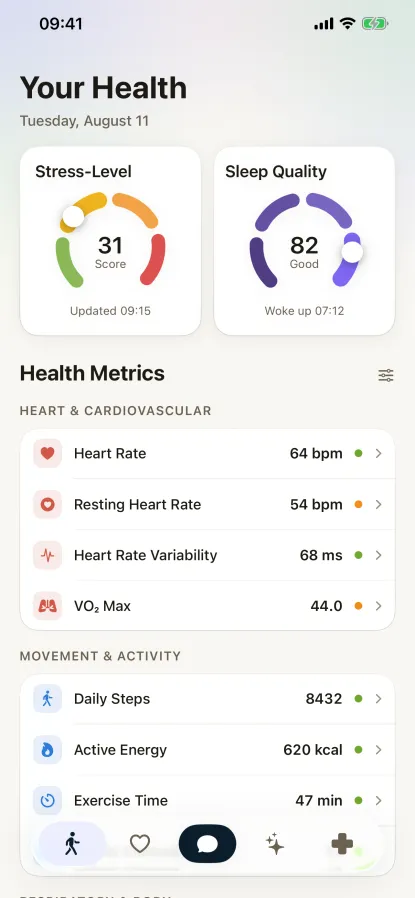
Sam app: the health overview with sleep, heart rate and activity

Blood sugar and HbA1c are outside what a smartwatch can measure. What your Watch produces and what you log, Sam keeps.

How Sam accompanies you day to day with Type 2 Diabetes

Sam reads the data your wearable already writes to Apple Health and compares it to your personal baseline - understandable, not a wall of numbers.

1

Your movement without a logbook

Steps, active energy and exercise minutes come from Apple Health. You see how much movement your weeks contain.

2

Your sleep as a weekly trend

Sleep duration and sleep quality appear as a trend next to your movement, as Apple Health records them.

3

A monthly report for your appointment

The free monthly report puts movement and sleep into a PDF. You go into the conversation with a trend, not memory gaps.

Sam is a wellness companion, not a medical device. The app does not diagnose, treat, cure, or prevent any illness and does not replace medical advice. Consult a qualified healthcare professional for medical decisions.

Ask about your numbers. Take the report along.

Sam shows your values next to your entries. What they mean is something to talk through with your doctor.

Ask Sam about your data

You ask a question, Sam answers with your own numbers. For example:

How consistent was my activity this month?
You hit your step goal on 18 of 30 days - your best month yet.
And how does my sleep rhythm look?

Your monthly report as a PDF

The monthly report sums up your weeks - for appointments, applications, or simply your own record.

Monthly Report - June

Your Health Overview

Resting heart rate

64Avg (bpm)
-2vs. baseline
30Days logged

Activity

7.4kSteps/day
18Days on target
+12%vs. last month
Created by Sam HealthPDF

Example values. Your report is based on your own data.

Articles about Type 2 Diabetes

Further reading: what wearable data can show about everyday life with Type 2 Diabetes - and where its limits are.

3 min read

Can Apple Watch measure blood sugar? Current reality and timelines

Apple has pursued non-invasive blood glucose monitoring for years. Here's what actually works today, why the FDA still hasn't cleared a single smartwatch for this capability, and what it means for you if you have type 2 diabetes.

Frequently Asked Questions

Does Sam measure my blood sugar?+

No. Sam does not measure blood sugar and does not replace your meter or sensor. If your meter or sensor saves readings to Apple Health, Sam can show them, next to your movement, sleep, stress and resting heart rate.

Where does Sam fit into my diabetes care?+

Your diabetes care team decides your treatment. Treatment guidelines consistently recommend movement as part of the foundation of care, and sleep and stress are increasingly part of that picture too. Sam records these everyday habits, so you can look at them with your care team.

What does my doctor see from my data?+

That's up to you. The monthly PDF report summarizes your trends, and you can bring it to your appointment.

What is HbA1c, and how often should it be tested?+

HbA1c reflects your average blood sugar over roughly the past two to three months. How often you get tested is something your diabetologist decides for you individually; testing every three to six months is typical.

Does stress affect blood sugar in type 2 diabetes?+

Yes. Acute and chronic stress can raise blood sugar through stress hormones like cortisol and adrenaline, which blunt how well insulin works. Sam shows a stress level calculated from your heart rate and HRV, and its stress program adds the K10 questionnaire once a month - as a starting point for a conversation, not a medical assessment.

Can I keep a diary for type 2 diabetes in Sam?+

For the everyday context, yes. Sam does not measure blood glucose; readings your meter or CGM saves to Apple Health can appear in Sam. Sam records steps, active energy, exercise minutes, sleep duration, resting heart rate and stress level, and sums them up monthly so you arrive at your appointment with more than isolated numbers.

Understand what your body is telling you.

Download Sam for free, connect Apple Health, and see what your data says about everyday life with Type 2 Diabetes - compared to your own baseline.

Free for iPhoneBuilt in Europe
Sam dashboard with wellbeing score, heart rate and sleep

Sam is a wellness companion, not a medical device. Sam does not diagnose, treat, cure, or prevent any illness and does not replace medical advice. For health questions or concerns, always consult a qualified medical professional.