11 min read
AHI Sleep Study Results: How to Read Your Report
What the AHI on a home test or sleep lab report counts, how guidelines grade it, what else the report shows and why one number does not decide therapy.
Living with sleep apnea
Your nights and the days after, side by side for your specialist.
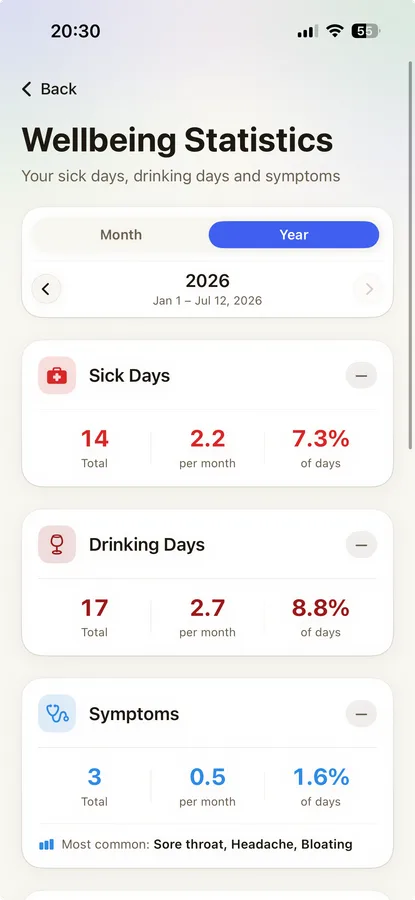
See sleep, respiratory rate and oxygen saturation as trends, and log snoring, daytime sleepiness or headache. You bring sleep and symptom days to the check-up as one PDF.
Your data
Your wearable already captures them. Sam reads them from Apple Health and shows you how they change over time, for many values against your personal baseline.
Your plan
Sam supports you in building habits with different programs you can use inside the app.
You told us
Sam suggests
Sleep Apnea
Condition
What Sam keeps
For people living with sleep apnea, facing a work-up or using therapy.
Your entries and your Apple Health data, over time, in one place.
You see sleep, respiratory rate and oxygen saturation across weeks and months. They are your watch's readings, not a lab measurement.
You log days with snoring, daytime sleepiness or headache. Wellbeing Statistics show your symptom days and which symptoms came up most often.
You create a PDF of sleep and symptom days. Sam does not read your therapy device's data; you bring that yourself.
Sam shows your values next to your entries. What they mean is something to talk through with your doctor.
You ask a question, Sam answers with your own numbers. For example:

The monthly report sums up your weeks - for appointments, applications, or simply your own record.
Monthly Report - June
Your Health Overview
Sleep
Symptoms
Example values. Your report is based on your own data.
Further reading: what wearable data can show about everyday life with Sleep Apnea - and where its limits are.
What the AHI on a home test or sleep lab report counts, how guidelines grade it, what else the report shows and why one number does not decide therapy.
What separates snoring from sleep apnea, why sleep apnea can occur without snoring and when to get your snoring checked by a doctor.
Suspect sleep apnea or just started CPAP? What a sleep doctor asks, home test versus sleep lab, CPAP follow-up, and a four-week log you can copy.
No. Sam does not diagnose sleep apnea and does not count breathing pauses. Neither does a watch, the way a sleep lab does, which records airflow and breathing effort among other signals. Apple offers its own sleep apnea notifications; Apple says they are meant for people without a diagnosis, not for people with diagnosed sleep apnea and not for diagnosis or treatment. They come from Apple. Sam does not read them from Apple Health and does not show them. If you add a sleep report to the Health Vault, Sam does not store the AHI from it as a value and does not grade it. More in our post on the sleep apnea notification.
Treat it as a wellness trend, not a finding. Apple states that Blood Oxygen measurements are not intended for medical use. A systematic review (Cureus, 2023) of studies on the 2020 Series 6 found differences against medical devices that, for 95% of readings, stayed within roughly 2.7 to 5.9 percentage points, depending on the study, with individual outliers of up to 15 points. The studies tested manually triggered readings at rest, not the automatic background readings the watch can also take during sleep. Because the watch measures only intermittently, its authors see it at most as useful for average levels over time, not for sudden drops. Sam shows the Apple Health values as a trend; what they mean for you is a question for your doctor. See our post on blood oxygen accuracy.
No. Sam does not read CPAP device data and cannot say whether therapy is working. The device records hours of use, residual events and mask leak. The AASM says adequate follow-up, including troubleshooting and a check of objective usage and efficacy data, should occur once therapy has started and throughout treatment. Its 2009 guideline adds that follow-up covers whether sleepiness has resolved, with close follow-up in the first few weeks and a review yearly. Sam can add your symptom days and your watch's nights as a trend to bring along.
A sleep specialist starts with your symptoms and daily life, and witnessed breathing pauses count among the signs that raise the suspicion. Helpful to bring: your symptom diary with the days of snoring, daytime sleepiness or headaches, the monthly PDF report, your medication list, and letters or reports you stored in Health Vault. The symptom diary has no note field, so write down what a bed partner notices.
Your sleep specialist decides. According to InformedHealth.org, the doctor may first give you a portable monitor for the night, and a sleep lab can follow if results are irregular. The AASM guideline allows either a lab or a home test for adults at increased risk of moderate-to-severe sleep apnea who have no major complicating conditions. It recommends a lab test rather than a home test with, among others, significant heart or lung disease, weak breathing muscles, breathing that is too shallow (hypoventilation), chronic opioid use, a past stroke or severe insomnia, and after a negative, inconclusive or technically inadequate home test. Neither Sam nor a watch replaces either test.
If you get drowsy or nod off while driving, pull over, stop driving and do not drive again until a doctor has looked into the sleepiness. Book an appointment now: InformedHealth.org notes that dozing off at the wheel is dangerous. The same applies if you are so sleepy during the day that you could nod off at the wheel. Repeatedly witnessed breathing pauses and sleepiness that limits your day are also reasons to see a doctor soon. According to Apple, an Apple Watch notification is not a diagnosis, and not everyone with sleep apnea receives one. For sudden severe shortness of breath or chest pain, call your local emergency number (112 in the EU, 999 in the UK, 911 in the US) and do not wait for it to pass.
The Sleep program is a lifestyle program for your sleep routine, with a monthly questionnaire, the MOS Sleep Scale. It is not used to work up sleep apnea: the questionnaire is not a test for it and has no cut-offs for a diagnosis. A program in Sam is not a treatment program and no substitute for therapy. If you notice snoring, breathing pauses or daytime sleepiness, talk to your doctor. See programs in Sam.
Download Sam for free, connect Apple Health, and see your data for everyday life with Sleep Apnea over time.
Sam is a wellness companion, not a medical device. Sam does not diagnose, treat, cure, or prevent any illness and does not replace medical advice. For health questions or concerns, always consult a qualified medical professional.