
Living with POTS

POTS: Heart Rate, Sleep and Daily Life on Record

Take care of your body.

Sam keeps your heart rate, sleep and symptoms in one place. You take the history to your next appointment.

  • Not a medical device
  • Works with Apple Watch, Oura, Whoop & Garmin
  • Built in Europe

POTS: where it shows in the body

Step by step: what POTS is, what is measured on standing and where it is felt.

  1. 1The body

    POTS

    A racing heart on standing

    POTS is a form of orthostatic intolerance: on standing up, the heart rate rises more than usual and symptoms such as lightheadedness and palpitations appear. Lying down usually eases them.

    A standing human figure, seen from the front at an angle. The view moves slowly towards the upper body. Nothing is highlighted.
  2. 2Where it is felt

    On standing

    What a doctor's stand test measures

    In a stand or tilt test, an adult's heart rate rises 30 bpm or more within 10 minutes and stays up, without a marked drop in blood pressure. Research discusses several mechanisms, including blood pooling in the legs on standing.

    • Heart rate
    • Blood pressure, no marked drop

    Example of a test with a doctor, not your data

    Head / Chest area

    The upper body, seen from the front. Soft violet areas appear on the head and the chest, marking where lightheadedness and palpitations are felt. The chest area throbs like a fast heartbeat; nothing flashes.

  3. 3Where people feel it

    Day to day

    More than a racing heart

    Many people also report fatigue, trouble concentrating and reduced exercise tolerance. Which symptoms appear differs from person to person. A fast heart rate on standing can also have other causes, such as fluid loss or medication.

    Worth discussing with your doctor.

    New or severe symptoms need a doctor. Chest pain, fainting or sudden breathlessness: call emergency services.

    The view pulls back to the whole standing figure. The soft violet areas on the head and chest stay; the chest keeps throbbing.

Sources concern the condition
  1. [1] Heart Rhythm Society (HRS). 2015 Heart Rhythm Society Expert Consensus Statement on the Diagnosis and Treatment of Postural Tachycardia Syndrome, Inappropriate Sinus Tachycardia, and Vasovagal Syncope. 2015. Heart Rhythm 12(6):e41-e63. https://doi.org/10.1016/j.hrthm.2015.03.029
  2. [2] Vernino S et al., 2019 National Institutes of Health (NIH) Expert Consensus Meeting. Postural orthostatic tachycardia syndrome (POTS): State of the science and clinical care from a 2019 National Institutes of Health Expert Consensus Meeting - Part 1. 2021. Autonomic Neuroscience 235:102828. https://doi.org/10.1016/j.autneu.2021.102828
  3. [3] Raj SR, Fedorowski A, Sheldon RS. Diagnosis and management of postural orthostatic tachycardia syndrome. 2022. CMAJ 194(10):E378-E385. https://doi.org/10.1503/cmaj.211373

Own simplified illustration based on the sources above.

The picture shows a standing reference body without organs; lying and standing appear only in the sketch. The coloured areas on the head and chest mark where lightheadedness and palpitations are felt; they show neither a cause nor a measurement. The area on the chest throbs like a fast heartbeat; the tempo is an example, not a measured rate. Blood pooling in the legs is named in the text only and not drawn. Fatigue, trouble concentrating and reduced exercise tolerance are not painted. The sketch is a drawn example of a stand test, not a measurement: it has no scale, and the blood-pressure line is drawn flat for simplicity. Adult male reference model; figure and sketch are not to scale.

3D anatomy: BodyParts3D, (c) The Database Center for Life Science, CC BY 4.0. Prepared via human-atlas; simplified, cropped, coloured and animated by SanoLabs.

What Sam keeps for you

No watch sees how standing up feels. What you notice, Sam keeps.

For people living with POTS who want a record for their appointments. Sam is not a medical device. It keeps what you and your wearable already produce and puts it in one place.

From Apple Health

Your Apple Watch, Oura, Whoop or Garmin already records them, and you add what you log. Sam reads them from Apple Health and shows you how they shift against your personal baseline.

Heart RateResting Heart RateHRVSleep Duration

You log it

Racing heartbeat, mild to severeDizziness, fatigue and brain fogGood, a bit off or sick, day by dayDoctor's letters and lab results

Once a month

Sleep, stress, sick days and symptomsMonthly health report as a PDF

Check in on most days, and once a month it becomes a PDF for your appointment.

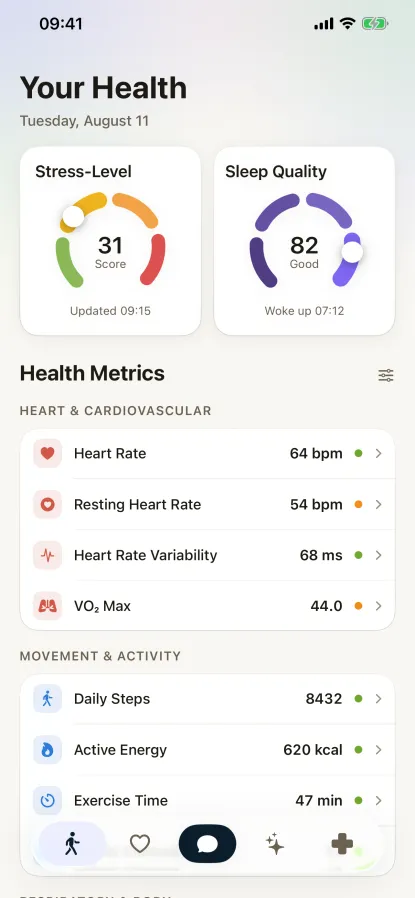
Sam app: the health overview with sleep, heart rate and activity

A stand test belongs with your doctor. Sam shows your heart rate against your personal baseline, never as a POTS test.

How Sam accompanies you day to day with POTS

Sam reads the data your wearable already writes to Apple Health and compares it to your personal baseline - understandable, not a wall of numbers.

1

Weekly trends, not single readings

With POTS, heart rate swings through the day. Sam shows resting heart rate, HRV and sleep over weeks, next to your own average.

2

Sleep, stress and pulse in context

You see sleep, stress level and heart rate side by side over the weeks, and bring your observations to your appointment.

3

Concrete numbers for the doctor's visit

The free monthly report shows trends from your everyday life as a PDF. POTS is easier to explain with a trend than with memory.

Sam is a wellness companion, not a medical device. The app does not diagnose, treat, cure, or prevent any illness and does not replace medical advice. Consult a qualified healthcare professional for medical decisions.

Ask about your numbers. Take the report along.

Sam shows your values next to your entries. What they mean is something to talk through with your doctor.

Ask Sam about your data

You ask a question, Sam answers with your own numbers. For example:

How has my heart rate looked throughout the day today?
This morning averaged 88 bpm - about 9 bpm above your usual range.
What about on calmer days?

Your monthly report as a PDF

The monthly report sums up your weeks - for appointments, applications, or simply your own record.

Monthly Report - June

Your Health Overview

Sleep

07:20Average
23:40Bedtime
68Score

Health status

3Sick days
27Healthy
4Symptoms
Created by Sam HealthPDF

Example values. Your report is based on your own data.

Articles about POTS

Further reading: what wearable data can show about everyday life with POTS - and where its limits are.

3 min read

POTS, Long COVID, and ME/CFS: How They Connect

POTS often occurs alongside Long COVID, ME/CFS, and hypermobility disorders, but each is a separate diagnosis. The exact combination determines whether structured exercise helps or harms you.

3 min read

POTS diagnostic criteria: what your standing heart rate means

POTS is defined by your heart rate response when you stand up. What the Schellong test and NASA Lean test measure, which heart rate values count as indicators, and what a wearable can actually tell you.

Frequently Asked Questions

Does Sam replace a stand test?+

No. Diagnosis belongs in the hands of a doctor - typically using a stand test or tilt table test. Sam shows you long-term trends in your wearable data.

What signals does Sam track for POTS?+

Sam reads data like resting heart rate, HRV, sleep, and activity from Apple Health and compares them with your personal baseline from recent weeks. Sam shows your heart rate over the day and against your baseline, but not whether you were lying down or standing at the time. A stand test belongs with your doctor.

Does Sam work if I'm taking beta blockers or other medication?+

Sam shows the data your wearable records, whatever medication you take. Keep in mind that medications can affect heart rate and HRV. Your baseline reflects you as you currently are; any changes to your treatment should be discussed with your doctor.

What are the typical symptoms of POTS?+

A racing heart (tachycardia) on standing is the core symptom, often accompanied by dizziness, lightheadedness, heart palpitations, headaches, nausea, brain fog (trouble concentrating), heat intolerance, and pronounced fatigue. How severe the symptoms are and which ones show up varies a lot from person to person - whether it's actually POTS is something only a doctor can determine.

Which smartwatch is best for tracking heart rate with POTS day to day?+

Sam reads Apple Health and works with the Apple Watch and with other wearables that save their data there, such as Oura, Whoop or Garmin, paired with an iPhone. Which values arrive depends on the device. A stand test belongs with your doctor, whatever watch you wear.

Can I still work or exercise with POTS?+

Whether and how you can work or exercise with POTS is highly individual - it depends on severity, any co-occurring conditions and your personal situation. Plan it with your care team; more in the article 'Living with POTS'.

Can I keep a symptom diary for POTS in Sam?+

Yes. You log your symptom days yourself, and Sam adds heart rate, resting heart rate, HRV, sleep duration and stress level. For heart rate on standing, keep to whatever measurement your care team asked for; Sam records your course over the weeks.

Understand what your body is telling you.

Download Sam for free, connect Apple Health, and see what your data says about everyday life with POTS - compared to your own baseline.

Free for iPhoneBuilt in Europe
Sam dashboard with wellbeing score, heart rate and sleep

Sam is a wellness companion, not a medical device. Sam does not diagnose, treat, cure, or prevent any illness and does not replace medical advice. For health questions or concerns, always consult a qualified medical professional.