7 min read
What doctor to see for obesity, and what to ask
Your GP or primary care doctor is usually the first stop for obesity. When a specialist or weight service comes in, and what to ask at the first visit.
Living with Obesity
The scale says something new each day. See the curve over months instead.
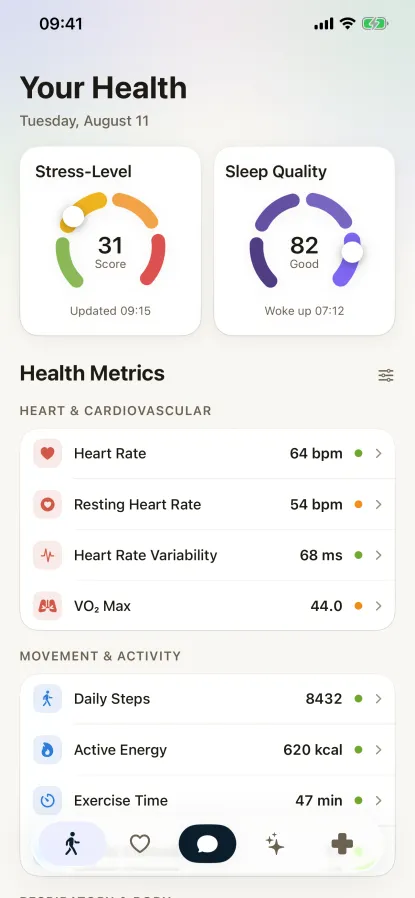
Your weight from Apple Health sits in the same app as steps, sleep and stress, no logbook needed. Your monthly PDF brings more than one number to the visit.
Your data
Your wearable already captures them. Sam reads them from Apple Health and shows you how they change over time, for many values against your personal baseline.
Your plan
Sam supports you in building habits with different programs you can use inside the app.
You told us
Sam suggests
Obesity
Condition
What Sam keeps
For people with obesity who follow their own trends and talk them through with their care team.
Your entries and your Apple Health data, over time, in one place.
You see your latest weight from Apple Health and a curve from one day to six months.
Steps, exercise minutes, sleep and stress level come from Apple Health, so you do not need a logbook.
You create the monthly report yourself: activity, sleep, stress and symptom days in a PDF, without medication or lab values.
Sam shows your values next to your entries. What they mean is something to talk through with your doctor.
You ask a question, Sam answers with your own numbers. For example:

The monthly report sums up your weeks - for appointments, applications, or simply your own record.
Monthly Report - June
Your Health Overview
Sleep
Symptoms
Example values. Your report is based on your own data.
Further reading: what wearable data can show about everyday life with Obesity - and where its limits are.
Your GP or primary care doctor is usually the first stop for obesity. When a specialist or weight service comes in, and what to ask at the first visit.
Why one reading on the scale says little, what NICE and the German S3 guideline say about weighing, and what to bring to an obesity appointment.
The WHO describes overweight and obesity as abnormal or excessive fat accumulation that presents a risk to health, and it calls obesity a chronic disease. For adults it draws the line at a BMI of 30 or above, and it notes that other measures such as waist circumference can also be used. The German S3 guideline adds that BMI describes body fat only roughly and lists waist circumference at the start of treatment as an optional measure (a weak recommendation). Whether obesity applies to you is for your doctor to decide.
Your weight moves from day to day, most often because of water, for example after a salty meal. Food and drink, digestion, hormonal changes such as the menstrual cycle, and some medications add to it. Small swings up or down are not unusual. One reading is therefore a snapshot, and writing readings down makes changes over time visible. What a trend means for you is for your care team to judge. If you have suddenly gained weight or are breathless lying down or with everyday activity, ask for an urgent appointment with your doctor straight away; for sudden or severe breathlessness, call 112 (EU).
There is no single rule that fits everyone, and Sam sets none. According to the German S3 guideline, your weight change during treatment should be monitored, recorded and discussed with you; this is addressed to the care team. Some people like to weigh in regularly, others find it unpleasant. Agree on a rhythm with your care team. Sam shows what your scale saves to Apple Health and does not remind you to weigh in. The weight row is an optional group in your health metrics, and you can leave it switched off.
Sam reads your weight from Apple Health, from a scale that writes there or from a manual entry in the Health app. You do not enter it in Sam. In the Health Metrics list, tap the sliders icon ('Customize Metrics') and add the 'Blood Pressure & Glucose' group, which holds the weight row. It shows your latest value and the trend, with a neutral dot instead of a traffic-light color. Sam Chat does not answer questions about weight. If you share anything through Friends & Family, your height and latest weight from Apple Health go with the profile the invited person sees.
No. Sam is not a diet or weight-loss app: it shows no BMI, sets no target weight, counts no calories and keeps no food diary. Active energy in Sam is the value Apple Health records for movement, not a calorie balance. Which goals fit you is something you settle with your care team.
In its section on prevention, the German S3 guideline gives an expert recommendation to keep enough sleep and a regular sleep rhythm in mind and to avoid high, lasting negative stress where possible. The studies behind it are thin: the links are small or inconsistent. Whether that plays a role for you, Sam cannot tell you; your doctor can put it in context. Sam shows sleep duration and a stress level (calculated from heart rate and HRV) as trends and draws no conclusion from them.
You can bring your medication list, weight trend, symptoms and lab reports. The list matters: for medicines that can raise weight in a relevant way, the German S3 guideline says this should enter the weighing of benefit and harm and be discussed. Never stop a medicine or change its dose on your own; talk to your doctor first. What belongs on it is covered in medication list for your doctor. Sam keeps medication, the symptom diary and the Health Vault; the monthly PDF report holds neither weight nor a medication list. If talking about your weight is hard, you may say so: the S3 guideline gives weight stigma its own chapter for the first time. For sudden shortness of breath or chest pain, call emergency services (112 in the EU) instead of waiting for an appointment.
Yes, as a reminder and log, not as a dosing aid. In the medication list you add the medication, set the time of day and choose daily, as needed, or an interval of 1 to 12 weeks or months. With a daily schedule or an interval, Sam reminds you at the chosen time; with an interval, it counts the next day from the last dose you ticked off, and a skipped dose does not move it. Your practice sets the dose and the interval. What applies to a late or missed dose is in the package leaflet or from your practice, and the date in Sam does not replace that.
Download Sam for free, connect Apple Health, and see your data for everyday life with Obesity over time.
Sam is a wellness companion, not a medical device. Sam does not diagnose, treat, cure, or prevent any illness and does not replace medical advice. For health questions or concerns, always consult a qualified medical professional.