7 min read
Apple Watch and Perimenopause: What It Shows and Doesn't
Apple Watch measures no hormones and no hot flashes. What Apple's perimenopause notification means, and what Sam shows from Apple Health.
Living through menopause
Your symptoms shift month to month. Your record keeps up with them.
Log hot flashes and night sweats and how strong they were, plus bleeding days; Sam counts your cycle length. At the visit, you have a record instead of memory.
Your data
Your wearable already captures them. Sam reads them from Apple Health and shows you how they change over time, for many values against your personal baseline.
What Sam keeps
For anyone in perimenopause, menopause or after who wants to log symptoms, bleeding and sleep over weeks.
Your entries and your Apple Health data, over time, in one place.
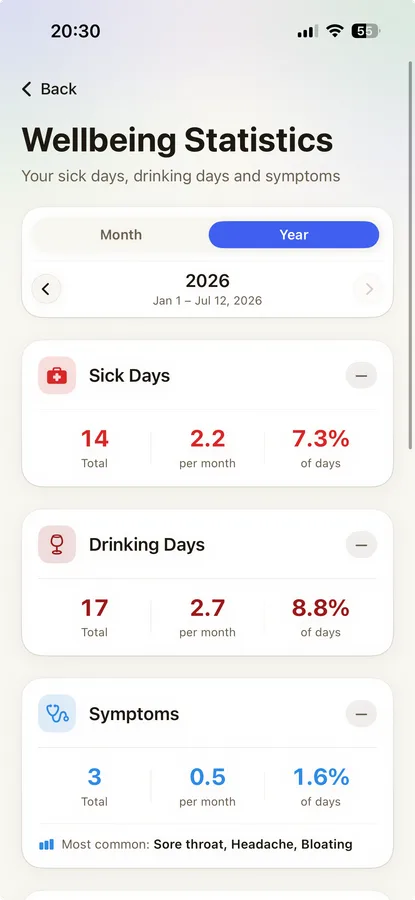
You log hot flashes and night sweats with a severity. Wellbeing Statistics show your symptom days and five most frequent.
You log bleeding days, flow and spotting. Sam counts cycle length from your entries, without estimating or predicting a next period.
You create the monthly report yourself and go into the visit with a record instead of memory.
Sam shows your values next to your entries. What they mean is something to talk through with your doctor.
You ask a question, Sam answers with your own numbers. For example:

The monthly report sums up your weeks - for appointments, applications, or simply your own record.
Monthly Report - June
Your Health Overview
Sleep
Symptoms
Example values. Your report is based on your own data.
Further reading: what wearable data can show about everyday life with Menopause - and where its limits are.
Apple Watch measures no hormones and no hot flashes. What Apple's perimenopause notification means, and what Sam shows from Apple Health.
Do you need a menopause blood test? From 45, usually not. When an FSH test helps, why one result says little, and what home urine tests can show.
What to note in a menopause symptom diary, how long to keep it, which bleeding needs a check, and how to bring it to your GP or gynecologist.
Which doctor to see for menopause symptoms, how referrals work in the UK and the US, when a specialist helps, and what to bring to the visit.
Palpitations, anxiety and blood pressure in perimenopause: possible causes, what your doctor checks, and how to record episodes, pulse and sleep.
The WHO lists hot flashes and night sweats, changes in how regular and how heavy periods are, vaginal dryness, incontinence, trouble sleeping, mood changes, depression and anxiety. The NHS adds joint and muscle aches, headaches and palpitations. Not everyone has all of them, and for many they last several years. You can log these in the symptom diary. Have palpitations checked rather than assuming they come from menopause; see Menopause: Palpitations, Anxiety and Blood Pressure. If low mood lasts or you have thoughts of harming yourself, talk to your doctor soon. A free crisis line is open around the clock (116 123 in the UK, Ireland and many other European countries, 988 in the US); in immediate danger call your local emergency number.
No. Sam can't tell you whether you are or which stage you're in, and it doesn't infer hot flashes from Apple Watch data. From age 45, NICE and the 2020 German S3 guideline usually base the assessment on symptoms and periods rather than hormone tests. With symptoms such as a change in your periods between 40 and 45, or with suspected very early menopause before 40, an FSH test can make sense. Guidelines differ on how many measurements that takes; your doctor decides whether a test applies to you. What you log in Sam is a basis for that conversation, not an assessment.
If your doctor asks how bad, how often and since when, a record beats memory; the German institute IQWiG notes that jotting down a few keywords on your symptoms before an appointment may help. In Sam's symptom diary you log one entry per symptom per day, with a severity where the symptom has one. How many times something came in a day, at what time, and a note are not recorded there. Wellbeing Statistics show your days with symptoms and your five most frequent, and the monthly report puts both into a PDF. A general guide is Symptom diary for your doctor.
No. Sam measures nothing itself and doesn't read hot flashes from Apple Health; they are in the symptom diary because you log them. From Apple Health, Sam shows sleep duration, resting heart rate and HRV as trends, plus a sleep quality figure that Sam calculates from the sleep data. Sam draws no link between those curves and your hot flashes. What an Apple Watch shows during perimenopause, and what it doesn't, is covered in Apple Watch and perimenopause: what it shows and doesn't.
Trouble sleeping is on the WHO's list of menopause symptoms. Sam shows sleep duration and a sleep quality figure it calculates from the sleep data as a trend; trouble falling asleep, waking during the night and night sweats you log yourself. Sam can't say why a night went badly. There is also the Sleep lifestyle program, which keeps your sleep routine and asks the MOS Sleep Scale questionnaire once a month. It is not a treatment for menopause. What to note about sleep before your visit is in Insomnia in menopause: what to note before your visit.
In cycle tracking you log each bleeding day with a flow from spotting to heavy, how it affected your day. Sam counts cycle length and bleeding days from your entries, shown from your shortest to your longest cycle. It doesn't predict your next period, show fertile days or work as contraception. The WHO lists changes in how regular and how heavy periods are among the symptoms; what they mean for you is a question for your gynecologist. From Apple Health, Sam brings in only bleeding days that have a flow level logged (light, medium or heavy); days logged without a flow level and spotting are not brought in.
Any bleeding after 12 months without a period, even if it is light or happens only once. Also bleeding that is heavier than before, between periods or after sex, and heavy bleeding: changing a pad or tampon every one to two hours, needing two products at once or bleeding for more than seven days (this is how the NHS describes heavy periods). You can log such days in cycle tracking and bring them to the practice; that doesn't replace a medical check. Bleeding after 12 months without a period should be checked soon. If you take hormones, ask your doctor which bleeding to expect. For chest pain, shortness of breath or fainting, call your local emergency number (112 in the EU, 999 in the UK, 911 in the US).
Yes. In the medication list you enter what you take, daily, every few weeks or months, or as needed, and tick off each dose. Anything the catalog does not know, you add as your own entry. In the Health Vault you can file lab reports. Sam knows 33 lab values by name, including TSH, vitamin D, total cholesterol and ferritin. Other rows on your report, hormone values such as FSH included, are carried over as printed. If Sam can read a printed reference range, it shows only the comparison next to the value: high, low or in range. If the lab prints several ranges, Sam uses only one of them and the label can be wrong. What the values mean for you, Sam doesn't say. Whether a hormonal treatment suits you is not something Sam says either; that is a conversation with your doctor.
Download Sam for free, connect Apple Health, and see your data for everyday life with Menopause over time.
Sam is a wellness companion, not a medical device. Sam does not diagnose, treat, cure, or prevent any illness and does not replace medical advice. For health questions or concerns, always consult a qualified medical professional.