11 min read
Insomnia in Menopause: What to Note Before Your Visit
Why menopause can wreck your sleep, how long it may last, and what to note before you see a doctor: sleep problems, night sweats, periods and daytime effects.
Living with Insomnia
The worst night you remember. Sam keeps the others too.
Your nights arrive from Apple Health as a trend, and you log daytime sleepiness or trouble falling asleep. At the appointment, you show weeks, not one night.
Your data
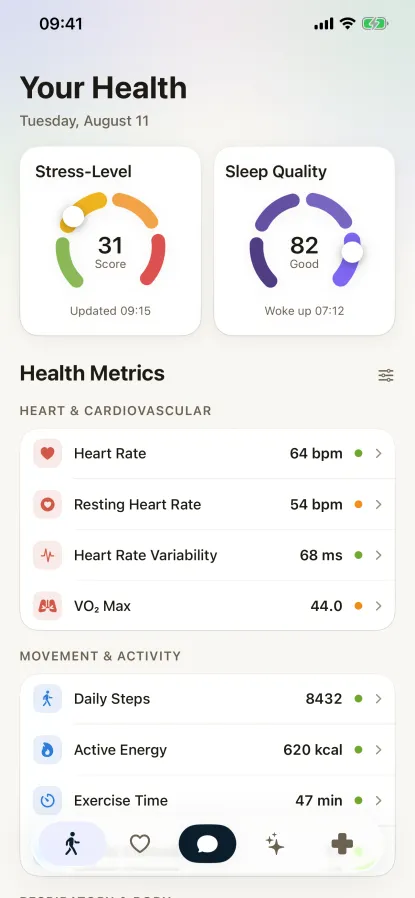
Your wearable already captures them. Sam reads them from Apple Health and shows you how they change over time, for many values against your personal baseline.
What Sam keeps
For people with sleep trouble who want nights and symptoms on record, for themselves or a doctor.
Your entries and your Apple Health data, over time, in one place.
Your nights show as a trend over weeks and months. A watch estimates them at the wrist; a sleep lab measures them.
You record difficulty falling asleep or daytime sleepiness. Once a month, the MOS Sleep Scale asks about the past four weeks.
You create a PDF with a sleep page and your symptom days. It is not a sleep diary with bedtimes.
Sam shows your values next to your entries. What they mean is something to talk through with your doctor.
You ask a question, Sam answers with your own numbers. For example:

The monthly report sums up your weeks - for appointments, applications, or simply your own record.
Monthly Report - June
Your Health Overview
Sleep
Symptoms
Example values. Your report is based on your own data.
Further reading: what wearable data can show about everyday life with Insomnia - and where its limits are.
Why menopause can wreck your sleep, how long it may last, and what to note before you see a doctor: sleep problems, night sweats, periods and daytime effects.
Who to see for insomnia, how doctors diagnose it, when a sleep study is considered and what a sleep diary should hold, with the guideline behind each step.
The ISI is a validated 7-question self-report tool that measures how much your sleep difficulties are affecting your life right now - producing a score from 0 to 28 that you can track over time to see whether your sleep is genuinely improving or just varying.
Needs differ from person to person. The NHS gives 7 to 9 hours as the usual range for adults, and the American Academy of Sleep Medicine and the Sleep Research Society recommend that adults regularly get at least seven. Sam can't tell you how much sleep is right for you. In the monthly report, Sam sets your average sleep duration against a fixed mark of seven hours and labels it "Good" or "Below target"; the mark is the same for everyone and not a medical assessment of how much sleep you need. Sam shows how long you slept according to Apple Health and how that moves over weeks. On why duration alone can mislead: sleep duration as a health metric.
Sleeping badly now and then is common. Insomnia disorder means trouble falling asleep, staying asleep or waking too early despite enough opportunity to sleep, with effects in the daytime such as tiredness or low mood. DSM-5, ICSD-3 and ICD-11 call it chronic when it happens several times a week (DSM-5 and ICSD-3: at least three nights a week) for at least three months. These are criteria for a diagnosis, not a waiting period: you can talk to a doctor sooner. Whether that fits you is for your doctor to decide, and Sam doesn't diagnose. On the ISI questionnaire: how to use the ISI. Sam does not include the ISI.
A score combines estimates. Apple says its Sleep Score weighs sleep duration, bedtime consistency and interruptions. Sam calculates its own sleep score from up to ten parts of the night, including time awake, HRV and resting heart rate. Both rest on wrist sensors that estimate sleep stages. The European Insomnia Guideline notes that the validity of such devices for diagnosing insomnia has not been satisfactorily studied. No score replaces how you feel during the day. More: how accurate Apple Watch sleep stages are.
Sleep hygiene covers conditions and habits around sleep, such as bedroom temperature, light and noise, caffeine, alcohol and a regular daily routine. The European Insomnia Guideline states that sleep hygiene alone is not an evidence-based treatment for chronic insomnia, and the American Academy of Sleep Medicine guideline suggests not using it as a single treatment. The European guideline names cognitive behavioral therapy for insomnia (CBT-I), in person or digital, as the first-line option, and the American guideline gives CBT-I a strong recommendation. CBT-I is something to raise with your doctor or a psychotherapist.
The NHS advises seeing a doctor if changing your sleeping habits hasn't helped, you've had trouble sleeping for months, or it makes daily life hard to cope with. Loud snoring with pauses in breathing, heavy daytime sleepiness or suddenly falling asleep are worth raising promptly: they can point to another sleep disorder such as sleep apnea (what an Apple Watch apnea notification means). If you feel drowsy at the wheel, do not keep driving. If low mood or thoughts of harming yourself weigh on you, contact your doctor right away. In an emergency call your local emergency number (112 in the EU, 999 in the UK, 911 in the US). For urgent problems that are not life-threatening when your practice is closed, call its out-of-hours number or, in the UK, NHS 111. Free support lines: Samaritans 116 123 (UK and Ireland), 988 (US), Telefonseelsorge 0800 111 0 111 (Germany). The monthly report can go with you to the appointment. Which doctor to see and which tests are used is covered in What doctor to see for insomnia.
No. Sam doesn't diagnose and can't tell you why you sleep the way you do. An answer in Sam Chat may point to a possible link in your data, such as a workout the day before and a lower HRV; that is not a finding of a cause. It is also not CBT-I: there is no sleep diary where you type in bedtimes and no sleep schedule with fixed bed and wake times. Sam shows the times Apple Health records and keeps symptoms per day in the symptom diary, without a time of day or a count of awakenings. The Sleep lifestyle program (see programs) offers occasional general everyday habits and is no substitute for therapy. Sam Chat answers questions about your own data, without medical advice.
It is possible, but the evidence is limited. Case reports describe people who sought help for suspected sleep problems because of their tracker data, a pattern called orthosomnia. In an experiment with people who have insomnia, fake feedback about their sleep changed how they rated their symptoms the same day (Gavriloff et al., 2018). The European Insomnia Guideline mentions that using such devices might affect sleep behavior negatively, and it generally advises against sleep trackers for people with insomnia until their accuracy against polysomnography has been shown. Only you can tell whether the numbers help or unsettle you. If they unsettle you, that is worth mentioning at your appointment.
Download Sam for free, connect Apple Health, and see your data for everyday life with Insomnia over time.
Sam is a wellness companion, not a medical device. Sam does not diagnose, treat, cure, or prevent any illness and does not replace medical advice. For health questions or concerns, always consult a qualified medical professional.