11 min read
High Cholesterol but Eat Healthy? When It's Genetic
Eating well but LDL still high? How much diet really moves cholesterol, when it is inherited (FH) and how doctors check for it, step by step.
Living with High Cholesterol
Last year's lab report is somewhere. Keep it next to the new one.
Photograph each lab report and see LDL, HDL and triglycerides against your lab's own range. Medication reminders and your daily steps are in the same app.
Your data
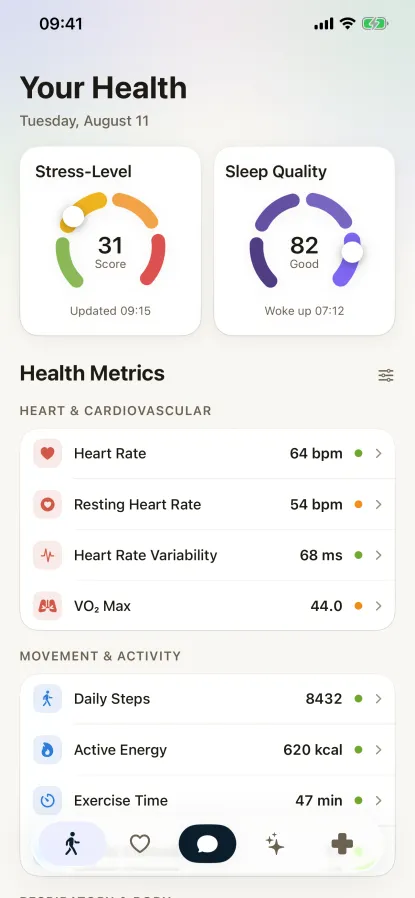
Your wearable already captures them. Sam reads them from Apple Health and shows you how they change over time, for many values against your personal baseline.
Your plan
Sam supports you in building habits with different programs you can use inside the app.
You told us
Sam suggests
High Cholesterol
Condition
What Sam keeps
High cholesterol usually causes no symptoms, so Sam keeps lab reports, medication and everyday movement.
Your entries and your Apple Health data, over time, in one place.
You photograph or upload the report. Once you agree, Sam reads the values, and you check them before they are saved.
Values are marked against the range printed on your report. Any goal is for your doctor to set.
Sam reminds you at the times you enter, and you tick off each dose. Steps and exercise minutes appear as a trend.
Sam shows your values next to your entries. What they mean is something to talk through with your doctor.
You ask a question, Sam answers with your own numbers. For example:

The monthly report sums up your weeks - for appointments, applications, or simply your own record.
Monthly Report - June
Your Health Overview
Sleep
Symptoms
Example values. Your report is based on your own data.
Further reading: what wearable data can show about everyday life with High Cholesterol - and where its limits are.
Eating well but LDL still high? How much diet really moves cholesterol, when it is inherited (FH) and how doctors check for it, step by step.
Cholesterol results explained: what LDL, HDL, non-HDL and triglycerides mean, whether you need to fast, and why your goal can differ from the lab range.
No. Cholesterol can only be measured with a blood test. Sam doesn't measure blood values, and an Apple Watch doesn't give you a cholesterol reading either. Sam reads the numbers from lab reports that you add yourself as a photo or PDF, and only after you agree.
Total cholesterol adds up all the cholesterol in your blood. LDL cholesterol is the value that the treatment goals in the European guideline mostly refer to. HDL cholesterol is often called the good one, but the German health institute IQWiG says a protective effect has not been confirmed in newer studies. Triglycerides are another type of blood fat. Doctors call raised blood fats dyslipidaemia. IQWiG also notes there is no single value above which risk suddenly rises, and what your numbers mean for you is for your doctor to say.
Usually not. The NHS says most people do not need to fast, and the 2019 European guideline (ESC/EAS) says non-fasting samples seem to have at least the same prognostic value for general risk screening. On average, triglycerides run about 27 mg/dL (0.3 mmol/L) higher after eating; if they are very high, your clinic may repeat the test fasting. Your clinic tells you what applies to your appointment, for example if a fasting glucose is measured at the same visit.
Your doctor sets that for you. As one example, the NHS Health Check in England includes a cholesterol test and is offered every five years to adults aged 40 to 74 who do not already have a condition such as heart disease or inherited high cholesterol and are not taking cholesterol-lowering medicine; people who do are followed up through regular check-ups. Sam keeps every lab report you add and, if both reports print the same unit, shows what changed compared with the previous one.
The range printed on a lab report is usually a general reference point from the lab, not tailored to your personal risk. Whether a goal applies to you, and which, depends on your overall cardiovascular risk and is for your doctor to set. Guidelines also differ: the European guideline (ESC/EAS) gives LDL goals by risk group, while the German GPs' society DEGAM called an LDL-target strategy unnecessarily complex in a 2024 statement. Sam only shows the range printed on your report, sets no goal of its own and calculates no risk, so it cannot tell you whether you have reached your personal goal.
Whether to take preventive medication when you have not had a heart attack or stroke is, as IQWiG puts it, a matter of personal weighing-up; IQWiG recommends treatment for people who have already had a heart attack, stroke or other cardiovascular disease, and for people with inherited high cholesterol. Worries, possible side effects and any question about stopping belong in a conversation with your doctor. Sam doesn't take any of that on: it reminds you at the times you enter for your medication and keeps a record of when you ticked off a dose. You can note complaints in the symptom diary. Sam doesn't link them to a medicine or check interactions, and which dose applies is for your doctor to decide. Do not stop a prescribed medicine on your own.
European guidelines list not smoking, a diet low in saturated fat and regular physical activity as part of lifestyle advice for blood fats. How much that matters for you is for your doctor to judge. Sam shows steps, active energy and exercise minutes from Apple Health as a trend over weeks, and its movement and exercise features add a short activity questionnaire once a month. That is a display of your data, not a measure against high blood fats. Sam doesn't measure what you eat and doesn't link your activity to your lab values. For high cholesterol despite a healthy diet, see High cholesterol but eat healthy? When it's genetic.
Your latest lab reports, a current medication list and the answer to whether a parent or sibling had a heart attack or stroke early in life all fit an appointment. IQWiG names early cases in the family as a risk factor. You add the reports to your Health Vault in Sam; Sam reads the values only after you agree. Sam files some rows under the wrong value, for example VLDL cholesterol under total cholesterol; check the name and number of every row against the original report. You create the monthly report yourself; it only counts your reports and values, not the values themselves. High cholesterol doesn't usually cause symptoms. Chest pain or pressure is always a reason to call the emergency number straight away (112 in the EU, 999 in the UK, 911 in the US); it can spread to the arm, neck or jaw and come with shortness of breath, sweating or nausea. The same goes for sudden weakness in the face or arms, trouble speaking or loss of vision. Don't wait to see whether the symptoms go away on their own.
Download Sam for free, connect Apple Health, and see your data for everyday life with High Cholesterol over time.
Sam is a wellness companion, not a medical device. Sam does not diagnose, treat, cure, or prevent any illness and does not replace medical advice. For health questions or concerns, always consult a qualified medical professional.