
Living with heart failure

Heart Failure: Activity, Resting Heart Rate and Sleep

Take care of your heart.

Sam keeps your resting heart rate, activity, sleep and symptoms in one place. You take that history to your next appointment.

  • Not a medical device
  • Works with Apple Watch, Oura, Whoop & Garmin
  • Built in Europe

What happens in the heart with heart failure

Step by step: how the heart fills and pumps, what changes with heart failure and where people notice it. The model shows the heart and the start of its large vessels.

  1. 1The heart

    The heart

    Where heart failure plays out

    The heart is a muscular pump. Its two lower chambers push blood out, the right one to the lungs, the left one to the rest of the body.

    Heart

    A human figure, seen from the front at an angle. The heart in the chest turns rose; the large vessels around it stay grey. The heart beats at a calm resting pace, the upper chambers just before the lower ones.
  2. 2Without heart failure

    Each heartbeat

    Fill, then pump

    Between beats the heart relaxes and fills with blood; then its muscle contracts and pumps the blood out. This supplies organs and muscles with oxygen.

    Atria / Ventricles

    Close view of the heart, the large vessels dimmed around it. With each beat the upper chambers contract first, then the lower chambers, at a calm resting pace.

  3. 3With heart failure

    Heart failure

    Less than the body needs

    In heart failure, the heart cannot pump as much blood as the body needs. In some people the heart muscle is too weak to pump properly; in others the heart is too stiff to relax and fill well between beats.

    Ventricles

    Same view, turned slightly. The lower chambers turn a deeper, muted rose. The heart keeps its pace, but each beat is a smaller movement than before, which stands for less blood being pumped.

  4. 4Where people feel it

    Day to day

    Symptoms in daily life

    Typical symptoms are breathlessness, tiredness and swollen ankles. Fluid can collect in the legs and the lungs. Breathlessness can come with exertion or when lying flat.

    Worth discussing with your doctor.

    New or severe symptoms need a doctor. Chest pain, fainting or sudden breathlessness: call emergency services.

    Breathlessness / Tiredness

    The view pulls back to the figure from the head to the thighs. The heart returns to a neutral grey and keeps beating with the smaller movement. A soft rose area marks the chest, for breathlessness, and a fainter tint covers the body from the neck down, for tiredness.

Sources concern the condition
  1. [1] OpenStax; Betts JG, Young KA, Wise JA, et al.. Anatomy and Physiology 2e, sections 19.1 Heart Anatomy and 19.3 Cardiac Cycle. 2022. OpenStax, Rice University. https://openstax.org/books/anatomy-and-physiology-2e/pages/19-1-heart-anatomy
  2. [2] European Society of Cardiology (ESC); Køber L, Adamo M, et al.. 2026 ESC Guidelines for the management of heart failure. 2026. European Heart Journal (published online 28 August 2026). https://doi.org/10.1093/eurheartj/ehag100
  3. [3] National Heart, Lung, and Blood Institute (NHLBI), NIH. Heart Failure: What Is Heart Failure?, Causes and Risk Factors, Symptoms (last updated 24 March 2022). 2022. nhlbi.nih.gov. https://www.nhlbi.nih.gov/health/heart-failure
  4. [4] Bundesministerium für Gesundheit, in Zusammenarbeit mit dem Institut für Qualität und Wirtschaftlichkeit im Gesundheitswesen (IQWiG). Herzschwäche (Herzinsuffizienz) (Stand 14.03.2024). 2024. gesund.bund.de. https://gesund.bund.de/herzschwaeche
  5. [5] NHS. Heart failure (page last reviewed 26 June 2026). 2026. nhs.uk. https://www.nhs.uk/conditions/heart-failure/

Own simplified illustration based on the sources above.

The model shows the heart's atria and ventricles from outside and, for orientation, the start of the large vessels. Heart valves, the inside of the chambers, the lungs, the leg veins and the rest of the circulation are not in the model. Each heartbeat is shown as a small change in size, the atria just before the ventricles. In the heart failure step the smaller movement stands for the heart not pumping as much blood as the body needs, and the deeper rose of the ventricles marks the condition. The model cannot show whether the heart muscle is weak or stiff. In the stiff form the heart can still squeeze strongly but fills less; the smaller movement is a symbol for both forms, not a picture of how the muscle moves. The two ventricles share one wall in the model, so the tint covers both, although heart failure can affect the left side, the right side or both. Fluid in the lungs and swollen ankles are not shown. The rose area on the chest marks where breathlessness is felt, the faint tint on the body stands for tiredness; neither shows a cause or a measurement. In the last step the heart turns grey to move the focus to the body; the smaller movement continues. Adult male reference model; close-ups are not to scale.

3D anatomy: BodyParts3D, (c) The Database Center for Life Science, CC BY 4.0. Prepared via human-atlas; simplified, cropped, coloured and animated by SanoLabs.

What Sam keeps for you

No watch sees inside the heart. What you notice, Sam keeps.

For people living with heart failure who want a record for their appointments. Sam is not a medical device. It keeps what you and your wearable already produce and puts it in one place.

From Apple Health

Your Apple Watch, Oura, Whoop or Garmin already records them, and you add what you log. Sam reads them from Apple Health and shows you how they shift against your personal baseline.

Resting heart rateDaily stepsExercise minutesRespiratory rateSleep duration

You log it

Shortness of breath, fatigue, leg or ankle swellingHow strong, from mild to severeWhere the swelling sitsGood, a bit off or sick, day by dayDoctor's letters and lab results

Once a month

Monthly health report as a PDF

Check in on most days, and once a month it becomes a PDF for your appointment.

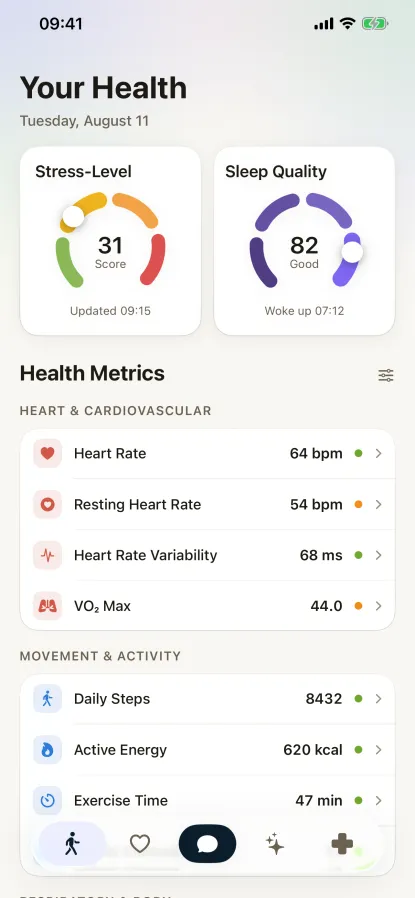
Sam app: the health overview with sleep, heart rate and activity

How much blood the heart pumps is outside what an Apple Watch can record. Sam keeps what you notice and what your Watch produces.

How Sam accompanies you day to day with Heart Failure

Sam reads the data your wearable already writes to Apple Health and compares it to your personal baseline - understandable, not a wall of numbers.

1

Your weekly activity at a glance

Steps, movement and rest from Apple Health show whether your weeks are getting more active or more restful.

2

Activity, resting heart rate and sleep together

You see all three as a trend next to your own average. It is an overview, not a medical assessment. For symptoms, talk to your care team.

3

A report for your care team

The free monthly report shows your weeks between appointments as a PDF. You bring it along instead of reporting from memory.

Sam is a wellness companion, not a medical device. The app does not diagnose, treat, cure, or prevent any illness and does not replace medical advice. Consult a qualified healthcare professional for medical decisions.

Ask about your numbers. Take the report along.

Sam shows your values next to your entries. What they mean is something to talk through with your doctor.

Ask Sam about your data

You ask a question, Sam answers with your own numbers. For example:

Was I more active this week than last week?
Yes - about 5,800 steps a day on average, roughly 12% more than last week.
How stable was my resting heart rate during that time?

Your monthly report as a PDF

The monthly report sums up your weeks - for appointments, applications, or simply your own record.

Monthly Report - June

Your Health Overview

Resting heart rate

64Avg (bpm)
-2vs. baseline
30Days logged

Activity

7.4kSteps/day
18Days on target
+12%vs. last month
Created by Sam HealthPDF

Example values. Your report is based on your own data.

Articles about Heart Failure

Further reading: what wearable data can show about everyday life with Heart Failure - and where its limits are.

Frequently Asked Questions

Can my Apple Watch tell if my heart failure is getting worse?+

No. Sam is not a medical device, and the Apple Watch does not show whether heart failure is getting worse. Sam shows how your activity, resting heart rate and sleep compare with your own recent weeks, as a starting point for talking with your care team. If you notice symptoms like shortness of breath or swelling, contact your doctor directly.

Which wearable data actually matters for heart failure?+

That's best discussed with your care team. Your wearable already records steps, exercise minutes, resting heart rate and sleep without any input from you, and Sam shows them as trends against your own recent weeks.

Do I need to log or measure anything myself?+

You don't measure anything extra: Sam reads the data your Apple Watch or other wearable already writes to Apple Health. For the monthly report, Sam needs to know how you felt on at least half of the days. The Weekly Check asks about the past seven days in one go. Logging symptoms is up to you.

What about the heart rhythm features on my Apple Watch?+

The ECG app and the irregular rhythm notification are regulated features from Apple, not part of Sam. Heart rhythm is a matter for those features and your doctor; Sam keeps your resting heart rate, activity, sleep and what you log. If your watch shows a rhythm notification, talk to your doctor about it.

Can my Apple Watch measure low blood oxygen levels related to heart failure?+

Newer Apple Watch models offer a Blood Oxygen feature that estimates levels in the background, but Apple states it is not intended for medical use. If your watch saves blood oxygen readings to Apple Health, Sam shows them next to your other values. For questions about your oxygen saturation, your care team is the right place to ask.

Can I keep a symptom diary for heart failure in Sam?+

Yes, for symptoms and daily context. You log your symptom days yourself in the symptom diary, and Sam fills in resting heart rate, steps, exercise minutes, respiratory rate and sleep duration. Sam does not measure your weight - that goes into Apple Health as usual, and what follows from it is a conversation with your clinician.

Understand what your body is telling you.

Download Sam for free, connect Apple Health, and see what your data says about everyday life with Heart Failure - compared to your own baseline.

Free for iPhoneBuilt in Europe
Sam dashboard with wellbeing score, heart rate and sleep

Sam is a wellness companion, not a medical device. Sam does not diagnose, treat, cure, or prevent any illness and does not replace medical advice. For health questions or concerns, always consult a qualified medical professional.