12 min read
Back Pain but a Normal MRI: What It Means, What to Log
Your MRI is normal but your back still hurts: what non-specific low back pain means, what to log after the scan, and when another check is needed.
Living with chronic low back pain
Some days your back is fine. Sam counts the days it isn't.
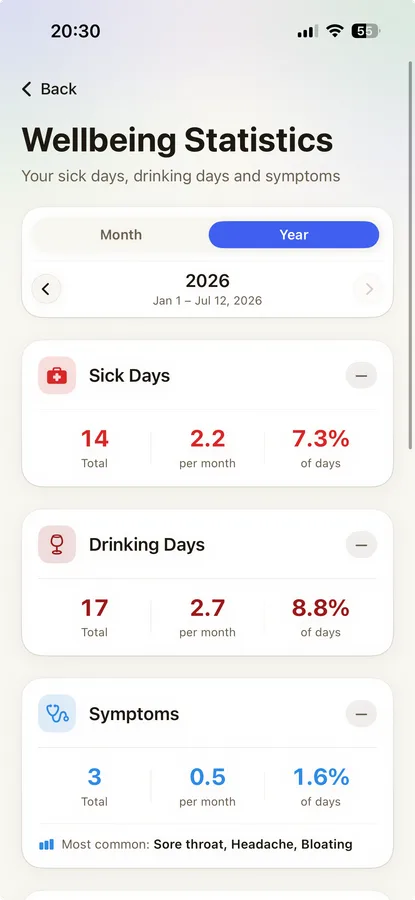
Log back pain as mild, moderate or severe, and Sam counts your symptom days. Your monthly PDF adds activity, sleep and stress, so you bring a record, not a guess.
Your data
Your wearable already captures them. Sam reads them from Apple Health and shows you how they change over time, for many values against your personal baseline.
Your plan
Sam supports you in building habits with different programs you can use inside the app.
You told us
Sam suggests
Chronic Low Back Pain
Condition
What Sam keeps
For people with ongoing back pain who want to record their weeks between appointments.
Your entries and your Apple Health data, over time, in one place.
You log back pain per day: mild, moderate or severe. Sam counts your symptom days and shows your most frequent symptoms.
Trends are a few taps from your entries. Statistics and report calculate no link; whether there is one is for your doctor.
You create the PDF yourself: symptom days, most frequent symptoms, activity, sleep and stress. You show it at the visit.
Sam shows your values next to your entries. What they mean is something to talk through with your doctor.
You ask a question, Sam answers with your own numbers. For example:

The monthly report sums up your weeks - for appointments, applications, or simply your own record.
Monthly Report - June
Your Health Overview
Sleep
Symptoms
Example values. Your report is based on your own data.
Further reading: what wearable data can show about everyday life with Chronic Low Back Pain - and where its limits are.
Your MRI is normal but your back still hurts: what non-specific low back pain means, what to log after the scan, and when another check is needed.
What doctor to see for back pain that lasts: usually a GP first, then a physio or specialist, depending on the findings. Signs that cannot wait are listed.
When back pain counts as chronic, what to write down between appointments, what your GP or physio will ask, and which symptoms need a doctor now.
NICE, the UK guideline body, defines chronic low back pain as pain lasting three months or longer, and notes that the intensity can fluctuate over time. The German national guideline (2017 edition, no longer valid) uses more than twelve weeks. Neither sets a minimum number of pain days per month. For research, an NIH task force (2014) uses a narrower definition: pain for at least three months, on at least half the days of the past six months. Whether yours counts is for your doctor to say; Sam does not classify your pain.
NICE advises that people with low back pain are encouraged to continue with normal activities, and the NHS says to stay active and not to stay in bed for long periods. How much and what kind of movement suits you is something to work out with your doctor or physiotherapist. Sam gives no exercises and shows steps and exercise minutes from Apple Health.
When the conversation and examination give no sign of a serious cause, NICE says not to routinely offer imaging in a non-specialist setting, and to consider it in specialist care only if the result is likely to change management. German patient information adds that scans often show changes in people who have no back pain at all. Whether a scan makes sense for you is a decision for your doctor, especially if there are signs of a serious cause (see the question on getting medical help); Sam cannot assess images. If you already have a scan with a normal result, Back pain but a normal MRI: what it means, what to log explains what that means.
The German patient guideline (2017) lists typical questions: where the pain is, whether it spreads, when it is better or worse, how it has changed over weeks and months, and how much it limits daily activities. In the symptom diary you log days: lower back pain as mild, moderate or severe, plus for example morning stiffness or numbness or tingling. Pain medication you only take when needed goes into medications with amount and time; there is no reminder for it.
Back pain rarely has a serious cause. Call your local emergency number or go to an emergency department for pain, tingling, weakness or numbness in both legs, numbness in the buttocks or around the genitals or anus, difficulty peeing or loss of bladder or bowel control, changes in how your penis or vagina feels during sex, erection problems or not being able to orgasm, chest pain, or pain after a serious accident. Get medical help straight away, without waiting for your next appointment (in the UK, an urgent GP appointment or NHS 111; elsewhere, a same-day or urgent appointment with your doctor or your local out-of-hours service), for signs of paralysis, severe symptoms, new numbness or growing weakness in one leg, a fever, chills, night sweats or feeling generally unwell, or severe pain that starts suddenly or gets worse quickly. See a doctor about weight loss without trying, loss of appetite or a general feeling of physical weakness, a history of cancer, severe pain at night or at rest, pain that gets worse at night or when you lie on your back or does not ease with rest, pain after a fall or, with osteoporosis, after heavy lifting or an awkward twist of the spine, pain spreading down a leg, especially past the knee or into the foot, also with numbness, tingling or weakness, several signs of inflammatory back pain together (pain lasting more than twelve weeks, a gradual start, morning stiffness that eases with movement and gets worse with rest), back pain together with psoriasis, inflammatory bowel disease, joint or tendon inflammation or inflammation of the middle layer of the eye, a lump, swelling or change of shape in your back, pain that is worse when sneezing, coughing or pooing, pain between the shoulder blades, and back pain that does not improve after a few weeks at home, stops your day-to-day activities, or leaves you worried or struggling to cope. Sam gives no medical assessment of your entries, including numbness or tingling, and does not replace that check.
A 2021 review of 27 studies (Van Looveren et al., Journal of Clinical Medicine) found weak to moderate evidence of an association between sleep and chronic pain in the back and neck, with low to moderate study quality. The German patient guideline (2017) lists stress and emotional strain among factors that can contribute to back pain or keep it going. Sam shows sleep duration, sleep quality and a stress level calculated from heart rate and HRV in the same app, a few taps from your entries. In the statistics and the monthly report, Sam calculates no link. Whether there is one for you is a question for your doctor.
No. Sam does not measure pain, look for a cause, judge your posture or show exercises. There is no 0 to 10 pain scale, which the German patient guideline mentions as a tool for the conversation with your doctor: you pick mild, moderate or severe, once per day and symptom, with no time of day and no note. For body aches you can tap the back on the body map. If your clinic gives you its own pain diary, Sam does not replace it.
Yes. In medications you can add something as needed, with no reminder, and log each time you take it with amount and time. The catalog is a selection, not a recommendation; Sam does not check interactions and does not link an intake to a symptom entry. The medication log guide explains what is worth noting for as-needed medication.
Download Sam for free, connect Apple Health, and see your data for everyday life with Chronic Low Back Pain over time.
Sam is a wellness companion, not a medical device. Sam does not diagnose, treat, cure, or prevent any illness and does not replace medical advice. For health questions or concerns, always consult a qualified medical professional.