9 min read
Low eGFR: What to Do After a High Creatinine Result
A low eGFR or high creatinine result needs a doctor's review. What gets checked next, why confirming takes three months and which symptoms should not wait.
Living with chronic kidney disease
Which values moved since last time? See the three that moved most.
Keep lab reports, blood pressure and weight from Apple Health, your medicines and symptoms like ankle swelling in one app. At the check-up, everything is at hand.
Your data
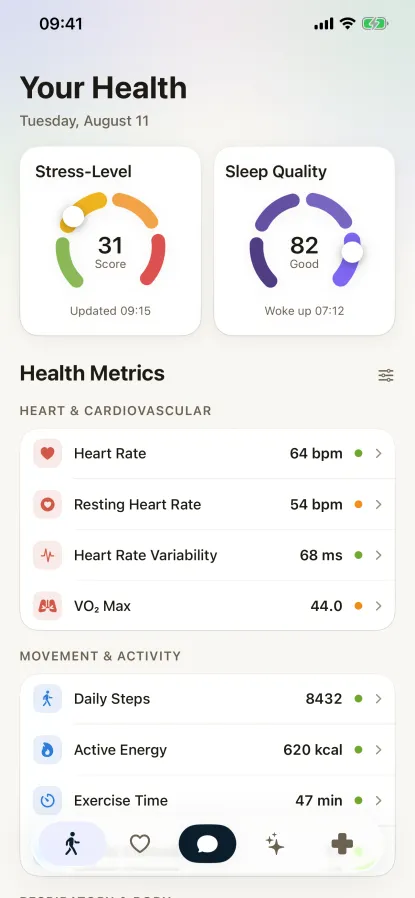
Your wearable already captures them. Sam reads them from Apple Health and shows you how they change over time, for many values against your personal baseline.
Your plan
Sam supports you in building habits with different programs you can use inside the app.
You told us
Sam suggests
Chronic Kidney Disease
Condition
What Sam keeps
For people with chronic kidney disease who want to order values, medicines and symptoms before a check-up.
Your entries and your Apple Health data, over time, in one place.
With your consent, Sam reads values such as eGFR from a photo or PDF. It shows the three that moved most.
Blood pressure and weight appear if Apple Health stores them and you switch them on. Steps, sleep and stress show as trends.
A medication list with reminders and a symptom diary for things like ankle swelling. You have both at the check-up.
Sam shows your values next to your entries. What they mean is something to talk through with your doctor.
You ask a question, Sam answers with your own numbers. For example:

The monthly report sums up your weeks - for appointments, applications, or simply your own record.
Monthly Report - June
Your Health Overview
Sleep
Symptoms
Example values. Your report is based on your own data.
Further reading: what wearable data can show about everyday life with Chronic Kidney Disease - and where its limits are.
A low eGFR or high creatinine result needs a doctor's review. What gets checked next, why confirming takes three months and which symptoms should not wait.
Why doctors refer people to a nephrologist, what happens at the first kidney clinic visit and what to bring, based on NICE, KDIGO and NHS guidance.
What creatinine, eGFR and urine albumin (ACR) on your lab report mean, how KDIGO stages kidney disease and how often guidelines suggest checking them.
eGFR is an estimate of how much blood your kidneys filter each minute. The lab usually calculates it from your blood creatinine, age and sex; it is not measured directly, and because creatinine also depends on muscle mass it stays an approximation. Doctors read it together with urine albumin, and KDIGO describes chronic kidney disease (CKD) as abnormalities of kidney structure or function that last at least three months. Sam keeps the eGFR from your report and shows it with the range your lab printed. What the number means for you is a question for your kidney doctor.
Labs measure creatinine with different methods and report it in mg/dL or in umol/L. For creatinine the range also depends on age and sex. For eGFR, some labs print a fixed cut-off and others print age-dependent ranges. The same number can therefore sit inside the printed range on one report and outside it on another. Sam always uses the range printed on that report, sets none of its own and converts no units: if a value is printed in different units on two reports, the comparison of your last two reports in the Health Vault leaves it out. Compare values only in the same unit. KDIGO also notes that eGFR and urine albumin vary from test to test, so an unexpected change is first checked by repeating the test.
Your care team sets this with you. KDIGO says to check kidney function and urine albumin at least once a year in CKD and more often when the risk of progression is higher. Its guide figures run from about once to four or more times a year, depending on the stage and the albumin level. The German GP guideline (DEGAM) proposes similar, somewhat lower frequencies. Sam sets no intervals. If you add each report after a visit, your reports stay together in your Health Vault and Sam compares the last two.
A CKD check-up usually covers blood and urine results, blood pressure and your medicines. In Sam you can bring together lab reports in your Health Vault, your medication list and symptoms from the symptom diary. You create the monthly report yourself; it holds activity, sleep, stress, symptom days with your top five symptoms and the number of lab reports you added, but no lab values, no blood pressure and no medication list. KDIGO asks clinicians to review over-the-counter and herbal products too, so add them to your list. Some over-the-counter products, especially certain painkillers, can harm the kidneys, so check with your clinic before taking them. More: what to put on a medication list. If your doctor has also confirmed high blood pressure, you can start the high blood pressure program and enter readings yourself. For what a nephrologist does and what happens at a first visit, see Why was I referred to a nephrologist? What to expect.
Not as a named value. Next to eGFR, urine albumin (the albumin-creatinine ratio) is the second core kidney test, and KDIGO says to test both. Urine albumin is not one of the values Sam knows by name, unlike creatinine, eGFR, urea, potassium, sodium, calcium and hemoglobin. If the line is in the values table of a lab report you add, Sam can take it over with your consent, with your lab's range if one is printed. You can check it before saving. Whether it comes through depends on how your report is laid out. Urine creatinine and some ways of printing the ratio, such as Albumin/Creatinine, are saved as creatinine, though. Check such rows on the saved report as well. Your clinic has the urine result, so ask them for it.
No. Sam has no features for a diet, fluid, potassium or phosphate log and none for dialysis. Potassium and sodium appear only as values from your lab report, against your lab's range, with a mark for whether the value sits inside it, but without medical interpretation. What applies to you for food, drink and medicine doses is a question for your kidney team and, where available, a dietitian.
The symptom diary includes Leg or ankle swelling (with a body map), Fatigue, Nausea, Itchy skin, Muscle cramps, Frequent urination and Blood in urine. You get one entry per symptom per day (mild, moderate or severe; Blood in urine only as present), with no time of day and no note. According to the German health information service IQWiG and the NHS, early CKD usually causes no symptoms, while later stages can bring swelling, nausea, itching, tiredness and cramps. Sam does not interpret any entry medically. For sudden or severe trouble breathing, chest pain or confusion, call your local emergency number (112 in the EU). For clearly less urine than usual, new swelling, breathlessness when you lie down, rapid weight changes, ongoing vomiting or diarrhea, or blood in your urine, ask for an urgent appointment with your doctor today; out of hours, use your on-call service (116 117 in Germany). For other new symptoms, contact your clinic soon.
Sam keeps your medicines in a list: daily at set times, every few weeks or months (an injection, for example) or as needed. At each intake time you get one notification for everything due, and you tick off each dose, also from the notification. Sam does not check interactions and does not tell you what or how much to take. KDIGO notes that people with CKD often take many medicines and see several specialists, and calls for regular medication reviews. Whether a medicine is adjusted to your kidney function is your doctor's decision.
Download Sam for free, connect Apple Health, and see your data for everyday life with Chronic Kidney Disease over time.
Sam is a wellness companion, not a medical device. Sam does not diagnose, treat, cure, or prevent any illness and does not replace medical advice. For health questions or concerns, always consult a qualified medical professional.