
Living with Atrial Fibrillation (AFib)

Atrial Fibrillation: Resting Heart Rate, Sleep and Activity

Take care of your heart.

Sam keeps your resting heart rate, sleep and the symptoms you log. You take that history to your next cardiology appointment.

  • Not a medical device
  • Works with Apple Watch, Oura, Whoop & Garmin
  • Built in Europe

What happens in the atria with atrial fibrillation

Step by step: where atrial fibrillation plays out, how a regular heartbeat starts, what changes with atrial fibrillation and how it shows day to day. The model shows the heart and its large vessels without the heart valves.

  1. 1The heart

    The heart

    Where atrial fibrillation happens

    Atrial fibrillation is a heart rhythm disorder in the atria, the two upper chambers of the heart. Below them, the ventricles pump blood to the lungs and the body.

    Atria / Ventricles

    A human figure, seen from the front at an angle. The view moves towards the chest, where the heart turns rose: the two atria on top and the ventricles below. The heart beats at a calm resting pace, the atria a moment before the ventricles.
  2. 2Without atrial fibrillation

    Heartbeat

    One signal sets the beat

    Normally, each heartbeat starts in the sinus node, in the wall of the right atrium. The signal spreads across both atria, which contract first; the ventricles follow a moment later.

    Sinus node (approx.) / Ventricles / Atria

    Close-up of the heart in rose. With each beat a white band starts at the top of the right atrium and spreads across both atria; the atria contract, and a moment later the ventricles below them.

  3. 3With atrial fibrillation

    In atrial fibrillation

    When the atria quiver

    In atrial fibrillation, fast and disorganised electrical signals run through the atria, so they quiver instead of contracting in a regular rhythm. The ventricles keep pumping, but irregularly and often too fast.

    Sketch, not an ECG

    Regular rhythm

    Even gaps between beats

    Atrial fibrillation

    Irregular gaps between beats

    Disorganised signals / Irregular beat

    Same view, slightly closer. Instead of one band, small deep rose rings appear and fade all over the atria, and the atrial walls ripple slightly. The ventricles below keep beating, now at uneven intervals. A sketch compares evenly spaced beats with irregularly spaced ones.

  4. 4Where people feel it

    Day to day

    Felt by some, not by all

    Some people notice a racing or pounding heartbeat, skipped beats, tiredness, breathlessness or dizziness; others notice nothing. Atrial fibrillation is confirmed with an ECG, a recording of the heart's electrical activity.

    Worth discussing with your doctor.

    New or severe symptoms need a doctor. Chest pain, fainting or sudden breathlessness: call emergency services.

    Chest area

    The view pulls back to the upper body. The heart returns to a neutral grey and keeps beating at uneven intervals, and a soft rose area marks the front of the chest.

Sources concern the condition
  1. [1] European Society of Cardiology (ESC); Van Gelder IC, Rienstra M, Bunting KV, et al.. 2024 ESC Guidelines for the management of atrial fibrillation developed in collaboration with the European Association for Cardio-Thoracic Surgery (EACTS). 2024. European Heart Journal 45(36):3314-3414. https://doi.org/10.1093/eurheartj/ehae176
  2. [2] Institut für Qualität und Wirtschaftlichkeit im Gesundheitswesen (IQWiG). Vorhofflimmern (aktualisiert 04.10.2022). 2022. gesundheitsinformation.de. https://www.gesundheitsinformation.de/vorhofflimmern.html
  3. [3] Bundesministerium für Gesundheit, in Zusammenarbeit mit dem Institut für Qualität und Wirtschaftlichkeit im Gesundheitswesen (IQWiG). Vorhofflimmern: Ursachen und Behandlung (Stand 16.12.2022). 2022. gesund.bund.de. https://gesund.bund.de/vorhofflimmern
  4. [4] National Heart, Lung, and Blood Institute (NHLBI), NIH. Atrial Fibrillation: What Is Atrial Fibrillation?, Symptoms, Diagnosis. 2022. nhlbi.nih.gov. https://www.nhlbi.nih.gov/health/atrial-fibrillation
  5. [5] OpenStax; Betts JG, Young KA, Wise JA, et al.. Anatomy and Physiology 2e, sections 19.1 Heart Anatomy and 19.2 Cardiac Muscle and Electrical Activity. 2022. OpenStax, Rice University. https://openstax.org/books/anatomy-and-physiology-2e/pages/19-2-cardiac-muscle-and-electrical-activity

Own simplified illustration based on the sources above.

The model shows the heart's atria and ventricles and, for orientation, the large vessels at the heart. The sinus node and the rest of the heart's conduction system are not in the model; the label marks the sinus node's approximate place. The white band stands for the electrical signal of a regular heartbeat; it spreads far more slowly than in the body, so it is still crossing the atria when the heart contracts. The scattered rings stand for the disorganised signals in atrial fibrillation; their number and speed are not true to life. The atrial walls are shown slightly bulged and rippling so the quivering is visible; this is slowed down and exaggerated and is not a change in the size of the atria. Heart valves and the inside of the heart are not shown. The tempo of the heartbeat is an example, not a measured rate, and the soft area on the chest marks where a racing or pounding heartbeat is often felt. Adult male reference model; close-ups and the sketch are not to scale, and the sketch shows only the spacing of beats, not an ECG.

3D anatomy: BodyParts3D, (c) The Database Center for Life Science, CC BY 4.0. Prepared via human-atlas; simplified, cropped, coloured and animated by SanoLabs.

What Sam keeps for you

The ECG shows the rhythm. What you notice, Sam keeps.

For people living with atrial fibrillation who want a record for their appointments. Sam is not a medical device. It keeps what you log, plus your resting heart rate and sleep from Apple Health, in one place.

From Apple Health

Your Apple Watch, Oura, Whoop or Garmin already records them, and you add what you log. Sam reads them from Apple Health and shows you how they shift against your personal baseline.

Resting heart rateSleep duration

You log it

Racing or skipped heartbeatMild, moderate or severeDizziness, shortness of breath, fatigueSick days and drinking daysDoctor's letters and lab results

Once a month

Monthly health report as a PDFSymptom days and sick daysSleep and stress over the month

Check in on most days, and once a month it becomes a PDF for your appointment.

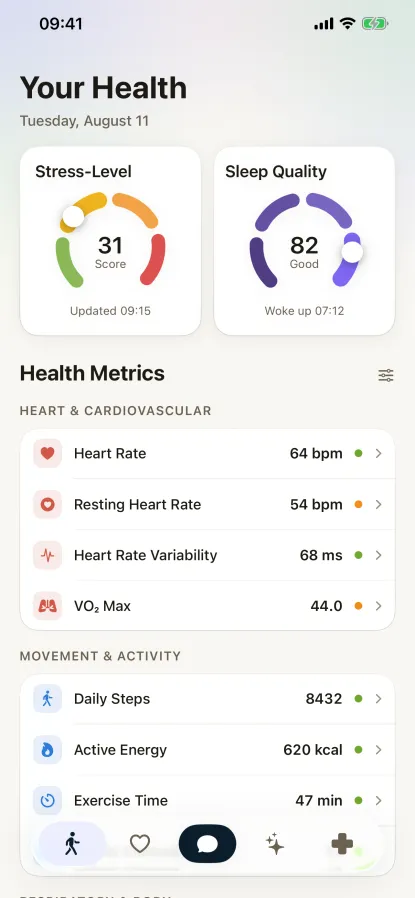
Sam app: the health overview with sleep, heart rate and activity

Heart rhythm is a matter for your cardiologist and for the regulated rhythm features on your Apple Watch. Sam keeps resting heart rate, sleep and what you log.

How Sam accompanies you day to day with Atrial Fibrillation (AFib)

Sam reads the data your wearable already writes to Apple Health and compares it to your personal baseline - understandable, not a wall of numbers.

1

You compare yourself with yourself

Resting heart rate differs a lot from person to person. Sam shows your Apple Health numbers next to your own history, not population norms.

2

Sleep, activity and pulse together

You see sleep, activity and resting heart rate side by side, week by week. What matters for you is something to discuss with your cardiologist.

3

A monthly report for your cardiologist

The free monthly report shows in a PDF what your last weeks looked like. You don't have to report from memory.

Sam is a wellness companion, not a medical device. The app does not diagnose, treat, cure, or prevent any illness and does not replace medical advice. Consult a qualified healthcare professional for medical decisions.

Ask about your numbers. Take the report along.

Sam shows your values next to your entries. What they mean is something to talk through with your doctor.

Ask Sam about your data

You ask a question, Sam answers with your own numbers. For example:

How was my sleep after the weekend?
After Saturday, your sleep averaged 5 hours 40 minutes a night, 80 minutes below your average of 7 hours.
How did my resting heart rate compare with my usual range?

Your monthly report as a PDF

The monthly report sums up your weeks - for appointments, applications, or simply your own record.

Monthly Report - June

Your Health Overview

Resting heart rate

64Avg (bpm)
-2vs. baseline
30Days logged

Activity

7.4kSteps/day
18Days on target
+12%vs. last month
Created by Sam HealthPDF

Example values. Your report is based on your own data.

Articles about Atrial Fibrillation (AFib)

Further reading: what wearable data can show about everyday life with Atrial Fibrillation (AFib) - and where its limits are.

Frequently Asked Questions

What does the Apple Watch show with atrial fibrillation, and what does Sam keep?+

The Apple Watch has the ECG app for a 30-second ECG and AFib History with a weekly estimate in percent. Both are Apple features. They show what they record. Whether it is atrial fibrillation is for your cardiologist to say. Sam keeps a symptom diary of the days you had symptoms, plus resting heart rate and sleep.

Where do I find the AFib History from my Apple Watch?+

In Apple's Health app, with its PDF export. Take it to your appointment from there. What your heart rhythm means is something to discuss with your cardiologist. In Sam you log the days you had symptoms in a symptom diary and see resting heart rate and sleep.

Which Apple Watch has the ECG app and AFib History?+

The ECG app runs on Apple Watch Series 4 and later, excluding the SE models, and on all Ultra models. Apple lists AFib History for Series 4 and later. Both are intended for people aged 22 or older, AFib History for people with doctor-confirmed atrial fibrillation. Last updated: October 2026.

Which data actually matters when you have atrial fibrillation?+

That's best discussed with your cardiologist. Many people with AFib keep an eye on resting heart rate, sleep, and activity - and those are exactly the signals Sam presents in an easy-to-read way. They arrive without any manual entry, and you can log symptom days alongside them when you want something on the record.

Does Sam replace my medical checkups?+

No. Sam is not a medical device and doesn't replace ECGs or checkup appointments. The monthly report can, however, help you prepare for those appointments with concrete everyday data.

Can I still exercise with atrial fibrillation?+

That depends on your individual situation and is a decision for your cardiologist. The current ESC guideline names physical inactivity as a risk factor for atrial fibrillation, so staying active generally makes sense. The intensity and type of exercise that suits you is for you and your care team to decide.

How do I prepare my Apple Watch data for a cardiology appointment?+

You export your AFib History and your ECG as PDFs from Apple's Health app. Sam compiles sleep, stress, activity, sick days and symptom days into a monthly PDF report. For that you log on at least half of the days whether you were sick or well. You also allow notifications and Apple Health access and answer the conditions question.

How can I support a family member with atrial fibrillation day to day?+

Help with everyday habits such as enough sleep and going easy on alcohol (more for family members). Call your local emergency number (112 in the EU, 999 in the UK, 911 in the US) immediately for chest pain, severe shortness of breath, fainting or signs of a stroke such as sudden weakness on one side, or trouble speaking or seeing. Sam does not replace medical advice.

Can I keep a symptom diary for AFib in Sam?+

Yes, in the symptom diary you log per day what you noticed, such as racing heartbeat, skipped heartbeat, dizziness or shortness of breath. You can add drinking days and sick days. Sam does not record the time or length of an episode. Sam also shows resting heart rate and sleep from Apple Health.

Understand what your body is telling you.

Download Sam for free, connect Apple Health, and see what your data says about everyday life with Atrial Fibrillation (AFib) - compared to your own baseline.

Free for iPhoneBuilt in Europe
Sam dashboard with wellbeing score, heart rate and sleep

Sam is a wellness companion, not a medical device. Sam does not diagnose, treat, cure, or prevent any illness and does not replace medical advice. For health questions or concerns, always consult a qualified medical professional.