11 min read
PCOS Blood Test: Which Labs Doctors Check and Why
Which PCOS blood tests the 2023 guideline names, why normal hormone results do not rule PCOS out, and what to tell your doctor about medication.
Living with PCOS
Your cycle doesn't keep a schedule. Sam keeps the dates for you.
Log bleeding days and acne, hair loss or mood changes; Sam shows your shortest and longest cycle. You bring two reports to your appointment instead of guessed dates.
Your data
Your wearable already captures them. Sam reads them from Apple Health and shows you how they change over time, for many values against your personal baseline.
Your plan
Sam supports you in building habits with different programs you can use inside the app.
You told us
Sam suggests
PCOS (PMOS)
Condition
What Sam keeps
For anyone documenting cycle, skin, hair and daily life over months, before, during or after a work-up.
Your entries and your Apple Health data, over time, in one place.
Sam shows your shortest and longest cycle from your entries. If a day is missing, a cycle looks longer than it was.
Log acne, hair loss or mood changes as mild, moderate or severe. Sam does not link them to Apple Health data.
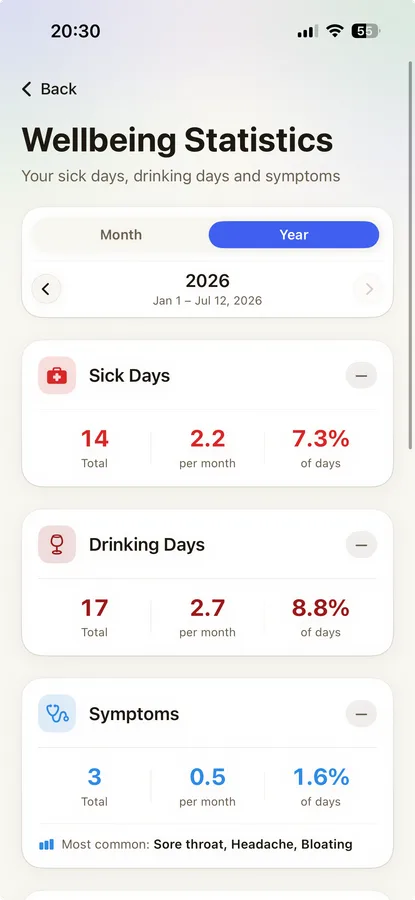
The Cycle report shows cycle length, the monthly report your symptom days. What the numbers mean is for you and your doctor.
Sam shows your values next to your entries. What they mean is something to talk through with your doctor.
You ask a question, Sam answers with your own numbers. For example:

The monthly report sums up your weeks - for appointments, applications, or simply your own record.
Monthly Report - June
Your Health Overview
Sleep
Symptoms
Example values. Your report is based on your own data.
Further reading: what wearable data can show about everyday life with PCOS (PMOS) - and where its limits are.
Which PCOS blood tests the 2023 guideline names, why normal hormone results do not rule PCOS out, and what to tell your doctor about medication.
Which doctor for PCOS? What a GP, gynecologist and endocrinologist each do, how referrals work in the UK and US, and what to bring along.
Suspected PCOS? What to log for your first appointment, what the 2023 guideline looks for, when not to wait and what the PMOS renaming means.
Medical guidelines set that, not an app. The international PCOS guideline calls cycles irregular in adults whose first period was more than three years ago when they are shorter than 21 or longer than 35 days, or when there are fewer than eight cycles a year. A single cycle longer than 90 days counts as well. Different limits apply in the first years after the first period. Whether that applies to you, and whether PCOS is behind it, is for your doctor to decide; irregular bleeding is worth having checked. Sam counts the days between the bleeds you log and shows cycle lengths from your entries. The Cycle report also states how many of your recorded cycles were shorter than 21 or longer than 35 days. That range is fixed, takes neither your age nor the time since your first period into account, and is not a medical assessment.
Your doctor will ask about your cycle and about signs of raised male hormones such as acne, hair loss or extra hair growth. The guideline states that unwanted extra hair growth and female pattern hair loss should be taken seriously however mild they look. In Sam you can keep bleeding days with dates in cycle tracking, acne and hair loss in the symptom diary, and everything you take regularly in the medication list, hormonal products too, because they can change both your cycle and your lab results. Earlier lab reports can go in the Health Vault.
No. Sam does not diagnose and does not measure hormones. For adults the guideline requires at least two of three features - an irregular cycle, signs of raised male hormones, and polycystic-looking ovaries on ultrasound or a raised AMH level - once other causes are ruled out. Your doctor assesses that. Sam does not predict your next period and shows neither ovulation nor fertile days, and it is not a method of contraception. It shows what you have logged.
According to the international guideline, insulin resistance plays a part in PCOS, and women with PCOS have a higher risk of impaired glucose metabolism and type 2 diabetes regardless of age and BMI. It provides for a check of glucose metabolism at diagnosis and every one to three years afterward, depending on other risk factors. The oral glucose tolerance test is named as the most accurate test. If it cannot be done, fasting glucose and HbA1c can be considered, with significantly reduced accuracy. Sam measures neither glucose nor insulin; you keep lab reports in the Health Vault. The guideline calls weight only one factor among several. Sam shows weight in your health metrics only if you switch it on and sets no target. If you share anything through Friends & Family, your latest weight from Apple Health goes with the profile the invited person sees.
Sam only records what you enter, and it cannot tell whether a bleed is your own period or a withdrawal bleed in the pill break. Hormonal contraceptives with estrogen and progestin suppress the normal cycle, and the withdrawal bleed is usually lighter than a normal period, according to the German family-planning portal familienplanung.de. How to read a log while on hormonal products is for your doctor. The medication catalog is a selection, not a recommendation about hormonal products, and Sam is not a method of contraception. From Apple Health, Sam brings in only bleeding days that have a flow level logged (light, medium or heavy); days logged without a flow level and spotting are not brought in.
Yes. Acne, hair loss, fatigue, mood changes, low mood, anxiety and pelvic pain are all in the symptom diary. You rate them per day as mild, moderate or severe, mood changes only as present. Each symptom gets one entry per day, with no time of day and no note. Extra hair growth has no entry of its own; you can add it as custom text. WHO lists anxiety and depression as possible burdens with PCOS, and the guideline recommends that clinicians ask about them. Your log can be a way into that conversation.
The name is changing step by step. WHO describes PCOS as a common hormonal disorder, estimated to affect 10 to 13 percent of women of reproductive age. On 12 May 2026 the Lancet published an international consensus renaming it polyendocrine metabolic ovarian syndrome (PMOS). Several German medical societies, including those for endocrinology, diabetes and gynecology, welcome the change. They give as reasons that the structures seen on ultrasound are small follicles, not cysts, and that the condition also affects metabolism. For a three-year transition they suggest writing PMOS (formerly PCOS), so you will meet both terms. For Sam nothing changes: it does not diagnose.
A heavy period should be checked by a doctor. Germany's federal health portal gesund.bund.de names as signs that you often need to change a pad or tampon after only one to two hours, or pass many thick clots. Severe period pain and bleeding between periods or after sex should be checked too. Ask for an urgent appointment if new thick, dark hair suddenly grows on your face and body, your voice gets lower or your muscles get bigger. If you go longer than 90 days without a bleed, get it checked soon; if you could be pregnant, do not wait that long. The portal lists dizziness, shortness of breath and a racing heart as possible symptoms of more severe anemia; if they come on top of heavy bleeding, get medical help the same day, out of hours via your local on-call medical service (116 117 in Germany, NHS 111 in the UK). Severe breathlessness where you are gasping or cannot get words out, sudden, very severe pain low in the abdomen with dizziness or fainting, bleeding that cannot be stopped, and fainting with chest pain or a racing, pounding or irregular heartbeat, while exercising, while lying down, with a serious injury or a seizure, without full recovery or with difficulty speaking or moving are emergencies: call your local emergency number (112 in the EU, 999 in the UK, 911 in the US). Call too if someone is not breathing or cannot be woken within a minute after fainting. If you have thoughts of harming yourself, call your local emergency number or a crisis line (in Germany: TelefonSeelsorge, 0800 111 0 111, free, around the clock; Samaritans 116 123 in the UK; 988 in the US).
Download Sam for free, connect Apple Health, and see your data for everyday life with PCOS (PMOS) over time.
Sam is a wellness companion, not a medical device. Sam does not diagnose, treat, cure, or prevent any illness and does not replace medical advice. For health questions or concerns, always consult a qualified medical professional.