With your consent, Sam reads ferritin and other values from your report in the [Health Vault](/sam/vault), and sets no targets.
Symptoms, cycle and medication on one timeline
Day by day, you log [symptoms](/sam/symptom-diary), [bleeding days](/sam/cycle) and [what you take](/sam/medication). Later you see the weeks before a blood draw.
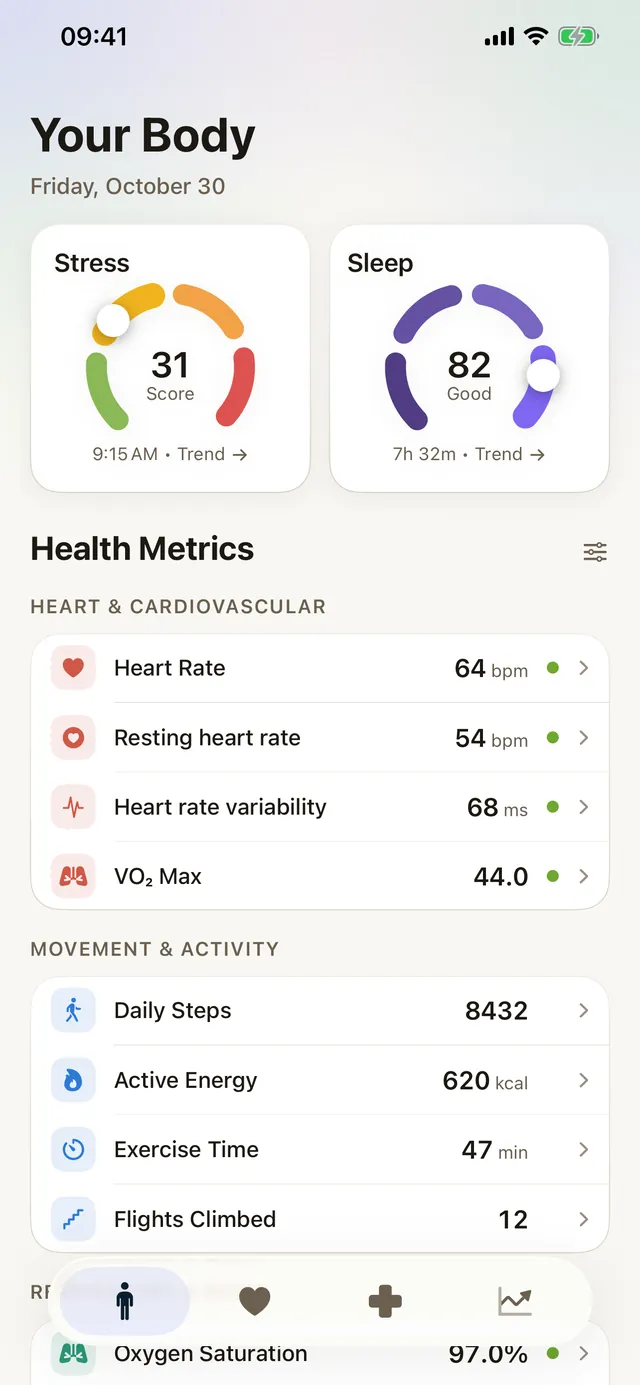
Sleep, stress and resting heart rate as trends
Sam shows trends, not causes: iron deficiency cannot be read from resting heart rate or step counts.
Your plan
What Sam suggests when you set up.
Your medication list and two habits to start with. Switch them, like in the app.
You told us
Sam suggests
You told us
Iron Deficiency
Condition
Sam suggests
Between appointments
Ask about your numbers. Take the report along.
Sam answers with your own numbers. What they mean, you talk through with your doctor.
What did my last lab report say about ferritin?
Your report from 12 September lists ferritin at 9 ng/mL. Your lab prints a range of 15 to 150 ng/mL, so the value sits below it. The report from 3 March had 14 ng/mL.
Ferritin reflects the body's iron stores, serum iron is what happens to be circulating in the blood, and hemoglobin is the red blood pigment. The German hematology guideline (Onkopedia) speaks of iron deficiency anemia when hemoglobin falls below the norm for age and sex because of iron deficiency, and notes that iron deficiency can exist before that point. Sam shows the values from your report, with the range your lab printed where there is one. What a result means for you is for your doctor.
It can. Ferritin is an acute-phase protein: inflammation, cancer and liver disease push it up and can mask a deficiency. That is why the guideline advises checking for inflammation, for example CRP, when judging it, and why WHO guidance on ferritin uses a higher cut-off when infection or inflammation is present. CRP is one of the values Sam reads from a lab report. Whether a ferritin result fits your situation is for your doctor to judge.
Nobody can say that from a distance, and Sam cannot either. The guideline describes exhaustion and poor concentration even in iron deficiency without anemia, but tiredness has many other causes. Your doctor decides which test comes next. Sam keeps the days you log fatigue and your lab reports, and shows sleep and stress in the same app, so you can show how long and how often.
Yes. For women of reproductive age, the Onkopedia guideline names blood loss through menstruation as the most important cause, and the NHS lists heavy periods among the very common ones. For iron deficiency, the guideline gives about 5 to 10 percent in Europe overall and about 20 percent in that group. Whether a period counts as heavy is for the practice to judge. In Sam's cycle tracker you log bleeding days, spotting, flow (light, medium, heavy), and what the bleeding did to your day. Sam does not judge flow volume.
The Onkopedia guideline lists a strict vegetarian diet among the possible reasons for reduced iron intake. It also says iron deficiency arises overwhelmingly from increased loss or use of iron. Once a deficiency is found, looking for the cause is part of the work-up. The guideline names ruling out blood loss from the digestive tract first, unless another cause is clearly present. What applies to you is for your doctor to work out. Sam has no food diary.
Follow-up results show your doctor whether hemoglobin and ferritin have moved since treatment began. Timing matters too: iron still circulating after an infusion can distort the ferritin result, so the guideline leaves a gap between the dose and that check. Your practice decides when and how often. In Sam you can set up reminders for your medication and keep your lab reports in the Health Vault.
No. Sam measures nothing itself: values come from your lab reports and from Apple Health, and an Apple Watch does not measure iron or hemoglobin. Sam cannot tell iron deficiency from other causes of tiredness, and the range is printed by your lab, while what a value means for you is for your doctor to judge, not Sam. There is no trend chart for single values, only the comparison of your last two reports, which shows the three biggest changes.
Things that fit: lab reports (older ones too), your medication list including supplements, the days you logged symptoms and, if periods are part of the question, your bleeding days. The appointment checklist goes into more detail. Call your local emergency number (112 in the EU, 999 in the UK, 911 in the US) for chest pain or severe shortness of breath (barely able to speak). Call too for vomiting blood, black sticky stool, blood in the stool beyond traces on the toilet paper, or heavy bleeding that cannot be stopped. A racing, pounding or irregular heartbeat is an emergency too if it does not go away or comes with shortness of breath, chest pain or feeling faint. For fainting, call when it comes with chest pain or a racing or irregular heartbeat. Call too if it happens during exercise or while lying down, or comes with shaking or jerking, a serious injury or difficulty speaking or moving. Also call if the person is not breathing, cannot be woken within a minute or does not fully recover. Dark stool can also come from iron supplements; black, sticky stool still calls for emergency help, and if you are unsure, get it checked soon. Get checked by a doctor the same day for shortness of breath that is worse than usual or a new racing or irregular heartbeat that has stopped. The same goes for a very heavy period with dizziness or weakness, or bleeding that is suddenly much heavier than usual. When your practice is closed, use the urgent care service where you live (111 in the UK). Get checked soon for fainting without those signs once you have fully recovered, for very heavy periods and for any trace of blood in the stool.
Sam is a wellness companion, not a medical device. It does not diagnose, treat, cure, or prevent any disease or health condition. Always consult a qualified healthcare professional for medical decisions.