
Apple Watch AFib History, Irregular Rhythm Notifications and ECG: What Each One Does and What It Cannot Do
What Apple Watch AFib History, irregular rhythm notifications and the ECG app each do, who they are for, and what the Apple Heart Study numbers show.
On this page
TL;DR
Apple Watch AFib History is a regulated health monitoring feature - with an official Instructions for Use document - that estimates the weekly percentage of time your heart shows signs of atrial fibrillation. It is designed exclusively for people with an existing AFib diagnosis to track their condition over time and support richer conversations with their physician. It does not screen for AFib in healthy users, it does not notify you in real time when you are in AFib, and it does not find every instance of irregular rhythm. It is a longitudinal burden tracker, not a real-time alert system.
Apple offers two other rhythm features with different jobs: irregular rhythm notifications, which Apple designed for people without an AFib diagnosis, and the ECG app, which records a 30-second strip when you start it. None of the three finds every episode, and a quiet watch does not rule out a rhythm problem.
What the watch cannot record is how you felt. In Sam you tap racing or skipped heartbeats, dizziness or shortness of breath into the symptom diary on the day they happen, and Sam reads resting heart rate and sleep from Apple Health into the same app. Sam does not show AFib History or ECG recordings, so those stay an export from Apple's Health app; the monthly report you create puts your symptom days, sleep and activity into one PDF for the appointment, and Sam's overview for atrial fibrillation shows the rest.
What atrial fibrillation is - briefly
Atrial fibrillation is an irregular heart rhythm in which the upper chambers of the heart (atria) beat chaotically and out of sync with the lower chambers (ventricles). Prevalence rises steeply with age - landmark US data from the ATRIA study reported under 0.1% in adults below age 55, rising to about 9% in adults aged 80 and older (Go et al., JAMA 285(18):2370-2375, 2001). More recent US estimates put the overall adult prevalence at about 1 in 22 - roughly 5% - with the burden concentrated in older adults (NHLBI, Atrial fibrillation estimated to affect about 1 in 22 Americans, 2024). Many people experience no symptoms at all; others notice palpitations, fatigue, shortness of breath, or rapid heartbeat.
AFib is chronic but variable. The proportion of time spent in AFib - called AFib burden - can fluctuate with lifestyle, treatment, and other health conditions. Tracking burden over time is clinically meaningful: reductions in burden are associated with reduced stroke risk and improved quality of life.
Three Apple features, three different jobs
Apple Watch has three heart rhythm features that are easy to mix up. All three are Apple's own regulated features, independent of Sam.
Per Apple, the three features differ in who they are for and what they record:
AFib History
For someone a physician has already diagnosed with atrial fibrillation. The feature requires you to confirm a diagnosis during setup. Not intended for people under 22.
Irregular rhythm notifications
Not designed for people diagnosed with AFib, not intended under 22. Occasionally checks for an irregular rhythm that may be AFib. A notification means it found one and confirmed it with multiple readings; it can also point to a different irregular rhythm. Turned off automatically when you activate AFib History.
ECG app
Records a 30-second single-lead strip when you start it, via the Digital Crown and the back of the case. Possible results: sinus rhythm (that recording only), AFib, inconclusive. Not intended under 22, not supported on Apple Watch SE, only in certain countries and regions. Cannot detect a heart attack, blood clots or a stroke.
If you have not been diagnosed with AFib, AFib History is not the right feature for you. Any concern about possible AFib needs a clinical evaluation, for example with an ECG or Holter monitor, not consumer wearable data alone.
What the Apple Heart Study found
The Apple Heart Study (Perez et al., New England Journal of Medicine, 2019) is the main source of numbers for irregular rhythm notifications. Apple funded it.
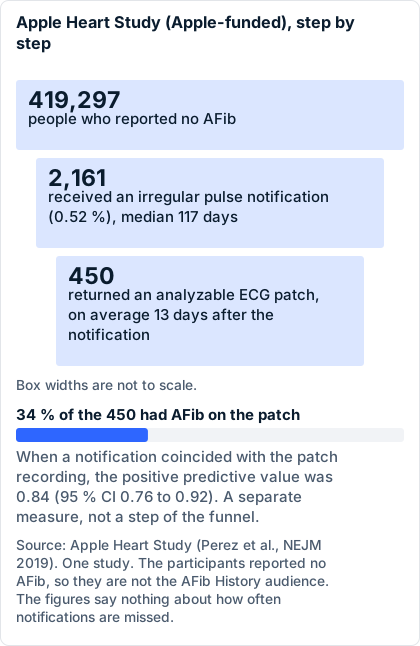
Most notified people who wore a patch did not have AFib on it, so a notification is a reason to talk to a physician, not a result in itself. In numbers: 419,297 people took part and 2,161 (0.52%) were notified over a median of 117 days. Of the 450 with an analyzable patch, 34% had AFib on it. The positive predictive value was 0.84 (95% CI 0.76 to 0.92). These figures describe one study. The participants reported no AFib, so they are not the AFib History audience. The figures say nothing about how often notifications are missed, and Apple states that the feature cannot find every instance of AFib.
For the ECG app, a 2025 systematic review and meta-analysis of 11 studies (4,241 participants) that used a standard 12-lead ECG as the reference reported pooled sensitivity of 94.8% and specificity of 95%. The studies differed widely from each other (heterogeneity of 67% and 88%), so read these as a range, not a promise.
What AFib History tracks
AFib History periodically checks your heart rhythm throughout the day and night while you are wearing the watch. These checks are not continuous; they occur at intervals when the algorithm determines that conditions are suitable - typically when you are still. The feature requires wearing your Apple Watch for at least 12 hours per day for 5 days per week to generate reliable weekly estimates.
Every Monday, Apple Watch delivers a weekly alert showing the estimated percentage of time your heart showed signs of AFib during the previous seven days. The Health app displays this data as a chart over time. Apple notes that the estimate will never appear as 0% - instead, periods of minimal detected AFib are reported as "2% or less."
After six weeks of consistent wear, AFib History Highlights become available, showing the day of the week and time of day when your heart most frequently showed signs of AFib. This contextual information can help you identify whether certain activities or times of day correlate with higher burden.
Life factors and what to log
AFib History tracks five life factors alongside the rhythm data, allowing you to compare burden against lifestyle variables:
- Exercise Minutes - automatically logged if you wear your watch during workouts
- Sleep - automatically logged if you use Apple Watch sleep tracking
- Weight - manually logged or pulled from compatible third-party apps
- Alcohol Consumption - manually logged
- Mindful Minutes - automatically logged from the Mindfulness app, or manually entered
The evidence base for these factors in AFib management is genuine: regular aerobic exercise, healthy weight maintenance, reduced alcohol consumption, and good sleep quality have all been associated with reduced AFib burden in clinical research. The life factors dashboard in AFib History is designed to make this relationship visible in your own data over weeks and months.
What AFib History cannot do
Several limitations are worth understanding clearly:
It does not alert you in real time when you are in AFib. If you are experiencing symptoms you think might be AFib, you should use the ECG app (which you initiate yourself and produces a 30-second rhythm strip) or contact a healthcare provider directly. AFib History is a retrospective weekly summary, not a moment-to-moment alert.
It may miss instances of AFib, and a quiet watch does not rule out a rhythm problem. Because checks are periodic rather than continuous, brief episodes of AFib between checks will not be captured. The weekly percentage covers only the periods the watch checked, not your total time in AFib. The same holds for irregular rhythm notifications: Apple states that the feature is not constantly checking, that people with AFib may not receive a notification, and that you should talk to your doctor about symptoms even if you did not get one.
It cannot detect a heart attack or stroke. Apple explicitly states this. If you experience chest pain, pressure, tightness, or symptoms you think might indicate a heart attack, call emergency services immediately.
Low Power Mode disables background heart measurements. If you enable Low Power Mode on your Apple Watch, background rhythm checks are suspended, potentially leaving gaps in your AFib History data for that period.
Sharing data with your physician
One of AFib History's most practical strengths is its export capability. You can export your AFib History - percentage estimates over time, life factor data, and highlights - as a PDF directly from the Health app, then share it with your physician by any means. In the United States, AFib History can also be shared automatically with enrolled healthcare providers through Apple Health's sharing features.
This positions AFib History as a clinical communication tool: data generated passively between appointments that can inform your physician's assessment of how your condition is progressing and how well interventions are working. Apple has published an Instructions for Use document for the feature, reflecting the regulatory framework under which it operates.
Log symptoms and resting heart rate in Sam and take them to your appointment
You bring symptom days and everyday heart data to the appointment, next to the AFib History you export from Apple's Health app. Sam's overview for atrial fibrillation shows what the app covers.
- Instead of memory at the appointment: in the symptom diary you log racing heartbeat, skipped heartbeat, chest tightness or pain, dizziness, shortness of breath and fainting on the day they happen. If you faint, call emergency services or have someone call; the diary is for afterwards.
- Instead of Apple Health alone: Sam shows resting heart rate, sleep and activity from Apple Health in one app.
- Instead of screenshots: the monthly report you create yourself takes sleep, activity and your symptom days along as a PDF.
Sam does not show your AFib History or ECG, so you take that export from Apple's Health app.
Try Sam for freeSam is a wellness companion, not a medical device. The app does not diagnose, treat, cure or prevent any condition or health state. Always consult qualified professionals for medical decisions.
Related reading
Sources
- Track your AFib History with Apple Watch - Apple Support, updated September 2025. Accessed 16 May 2026.
- AFib History Feature Instructions for Use (IFU) - Apple Inc. Accessed 16 May 2026.
- Heart health notifications on your Apple Watch - Apple Support. Accessed 12 October 2026.
- Take an ECG with the ECG app on Apple Watch - Apple Support. Accessed 12 October 2026.
- Large-scale assessment of a smartwatch to identify atrial fibrillation - Perez et al., N Engl J Med 381, 2019 (Apple Heart Study). Accessed 12 October 2026.
- Diagnostic accuracy of Apple Watch electrocardiogram for atrial fibrillation: a systematic review and meta-analysis - 2025. Accessed 12 October 2026.
More on Atrial Fibrillation (AFib)
Frequently Asked Questions
Who is the Apple Watch AFib History feature for?+
AFib History is exclusively for people who have already been diagnosed with atrial fibrillation by a physician. It is not designed for screening or for detecting AFib in people without a known diagnosis. You must confirm a physician diagnosis during setup, and the feature is not intended for users under 22 years old.
Does Apple Watch notify me when I am experiencing AFib?+
No. AFib History does not provide real-time alerts when your heart is in AFib. It delivers weekly estimates - every Monday - of the percentage of time your heart showed signs of AFib during the previous week. If you are experiencing symptoms such as palpitations, shortness of breath, or chest discomfort, contact your healthcare provider or emergency services directly.
How is AFib History different from the ECG app?+
The ECG app records a 30-second rhythm strip when you initiate it, producing a result you can share with a doctor. AFib History runs passively in the background and accumulates periodic rhythm checks throughout the day and night, producing a weekly percentage estimate of AFib burden. They serve different purposes and are both available on Apple Watch Series 4 and later.
How accurate is the AFib History percentage estimate?+
Apple Watch checks for signs of AFib periodically, not continuously. The feature may not find every instance of irregular rhythm. The weekly percentage is an estimate based on the rhythm checks that occurred during periods when you were wearing the watch and not moving. It is intended to provide directional awareness for conversations with your physician, not a precise clinical burden measurement.
What is AFib burden and why does it matter?+
AFib burden is the proportion of time your heart spends in atrial fibrillation. Higher burden is associated with increased risk of stroke, heart failure, and other complications. Monitoring burden over time - particularly in response to lifestyle changes or treatment - can help physicians assess how well AFib is being managed. Apple's AFib History provides a wearable-accessible approximation of this measure.
How accurate are Apple Watch irregular rhythm notifications?+
The Apple Heart Study (Perez et al., NEJM 2019) is the main source. It enrolled 419,297 people who reported no AFib; 2,161 of them (0.52%) received an irregular pulse notification. Of the 450 who returned an analyzable ECG patch, 34% had AFib on the patch. When a notification coincided with the patch recording, the positive predictive value was 0.84. These figures describe that one study, which Apple funded. Apple designed the notifications for people without a known AFib diagnosis, not for the AFib History audience, and says they do not find every instance of AFib.
Is the ECG app more accurate than irregular rhythm notifications?+
They work differently and the published numbers measure different things, so they cannot be ranked directly. Irregular rhythm notifications use the optical pulse sensor in the background; the ECG app records electrical activity for 30 seconds when you start it. A 2025 meta-analysis of 11 studies (4,241 participants) that compared the Apple Watch ECG with a standard 12-lead ECG reported pooled sensitivity of 94.8% and specificity of 95%, with large differences between studies. Apple tells you to talk to your doctor about symptoms or an AFib result.
Does Low Power Mode affect AFib History?+
Yes. Low Power Mode turns off background heart measurements, which may result in no AFib History estimate for that period. If you rely on AFib History for regular monitoring, avoid enabling Low Power Mode for extended periods.
Can I share my AFib History data with my doctor?+
Yes. You can export your AFib History to a PDF from the Health app and share it with your physician. In the United States, AFib History can also be shared automatically with enrolled healthcare providers through the Health app's sharing features.